INTERVIEW / Philippines envoy urges crackdown on 'bad brokers,' backs direct hiring center plan
Taipei, Feb. 17 (CNA) The Philippines' top envoy to Taiwan said authorities on both sides should crack down on unscrupulous brokers who overcharge migrant workers, and welcomed Taiwan's plan to open its first overseas direct recruitment center in Manila as a way to foster competition.
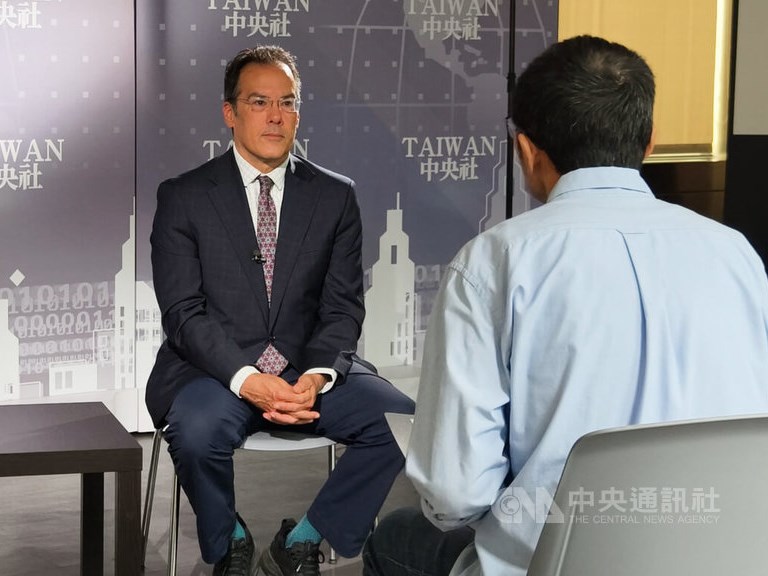
"I think some of the brokers charge too much, a lot. That has to change, and we have to weed out the bad brokers," said Corazon Avecilla-Padiernos, chairperson and resident representative of the Manila Economic and Cultural Office (MECO).
As the Philippines' de facto embassy in Taiwan in the absence of formal diplomatic ties, one of MECO's key roles is protecting the rights of Filipino blue-collar workers in Taiwan, who numbered about 173,000 as of December last year, according to statistics from Taiwan's Ministry of Labor (MOL).
Overcharging
"When I say weed out, if they're not really doing what is supposed to be done, they have to be taken out," Padiernos told CNA in an interview on Feb. 10, her first with Taiwanese media since taking office in late October.
Speaking at her Taipei office, she said weak oversight is not limited to either side, as labor brokers in both Taiwan and the Philippines are involved in recruitment and "deal with each other."
Under the broker-based system, many Filipino migrant workers pay fees to brokers in both countries -- a structure advocates say leaves them vulnerable to overcharging.
"Fees vary by country and by broker, but on average it comes to around NT$150,000 (US$4,780) to NT$200,000," said Chen Hsiu-lien (陳秀蓮), chairperson of Taiwan International Workers' Association (TIWA), in a separate interview Friday.
That total -- including monthly service fees charged in Taiwan -- equals roughly four to six months' wages for many workers. A mid-January MOL survey found business-sector migrant workers earned an average NT$34,900 in June 2025, while caregivers earned about NT$24,200.
Chen said many workers cannot afford the upfront payments in their home countries - sometimes disguised under other labels rather than as brokerage charges - and are forced to pledge assets or take high-interest loans, leaving them burdened with long-term debt.
Calling the costs "unreasonable," Chen said they should not fall solely on workers. "Those costs aren't only related to workers - why are workers the ones paying for everything?"
A better way
Padiernos said "a better way" is needed to regulate brokers and ensure contracts are "followed to the letter."
Contracts "have to be really, really discussed and understood by the worker -- they have to know their rights," said the new MECO head, a longtime women's rights advocate and former president of the Zonta Club of Valle Verde, the Philippines chapter of women's rights group Zonta International.
To help Filipino workers -- mostly caregivers and factory employees -- understand their rights, Padiernos said MECO posts online lectures and advisories on its Facebook page, updating content as rules and circumstances change.
To monitor brokers in the Philippines, she urged workers to provide feedback, calling it "the only way" to track problems. Without complaints, "there's nothing that we can do," she said.
On communication with Taiwanese authorities, Padiernos said she has raised overcharging concerns with the MOL, which she said is aware of the issue and "doing something about it," without elaborating.
"Sometimes it's not that easy to really manage it," she said of the cross-border broker system. "At least these brokers know that they're being monitored."
The two sides "have to act together and be proactive rather than reactive," she added.

The new recruitment center
The planned cross-border recruitment center -- which the MOL has said will be its first such facility outside Taiwan -- is set to begin operations in Manila in the first quarter of 2026. It aims to enable more direct hiring of Filipino workers through a government-linked channel, without having to go through brokers.
The ministry has said the center will allow Taiwan to work directly with foreign authorities, reducing workers' reliance on brokers. Employers would, in principle, cover airfare, health checks and visa costs.
Padiernos called the initiative "quite a good thing," saying it could serve as a "legitimate competitor" to the broker-based system and pressure brokers to comply with regulations.
"The brokers now are on their toes that they have to be better," she said.
When the center opens, "we want to make sure that the contracts are being followed and that the contracts are well worded," Padiernos said. "Those are the things that we look at first."
On the possibility of additional centers, she said the Manila facility is a "pilot program," but added that "if it is really going to help both the Philippines and Taiwan, why not?"
Padiernos also said she would welcome a broader shift toward direct hiring if it genuinely reduces Filipino workers' financial burden and improves compliance, including proper contract enforcement.
Any sensible country would adopt the model if it proves beneficial to both sides, she said. "It's crazy if you don't, right?"
Mixed opinions from NGOs
However, advocates noted the broker-based system remains attractive to employers because it is simple and largely cost-free for them, giving them little incentive to use a government-run channel -- especially if the new model requires employers to cover costs usually passed on to workers.
Lennon Wang (汪英達), director of the Serve the People Association's Department of Policies on Migrant Workers, told CNA it was too early to assess the overseas direct-hiring model, as details of its operation remain unclear.
Pointing to Taiwan's existing direct-hiring mechanism -- which allows employers to directly hire migrant workers already in Taiwan nearing the end of their contracts -- Wang said it has yielded "limited results," and he is not optimistic an overseas version would fare better.
He added that some brokers offer kickbacks to employers -- especially those hiring many migrant workers -- funded by fees collected from workers, making direct hiring less appealing.
TIWA's Chen, by contrast, said she welcomed the new center, arguing that its existence alone could show Taiwanese authorities are "capable" of handling recruitment directly.
If the pilot program proves workable, she said, Taiwan could expand similar centers to other source countries and "gradually move toward phasing out private labor brokers."
(By Sunny Lai)
Enditem/cs/cc
-
Transcending runner-up label: Go player Yang Tzu-hsuan's not-too-late comebackAmong women currently active on Taiwan's professional Go circuit, six-dan pro Yang Tzu-hsuan (楊子萱) stands out as one of the board game scene's most representative figures.02/16/2026 10:52 AM -
Filipino workers' well-being, investment ties top priorities: EnvoyCorazon Avecilla-Padiernos, the Philippines' new top envoy to Taiwan, said her priorities are safeguarding the well-being of Filipino workers in Taiwan and deepening economic ties between the two sides.02/13/2026 05:51 PM -
Jimmy Lai's daughter slams his 20-year sentence as 'laughable'The daughter of jailed Hong Kong media tycoon and pro-democracy activist Jimmy Lai (黎智英) on Tuesday condemned her father's trial as "extremely unfair" and his 20-year prison sentence as "laughable," a day after the verdict was handed down.02/10/2026 03:35 PM
-
Society
Lunar New Year's Day travel drives freeway traffic up roughly 30%
02/17/2026 04:18 PM -
Politics
U.S., Philippines reiterate importance of Taiwan Strait peace
02/17/2026 03:49 PM -
Society
Man killed, Vietnamese wife suffers 90% burns in Taichung house fire
02/17/2026 02:58 PM -
Society
-
Culture
Heritage at risk: Taiwan's last hand-pulled ferry
02/17/2026 11:02 AM