Asia University holds International Symposium on Humanoid Robotics and Sovereign AI for Future Living
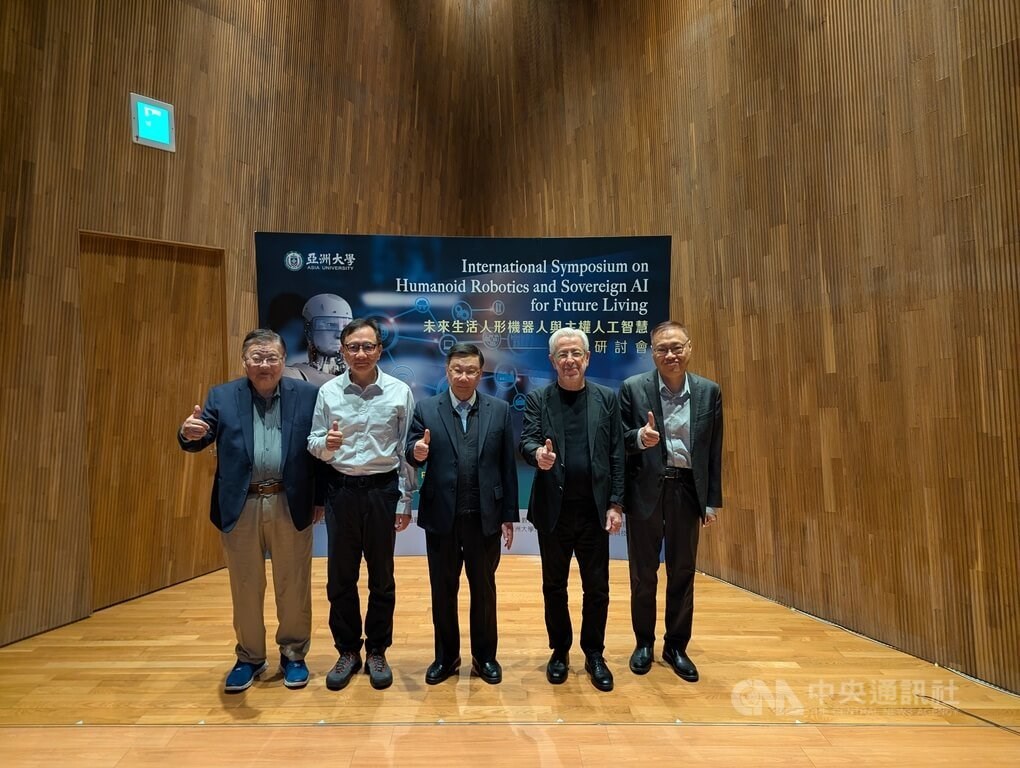
Asia University held the International Symposium on Humanoid Robotics and Sovereign AI for Future Living on Feb. 5 in Taichung City, bringing together scholars from Taiwan and abroad to present research outcomes in robotic applications. Through this international platform, the University aims to strengthen Taiwan’s smart technology ecosystem by gaining global experience and injecting new vitality.
The symposium took place at the Asia University Museum of Modern Art and was attended by domestic and international scholars as well as industry representatives. Discussions focused on the technologies, governance frameworks, and trust foundations required to extend humanoid robotics from laboratory settings into real-world applications.
At the symposium, Asia University President Jeffrey J. P. Tsai emphasized that as humanoid robots play increasingly significant roles in medical care, manufacturing, and daily services, their development must go beyond mechanical design and algorithmic optimization to address data security, system resilience, human-robot trust, and public acceptance. By using the symposium as a platform for exchange, the University seeks to explore practical applications of humanoid robotics with academic and industry partners, enhance learning experiences, and advance Taiwan’s smart technology capabilities.
Oussama Khatib, Director of the Stanford Robotics Lab, delivered a keynote speech titled “Shaping the Future of Human-Robot Cooperation.” He noted that the core of human-robot collaboration lies in augmenting human experience, intuition, and judgment in high-risk or inaccessible environments, such as deep-sea exploration and disaster response.
Citing Stanford’s underwater humanoid robot as an example, Khatib explained that tactile feedback and three-dimensional visual interfaces allow human experts to collaborate with robots in real time during deep-sea missions. Such humanoid technologies also hold potential for rural healthcare delivery, remote maintenance, and rescue operations in extreme environments.
The symposium also featured a robot demonstration showcasing a nursing robot called Eirbot, which was co-developed by China Medical University Hospital and Everbot Technology. Chou Ying, project manager at Everbot Technology, explained that the robot integrates voice interaction, image recognition, and motion guidance, enabling functions such as in-hospital navigation, health education, and standardized care assistance. Positioned as a “clinical partner,” the robot is designed to share repetitive frontline tasks, improving both care efficiency and patient experience.
Kuan-Tsae Huang, Director of the AI and Quantum Research Center at Asia University, stressed that to establish humanoid robots as reliable partners in medical care, manufacturing, and daily services, developers must strengthen data governance, system security, scalable deployment frameworks, and cross-disciplinary integration—alongside advancements in mobility and sensory hardware—to ensure safe and effective applications across diverse fields.
- Society
Magnitude 5.6 earthquake shakes northern Taiwan
07/26/2026 08:52 PM - Sports
36-year-old Chou Tien-chen becomes oldest winner of BWF Super 1000 title
07/26/2026 07:48 PM - Society
Heavy rain forecast in parts of central, northern Taiwan Monday
07/26/2026 07:21 PM - Society
Taiwanese actor Wang Kai found dead at Taipei home
07/26/2026 07:09 PM - Society
Miaoli Mazu temple becomes Taiwan's 1st temple to retire carbon credits
07/26/2026 07:06 PM