ANALYSIS/Venezuela, Iran moves boost U.S. ahead of Trump-Xi talks: Scholars
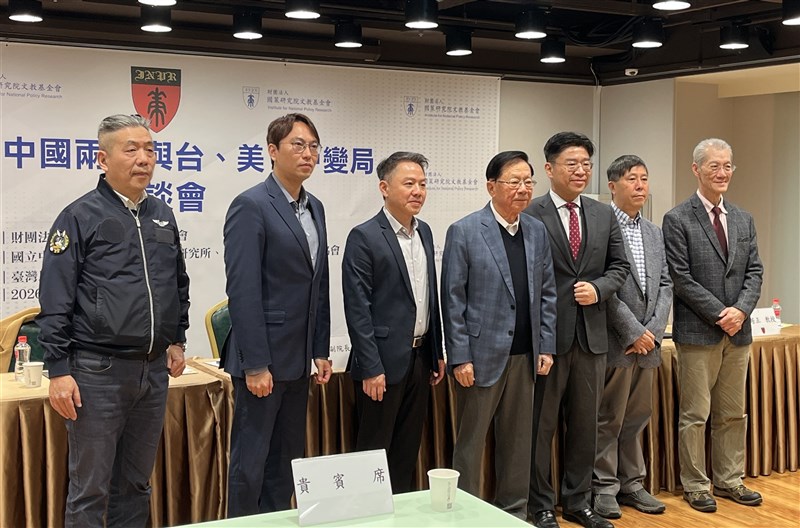
Taipei, March 9 (CNA) Taiwanese scholars said Monday that recent American military actions in Venezuela and Iran have strengthened Washington's hand ahead of the Trump-Xi meeting, but they were less sure how it would affect Taiwan.
"The United States recently struck Venezuela and Iran ... while Cuba is now at risk, and Washington is also tightening its control over Panama," Ming Chu-cheng (明居正), an emeritus professor of political science at National Taiwan University, said at a seminar in Taipei.
Both Venezuela and Iran are Beijing-backed oil-producing countries, while Cuba, also friendly to China, and Panama (due to Hong Kong-linked port operations that serve the Panama Canal) have come under increased U.S. pressure in recent months.
Such developments are "more favorable to the U.S. and highly unfavorable to the Chinese Communist Party (CCP)," Ming contended, saying they had "significantly changed" the leverage each side has ahead of their upcoming meeting.
Following a summit in South Korea in October 2025, U.S. President Donald Trump will again meet Chinese leader Xi Jinping (習近平) during a state visit to China from March 31 to April 2, according to the White House.
With China's major ally Russia mired in its war in Ukraine, any support Moscow can offer Beijing is likely to be "very limited," Ming said, leaving Beijing with "far fewer cards to play" in what he described as a "broader strategic confrontation" between the U.S. and China.
In the same vein, Ronan Fu (傅澤民), an assistant research fellow at Academia Sinica's Institute of Political Science, said a "recalibration" was needed when assessing U.S.-China relations, especially after recent developments in the Middle East.
Fu said China buys about 90 percent of Iran's oil exports -- which accounted for about 13 percent of China's seaborne crude imports in 2025, according to Reuters -- and the U.S. has shown it understands how "vulnerable" China is on the energy front following the aerial campaign against Iran.
"The implication is very clear: the Iran war can in effect be seen as a form of U.S. pressure on China," Fu said.
Fu also pointed to remarks by China's Foreign Minister Wang Yi (王毅) on Sunday that high-level China-U.S. exchanges should be properly prepared for and should "remove unnecessary disruptions."
Given that Beijing has provided little to no military support to Iran, Fu said Wang's remarks could also be interpreted as "a reminder to Washington not to allow Middle East affairs to undermine bilateral ties."
Against that backdrop, Fu told CNA that China had already been deterred by what happened in Venezuela and Iran, as those developments demonstrated what he called "American coercive capabilities."
"That is sending a very clear signal to China: Don't do anything crazy," he said.
Possible shift in rhetoric
The two scholars had slightly different views on how the edge they felt the U.S. had going into the Trump-Xi meeting would affect Taiwan.
Former American Institute in Taiwan (AIT) Chairman Richard C. Bush recently speculated that Xi could ask Trump during his visit to Beijing to publicly state that the U.S. "opposes Taiwan independence."
Such a statement would mark a subtle but important shift from current U.S. policy, which is that Washington "does not support" Taiwan independence.
Ming felt it was "unlikely" that Trump would agree to any change in Washington's wording on Taiwan independence because he now had the "upper hand."
Such a change would be a "major concession," Ming said, arguing that Trump currently holds more leverage than Xi and therefore has little incentive to compromise.
Fu said it was "not entirely impossible" that Trump could make such a statement, but stressed that the U.S. position on cross-Taiwan Strait relations remains "very clear" in opposing any "unilateral change of the status quo."
Any shift in wording would be more akin to propaganda aimed at a Chinese audience and would not carry "substantive meaning," said Fu, who urged observers to focus instead on whether Washington's core policy stance changed.
"We would have to start worrying if opposition to a unilateral change of the status quo was no longer the default policy," he said.
![Analysts see passage of scaled-down defense bill as 'positive first step']() Analysts see passage of scaled-down defense bill as 'positive first step'Taiwan's opposition-controlled Legislature approved a scaled-down defense budget on Friday, a move analysts viewed as a "positive first step" despite concerns that delays to local defense programs could hurt Taiwan's long-term military buildup.05/09/2026 02:32 PM
Analysts see passage of scaled-down defense bill as 'positive first step'Taiwan's opposition-controlled Legislature approved a scaled-down defense budget on Friday, a move analysts viewed as a "positive first step" despite concerns that delays to local defense programs could hurt Taiwan's long-term military buildup.05/09/2026 02:32 PM![Lai's canceled Africa trip a 'wake-up call' for world: Experts]() Lai's canceled Africa trip a 'wake-up call' for world: ExpertsPresident Lai Ching-te's (賴清德) aborted trip to Eswatini, allegedly due to pressure from China, should serve as a warning about Beijing's "kindness," two United States-based experts said.04/24/2026 01:14 PM
Lai's canceled Africa trip a 'wake-up call' for world: ExpertsPresident Lai Ching-te's (賴清德) aborted trip to Eswatini, allegedly due to pressure from China, should serve as a warning about Beijing's "kindness," two United States-based experts said.04/24/2026 01:14 PM![China's obstruction of Lai's trip aimed at reinforcing party lines: Scholars]() China's obstruction of Lai's trip aimed at reinforcing party lines: ScholarsChina's reported role in blocking President Lai Ching-te's (賴清德) planned visit to Eswatini this week was a reflection of its different approach to Taiwan's ruling and main opposition parties, Taiwanese scholars said Wednesday.04/23/2026 12:45 PM
China's obstruction of Lai's trip aimed at reinforcing party lines: ScholarsChina's reported role in blocking President Lai Ching-te's (賴清德) planned visit to Eswatini this week was a reflection of its different approach to Taiwan's ruling and main opposition parties, Taiwanese scholars said Wednesday.04/23/2026 12:45 PM
- Sports
National women's softball into world championship finals
06/22/2026 09:17 PM - Politics
All Taiwanese reservists now must undergo 14-day intensive training
06/22/2026 08:41 PM - Society
Mekkhala could come closest to Taiwan on Thursday: CWA
06/22/2026 08:22 PM - Society
Suspect in Taipei knife attack on cheerleader detained
06/22/2026 07:41 PM - Business
UBS raises Taiwan's GDP growth forecast to 9.9% for 2026
06/22/2026 07:37 PM