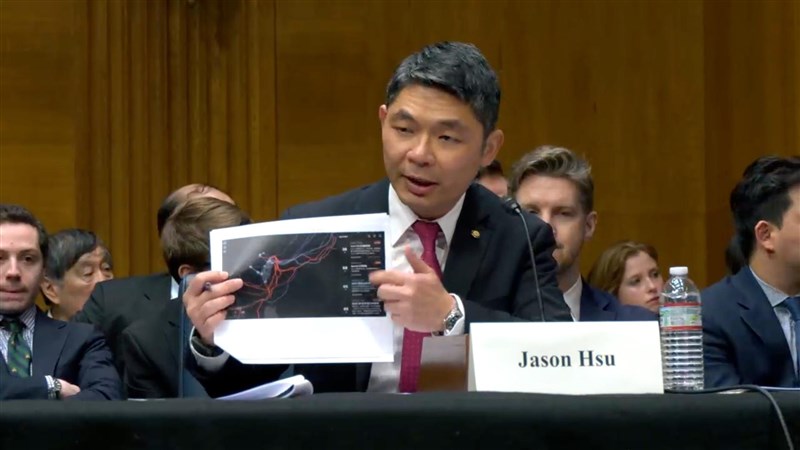
Washington, March 2 (CNA) Jason Hsu (許毓仁), a former Kuomintang (KMT) lawmaker, testified Monday before a commission set up by the United States Congress on the strategic importance of Taiwan's undersea infrastructure and urged congressional action to help protect it.
Now a senior fellow at the Washington-based Hudson Institute, Hsu spoke at a hearing titled "Part of Your World: U.S.-China Competition Under the Sea" held by the U.S.-China Economic and Security Review Commission.
Hsu addressed China's targeting of undersea cable infrastructure in the Taiwan Strait and the broader Indo-Pacific region, and warned of the consequences if the 24 undersea cables Taiwan depends on for its digital connectivity were cut.
The disruption in connectivity would interrupt semiconductor manufacturing that "underpins the global technology supply chain," while also paralyzing financial markets and severing critical military and government communications, Hsu said.
In a military conflict scenario, Hsu warned, the People's Liberation Army Navy would need only to sever three key cable clusters to reduce Taiwan's bandwidth by 99 percent.
That would be devastating, Hsu said, because Taiwan does not have its own dedicated cable repair vessel and average repair times for global cable repair fleets exceed 40 days under normal conditions.
Hsu urged the U.S. Congress to pass and fund the Critical Undersea Infrastructure Resilience Initiative Act, establish an Indo-Pacific undersea cable surveillance network, invest in repair capacity and conduct joint drills in the Taiwan Strait.
The bill, which was recently submitted for review in the Senate as an amended version of a bill originally introduced in July 2025, would commit the U.S. to develop monitoring systems capable of detecting disruptions or potential sabotage and establish rapid response protocols.
It would also require the U.S. to enhance "maritime domain awareness" to detect and intercept suspicious vessels and establish international frameworks for protection.
In addition to urging congressional support of the bill, Hsu, in response to questions from commission chair Randall Schriver, called for stronger public-private partnerships to expand repair capacity.
To sustain military communications and essential government functions, Taiwan would need to maintain at least 30-35 percent of normal data traffic, he said, adding that the goal over the next three to five years should be to secure at least one dedicated cable repair ship.
He also stressed the importance of secure cloud data backups, recommending redundancy sufficient to retain at least 30 percent of data to prevent Taiwan from "going dark."
- Business
Taiwan shares open higher
07/21/2026 09:08 AM - Society
Ex-TSMC manager indicted over alleged bid to leak secrets to China
07/20/2026 09:26 PM - Society
Wanli River barrier lake alert lowered; bridges to close at night
07/20/2026 09:18 PM - Society
Previously untested Central Union cooking oil passes safety tests: TFDA
07/20/2026 09:07 PM - Society
Taiwan's new delivery worker protection law to take effect Tuesday
07/20/2026 08:17 PM