FEATURE/More than a landmark: Danjiang Bridge to reshape traffic on Taiwan's north coast
By Sunny Lai and Huang Chiao-wen, CNA staff reporters
Editor's Note: This is part one of a three-part series on the design and construction challenges of New Taipei's Danjiang Bridge -- a new landmark spanning the mouth of the Tamsui River -- and mixed views on its potential to ease traffic and boost tourism.
• Danjiang Bridge: How an 'impossible' design becomes reality
• Danjiang Bridge stirs optimism and concern along the Tamsui River
On descent into Taoyuan International Airport, roughly 30 kilometers west of Taiwan's capital, Taipei, some air passengers may catch sight of a striking white bridge stretching across the mouth of the Tamsui River from their window.
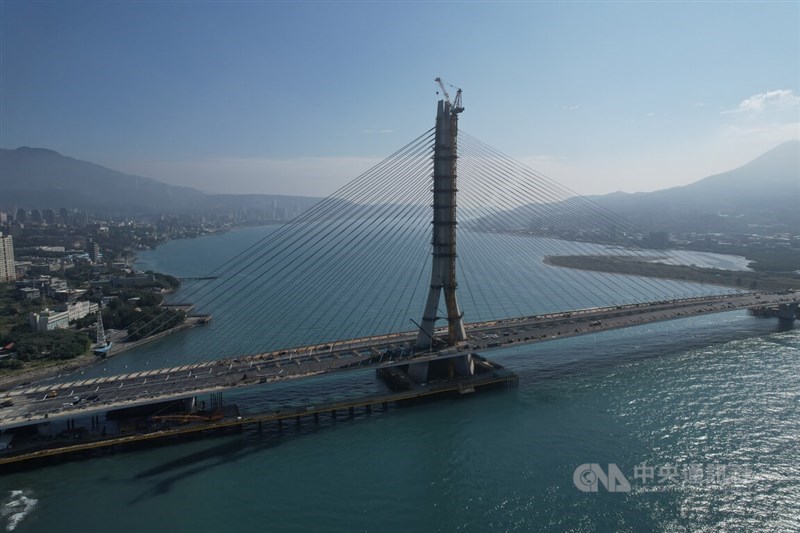
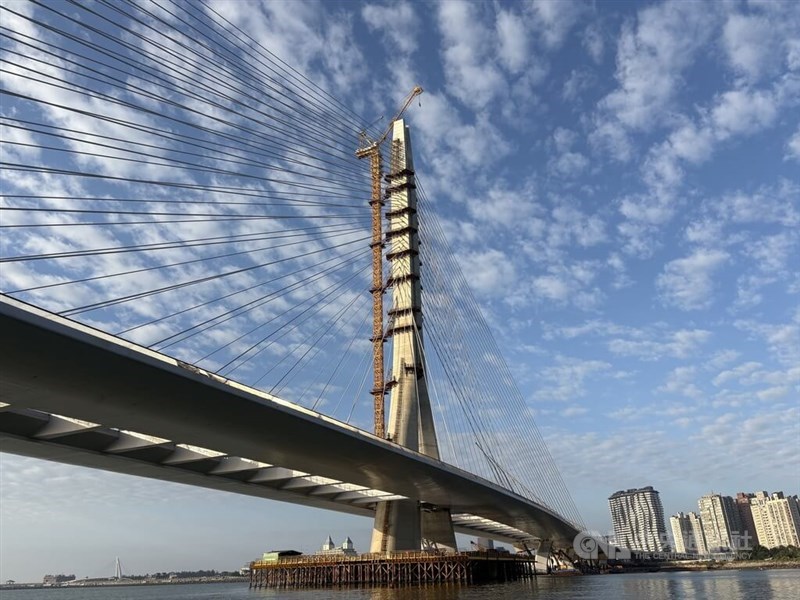
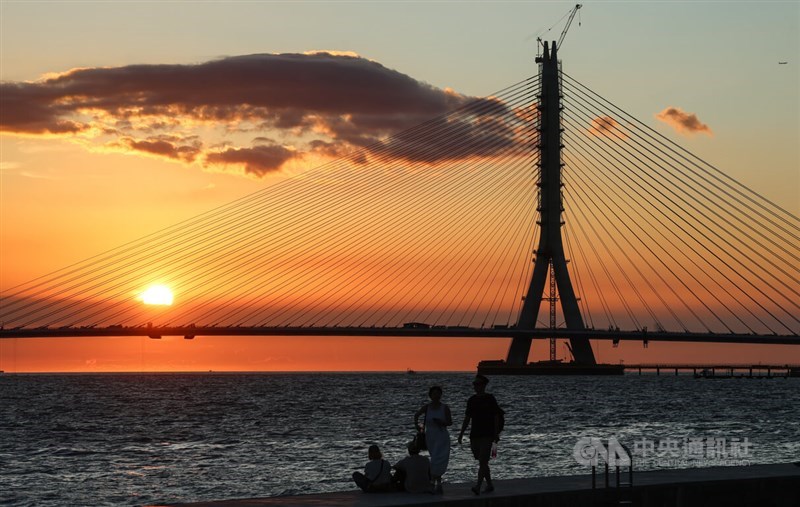
The Danjiang Bridge makes for a memorable first impression of the island nation: a nearly kilometer-long deck, suspended by a cascade of steel cables, lightly poised on a single central mast.
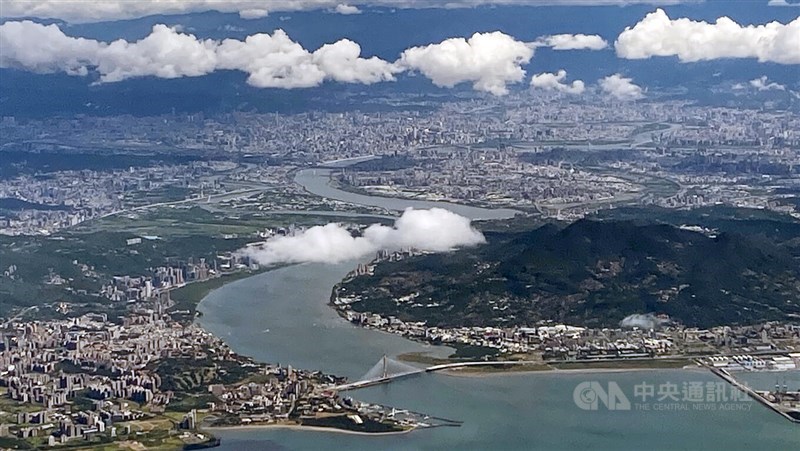
For those on the ground, it represents a more practical yet no less impressive addition to the region's transport network, nearly three decades in the works.
With four car lanes, dedicated routes for motorcycles, bicycles, sidewalks, and space reserved for a future light rail line, the new crossing between New Taipei's Tamsui and Bali districts is intended to relieve what has been for decades one of the country's most grueling traffic chokepoints.
Growth strains
The bridge's origins can be traced back to 1998, when the Directorate General of Highways (now the Highway Bureau under the Ministry of Transportation and Communications) began studying relief options as growth in greater Taipei placed the Guandu Bridge, built some 6 kilometers upriver in 1983, under increasing strain.
In the following years, the need for a new fixed link intensified.
Large-scale residential development, alongside the construction in Bali of the Port of Taipei -- now Taiwan's third-busiest container terminal -- has driven a massive increase in freight and commuter traffic.
Nowhere are congestion woes more acute than in Tamsui, whose population has grown from 101,396 in 1997 to 208,334 today, driven largely by the development of Danhai New Town, a planned city in the district's hinterlands designed for 300,000 and currently home to at least 40,000.
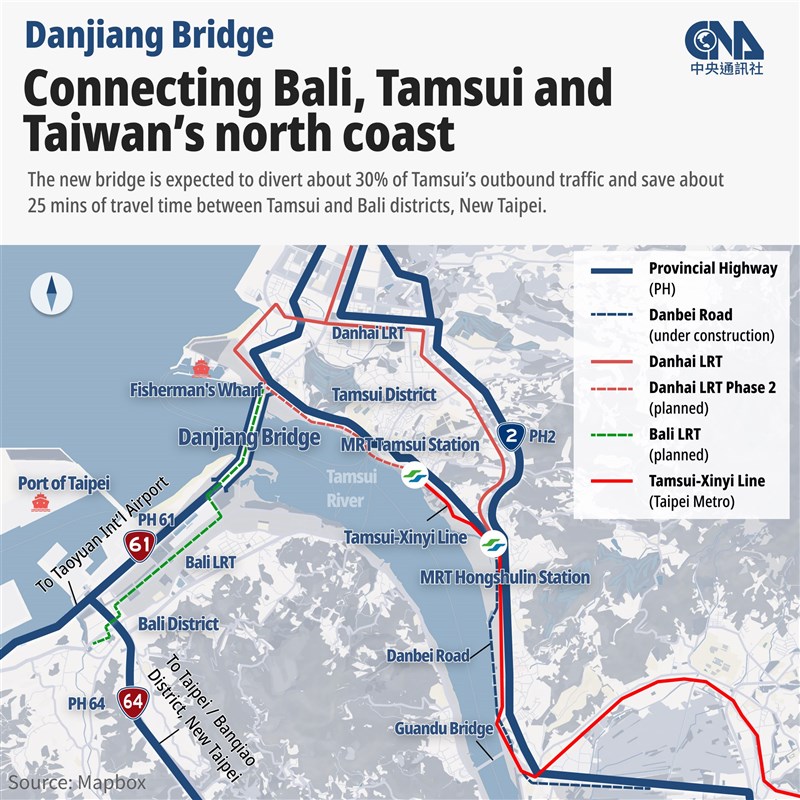
Although the road to Taipei fans out to the north and south, traffic slows to a crawl on a 1.1-kilometer stretch between Zhuwei and Guandu, where mountains press in from the east and the Tamsui River limits outward expansion.
At peak times, it can take up to half an hour to traverse the bottleneck. By contrast, the entire 18-kilometer journey from Tamsui to central Taipei can be done in as little as 22 minutes when traffic is light.
According to the Highway Bureau, once the Danjiang Bridge opens on May 12, traffic along the existing bottleneck and on the Guandu Bridge is expected to fall by about 30 percent, with travel times between Tamsui and Bali cut by around 25 minutes.
A regional lifeline
The new bridge also aims to make northern Taiwan's coastal road network "more complete," according to the Highway Bureau, by improving links to Provincial Highways 15 and 64 on the Bali side of the river as well as Taoyuan Airport.
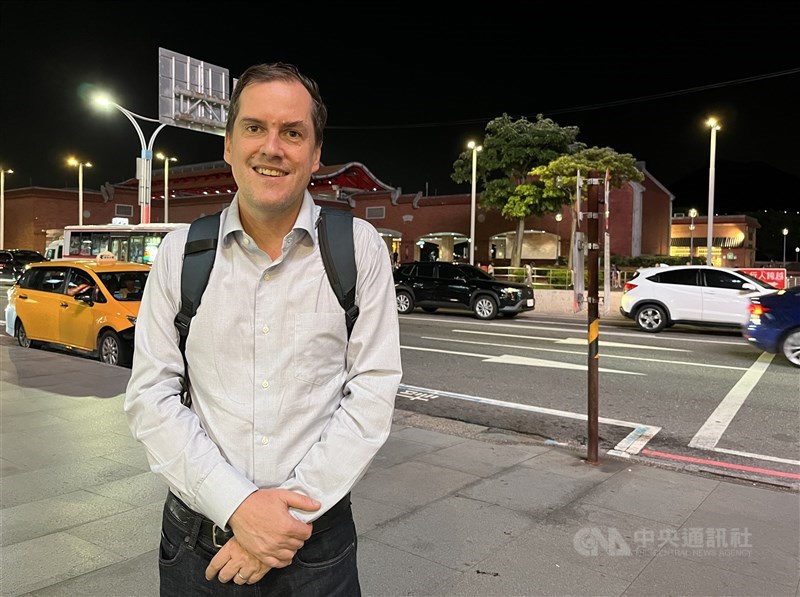
Alex, a 49-year-old German national who has lived in Tamsui for 19 years, welcomes such integration.
"The whole north coast -- like Sanzhi and so on -- will be better connected to Taipei Port and the airport, so I think in that regard [the Danjiang Bridge] makes a lot of sense," he told CNA.
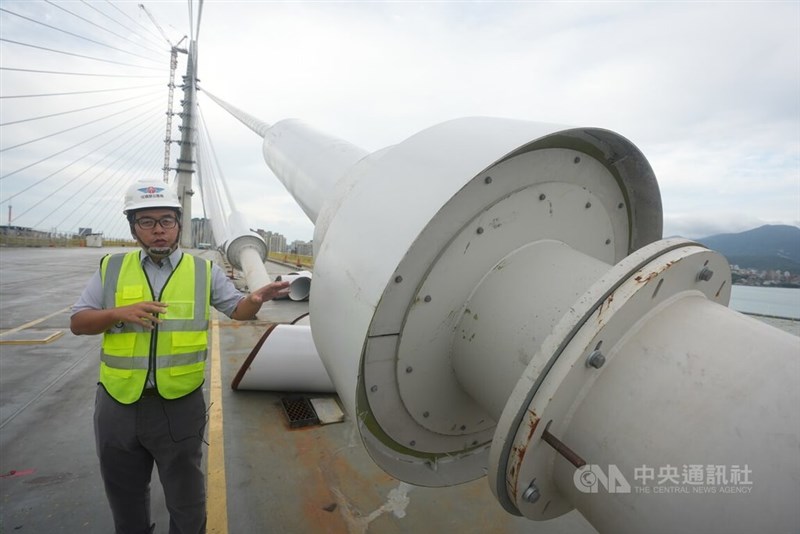
Given its role as a "vital transport lifeline for the north coast," the bridge has been designed to remain operational in the most extreme of circumstances, said Cheng Min-chung (鄭閔中), an engineering official with the Highway Bureau.
The main tower is equipped with dampers capable of absorbing the equivalent of 5,250 tons of seismic force, with additional dampers installed at both ends of the bridge, he said.
Even if it suffers damage in an extremely high-intensity earthquake, Cheng said, "the bridge deck will still be passable."
When it opens, the Danjiang Bridge will become the world's longest-span single-mast asymmetric cable-stayed bridge, with a main river-crossing section of 920 meters and a main span of 450 meters.
The bridge will also stand as the product of long-term vision and perseverance, with nearly three decades of planning and construction shaped by repeated environmental reviews, design revisions and engineering challenges.
Enditem/ASG
![Beyond labels: How immigrant families reshape NCCU's Southeast Asia department]() Beyond labels: How immigrant families reshape NCCU's Southeast Asia department[Editor's Note: This is part two of a two-part series on a university department in Taiwan dedicated to Southeast Asian languages and regional studies, and the people behind it.]08/12/2026 12:12 PM
Beyond labels: How immigrant families reshape NCCU's Southeast Asia department[Editor's Note: This is part two of a two-part series on a university department in Taiwan dedicated to Southeast Asian languages and regional studies, and the people behind it.]08/12/2026 12:12 PM![Beyond language: Inside a Taiwan university's Southeast Asian department]() Beyond language: Inside a Taiwan university's Southeast Asian department[Editor's Note: This is part one of a two-part series about a university department in Taiwan dedicated to Southeast Asian languages and regional studies, and the people behind it.]08/12/2026 12:10 PM
Beyond language: Inside a Taiwan university's Southeast Asian department[Editor's Note: This is part one of a two-part series about a university department in Taiwan dedicated to Southeast Asian languages and regional studies, and the people behind it.]08/12/2026 12:10 PM![U.S. basketball prospect Carter Coleman begins Taiwan journey]() U.S. basketball prospect Carter Coleman begins Taiwan journeyBefore Carter Coleman traveled to Taiwan, his parents wanted to see whether he could locate the island on a map.08/02/2026 07:23 PM
U.S. basketball prospect Carter Coleman begins Taiwan journeyBefore Carter Coleman traveled to Taiwan, his parents wanted to see whether he could locate the island on a map.08/02/2026 07:23 PM


- Society
Tropical Storm Saudel to make a comeback, with little impact on Taiwan
08/31/2026 08:41 PM - Business
Natural gas prices to consumers, industry to remain unchanged
08/31/2026 08:17 PM - Society
Retired, suspended Taipei officers indicted over data leaks
08/31/2026 07:23 PM - Society
500 millionth Taipei YouBike renter to get NT$20,000 prize
08/31/2026 07:05 PM - Business
Ministry approves Lam Research's NT$9.8 billion Taiwan investment
08/31/2026 06:47 PM