Focus Taiwan App
Download

FEATURE / To some, transitional justice has yet to expunge ghosts of 228 Incident

02/28/2026 09:49 AM
To activate the text-to-speech service, please first agree to the privacy policy below.
Kenneth Wang, son of 228 Incident victim Wang Pyng-shoei. CNA photo Feb. 28, 2026

By Chao Yen-hsiang, CNA staff reporter

When Kenneth Wang (王文宏) recounted his father's suffering during the 228 Incident of 1947, he used humor to break up the difficult memories.

"I was taught in elementary school that two times two makes four, so I used to wonder why people said 'two-two-eight,'" he said in an interview with CNA in late January.

Wang, who returned to Taiwan in 2017 after decades abroad, said he was only about 1 month old when his father, Wang Pyng-shoei (王平水), was shot to death in early March 1947.

To protect him, his family kept him largely unaware of the tragedy and of the 228 Incident itself until he was 18 and living overseas.

He can now speak about it openly, but he worries that Taiwanese are growing numb to this scar in the nation's history.

As the 79th anniversary of the 228 Incident approaches, he is not alone, with others feeling that measures to bring about transitional justice and ease the pain of history have fallen short.

CNA video

Transitional justice demands

The 228 Incident describes a deadly crackdown on islandwide protests and dissent in the days and months that followed government investigators' brutal beating of a tobacco vendor on Feb. 27, 1947.

A government-commissioned report on the massacre released in 1992 estimated the death toll at between 18,000 and 28,000 people, though more recent studies seem to indicate that estimate may be on the high side.

Many feel then-Republic of China President Chiang Kai-shek (蔣介石) should be blamed for the 228 Incident because he approved the bloody crackdown from his post in China.

• Chiang Kai-shek bears main responsibility for 228 Incident: Academia head

It was not until two years later that his Kuomintang (KMT) regime would lose China to the Communists and retreat to Taiwan, where it would embark on a decades-long "White Terror" campaign to stifle dissent and support for Taiwan sovereignty.

Taiwan has taken several measures to promote healing through transitional justice, including apologies for the abuses by successive governments, compensation for victims' descendants, and efforts to set the historical record straight.

But for Wang and others, transitional justice cannot be considered complete without addressing Chiang's legacy, including removing his statue from the Chiang Kai-shek Memorial Hall in Taipei and resolving the status of the remains of Chiang and his son, Chiang Ching-kuo (蔣經國), who later served as president.

Their bodies are currently housed in two mausoleums in Taoyuan, which Wang said cost about NT$60 million (US$1.9 million) a year to maintain.

"All those expenses are covered by taxpayers," he said.

For other descendants of victims, a more personal touch would be helpful.

"Many people ask us why we can't just let it go now that so much time has passed," said Kao Chao-hong (高兆弘) in a separate interview in January.

Kao Chao-hong, grandson of 228 Incident victim Chen Hsin. CNA photo Feb. 28, 2026

His maternal grandfather Chen Hsin (陳炘) was killed during the 228 Incident.

"I tell them we do want to let it go, but you must first give me a reason to forgive," Kao said.

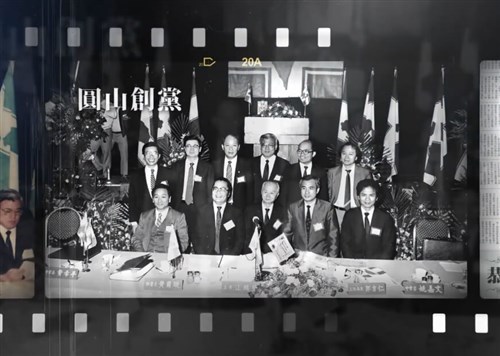
Chen, who co-founded what was then Taiwan's largest financial institution in 1926 during the Japanese colonial period, was detained by police in March 1947 and never returned.

It was not until more than a decade later that a court officially declared him dead, but his body was never recovered, Kao said.

Learning what happened to their relatives during the incident remains deeply important to victims' families and their descendants, Kao said, recalling his mother's lifelong regret that she never found her father's remains.

Many families would feel some measure of relief if descendants of those responsible were willing to acknowledge their forefathers' wrongdoing and offer apologies, Kao said.

He cited the example of a woman in Germany who, after finding out her father had been a Nazi officer, hugged and apologized to the descendant of a victim of the Nazi regime.

"Am I going to take revenge today? No way," Kao said. "But if I can see a sincere apology, that would help me let it go."

What remains unresolved?

Hsueh Hua-yuan (薛化元), a professor at National Chengchi University's Graduate Institute of Taiwan History, said transitional justice concerns not only Taiwan's past but also its future.

Taiwan's lingering ethnic tensions, he said, are partly an "aftereffect" of failing to clearly identify responsibility for the violence.

If society can reach a broad consensus on accountability, it may help foster greater internal reconciliation, he said.

Currently, members of certain groups, including public servants, teachers and some China-born residents of Taiwan who had no connection to the events, are sometimes treated as scapegoats, he said.

Some people view public servants as representatives of the state, but most did not participate in acts of violence, Hsueh said.

National Chengchi University professor Hsueh Hua-yuan hosts a seminar on the 228 Incident in Taipei on Thursday. CNA file photo

"As for those who later came to Taiwan from China, they were not here when the 228 Incident occurred, so such antagonism toward them reflects a displaced sense of history," he said.

Hsueh, who chaired the board of the Memorial Foundation of 228 for nine years, said the government should continue to apologize for what happened but also clarify who to hold accountable for the tragedy.

"When former President Lee Teng-hui (李登輝) apologized in 1995 on behalf of the government to the victims of the 228 Incident and their families, responsibility was not clearly assigned," he said. "It was not clear who was to blame."

Now, however, there are many reports and archives covering actions at many levels, from the leader of the country to district officials, that suggest accountability, he said, but the public remains largely unaware of them.

"Without broader awareness, it's difficult to reach a consensus on accountability," Hsueh said. "The difficulty lies in building a public consensus."

A past that is not past

In 1997, Feb. 28 was designated as a national holiday, Taiwan's first commemorative day marking a historical tragedy.

Both Wang and Kao said contemporary Taiwanese society can learn from the 228 Incident to respect human rights, safeguard democracy and remain vigilant against authoritarianism.

Yet they said many people now regard it simply as another day off, with limited understanding of its historical significance.

"I hope that one day, when Feb. 28 arrives, people will not just treat it as a holiday but will take time to reflect on why it exists," Kao said.

For Hsueh, history textbooks should focus more on questions of responsibility rather than only on the 228 Incident's causes, and those engaged in transitional justice must continue speaking out.

He acknowledged that historical research is inherently incomplete.

"But if a substantial majority of society can agree on who bears responsibility, then we can begin to see transitional justice take fuller shape," he said.

Enditem/ls

View All
We value your privacy.
Focus Taiwan (CNA) uses tracking technologies to provide better reading experiences, but it also respects readers' privacy. Click here to find out more about Focus Taiwan's privacy policy. When you close this window, it means you agree with this policy.
36