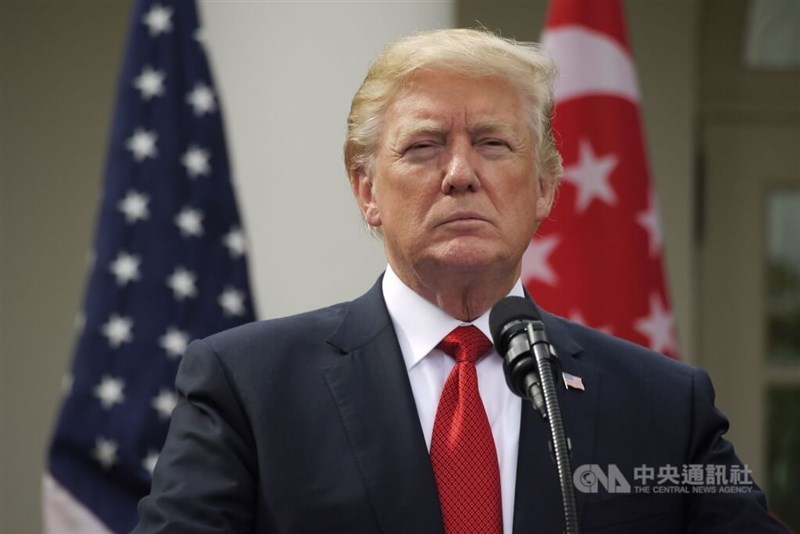
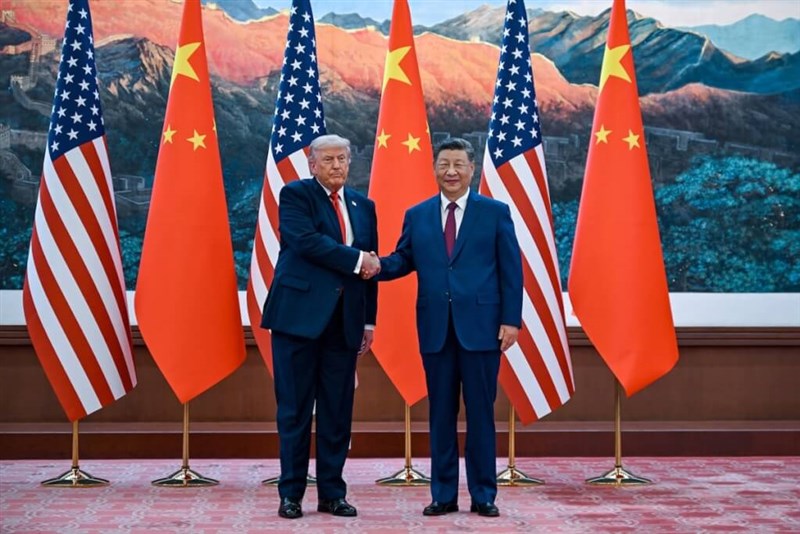
Taipei, May 19 (CNA) U.S. President Donald Trump's silence on Taiwan at last week's summit with Chinese President Xi Jinping (習近平) reflects Trump's desire to use Taiwan as leverage in dealing with Beijing rather than a shift in Washington's Taiwan policy, a scholar said.
During a speech at National Tsing Hua University in Hsinchu City on Monday, Tokyo-based scholar Lim Chuan-tiong (林泉忠) said Trump's lack of a public response to Xi's remarks on Taiwan at the Beijing summit was itself a calculated form of signaling.
"If Trump had said something Beijing liked, China definitely would have publicized it," said Lim, a research fellow at the University of Tokyo's Institute for Advanced Studies on Asia.
According to China's official readout, Xi warned Trump that mishandling the Taiwan issue could lead to "conflict and confrontation" and push bilateral ties into "a very dangerous situation."
• U.S. Taiwan policy unchanged after China visit: Trump
Neither the White House summary nor China's more detailed account recorded any substantive response from Trump on Taiwan.
Lim described Trump's approach as a "three-noes policy" toward Xi's Taiwan remarks: "no response, no position-taking and no argument."
Rather than constituting a concession to Beijing, Lim argued that Trump's silence reflected an effort to avoid giving China material it could later use to shape narratives about U.S. policy.
In addition, Trump's comments outside the summit suggested he still viewed Taiwan as an important strategic asset in U.S.-China competition, Lim said.
After the summit, Trump described arms sales to Taiwan as "a very good negotiating chip" and said he would need to speak with "the person that right now is ... running Taiwan" on the matter, remarks Lim saw as a sign that Trump had not accepted Beijing's veto power over U.S.-Taiwan military ties.
"For Trump, Taiwan is not necessarily a values-based partner, but a strategic card," Lim said. "And businessmen do not casually throw away valuable assets."
Lim argued that concerns in Taiwan that Trump could eventually "sell out" Taiwan in negotiations with China were overly simplistic.
"Using Taiwan as a bargaining chip does not necessarily mean sacrificing Taiwan," he said.
When asked after the summit if he would approve a pending US$14 billion arms package for Taiwan, however, Trump said, "I'm holding that in abeyance and it depends on China."
During the forum, Lim outlined what he called Trump's "10 Taiwan cards" -- potential measures Washington could use to pressure or negotiate with Beijing without fundamentally changing its "one China" policy.
Among the possibilities Lim listed were allowing Taiwan to participate in the U.S.-led Rim of the Pacific military exercise, increasing the number of U.S. military personnel training in Taiwan, permitting U.S. naval vessels to dock in Kaohsiung, and renaming Taiwan's representative office in Washington.
Lim stressed that such moves did not necessarily need to be implemented to have a political effect.
"The meaning of a card is not that you must use it," he said. "Simply showing the card can already have an impact."
- Politics
Lai's WWII remarks warn of China's bid to reshape world order: Analysts
10/10/2026 07:27 PM - Business
Gasoline, diesel prices to remain unchanged next week: CPC
10/10/2026 06:09 PM - Politics
Opposition leaders criticize DPP, Lai in National Day remarks
10/10/2026 04:48 PM - Politics
Ex-President Tsai calls for deeper ties between Taiwan, Silicon Valley
10/10/2026 04:25 PM - Society
Filipino worker hospitalized, over 300 evacuated in Tainan dorm fire
10/10/2026 03:59 PM