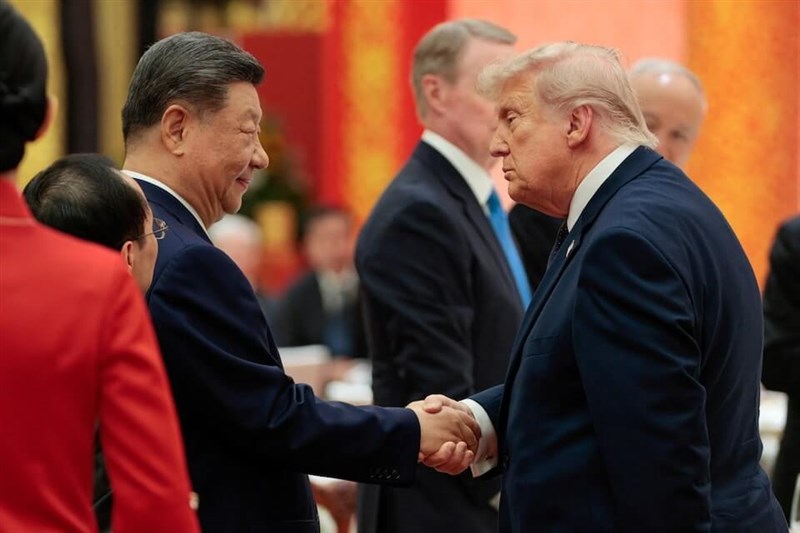
Washington, May 14 (CNA) The White House's decision not to mention Taiwan in its official summary of talks between U.S. President Donald Trump and Chinese President Xi Jinping (習近平) suggests Washington does not see the issue as up for negotiation, analysts said Thursday.
Trump and Xi held more than two hours of talks in Beijing on Thursday during Trump's state visit to China, but the two sides' readouts differed sharply on Taiwan.
Patricia Kim, a China expert at the Brookings Institution, said the differing summaries reflected contrasting messaging strategies.
"Beijing wants to show that it pressed on the Taiwan issue aggressively, whereas Washington wants to keep the focus on economic cooperation," Kim told CNA.
While China's state-run Xinhua News Agency said Xi described Taiwan as "the most important issue" in U.S.-China relations and warned that mishandling it could lead to "clashes and even conflicts," the White House readout omitted Taiwan entirely, focusing instead on economic cooperation and Iran.
Kim said that Beijing and Washington were "managing the optics differently."
Kim also highlighted what she described as a fundamental "gap in interpretation" regarding the U.S. "one China" policy.
While Washington does not support Taiwan independence, it maintains that helping Taiwan defend itself through arms sales and security cooperation is necessary to prevent Taipei from negotiating with Beijing under pressure, she said.
"The problem is Beijing views these U.S. actions as encouraging Taiwan independence," Kim said, adding that the differing interpretations would likely continue to fuel tensions.
Thomas Shattuck, a senior program manager at the University of Pennsylvania's Perry World House, said the omission of Taiwan from the White House readout itself carried a message.
"Taiwan is number one for China," Shattuck told CNA. "The United States, by not including Taiwan in the readout, shows that that's not really something up for negotiation."
Before the summit, Trump had suggested he would discuss U.S. arms sales to Taiwan with Xi, raising concerns in Taiwan over whether Washington's policy could shift.
While reports had suggested Trump delayed final approval of a major arms package for Taiwan to help ensure the summit proceeded smoothly, Shattuck said Trump was unlikely to block such sales over the long term because of their economic benefits to the U.S.
"When foreign countries buy arms through the foreign military sales process, that creates U.S. jobs," Shattuck said. "For someone who is big on the economy and manufacturing, why would you hurt U.S. businesses by preventing Taiwan from buying very expensive stuff?"
Pointing to remarks by U.S. Secretary of State Marco Rubio after the summit reaffirming that U.S. policy toward Taiwan remained unchanged, Kim said, "For now, it looks like the worst outcomes have been avoided."
"And that should be reassuring for Taiwan," she said.
- Politics
National Day celebrations to showcase Taiwan's diversity, vitality: Speaker
10/02/2026 06:04 PM - Business
Manufacturing sector flashes 'green' light in August
10/02/2026 05:20 PM - Sports
Lin Yu-ting sets sights on LA Olympics after winning Asian Games gold
10/02/2026 05:12 PM - Business
U.S. dollar closes lower on Taipei forex market
10/02/2026 04:18 PM - Politics
Ex-President Tsai Ing-wen to visit U.S., deliver speech at Stanford
10/02/2026 03:54 PM