INTERVIEW/Taiwan eyes role in NASA moon program after receiving proposal request
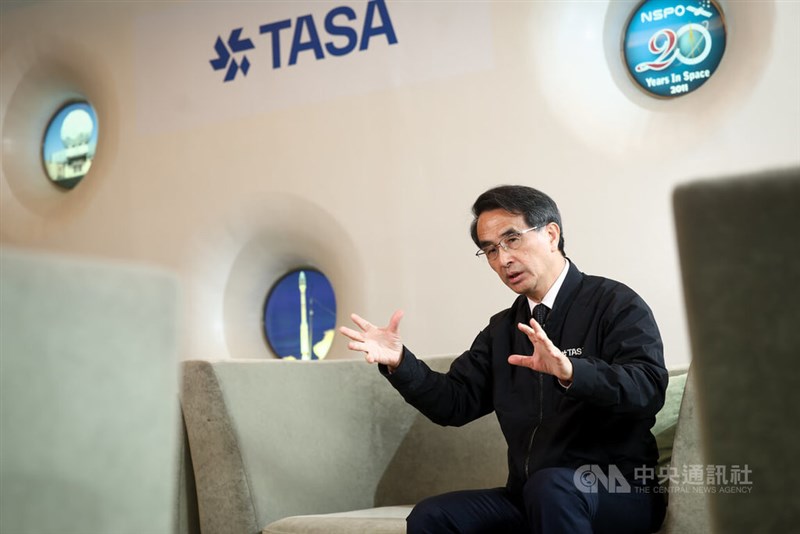
Taipei, May 18 (CNA) Taiwan has been invited for the first time to submit suggestions on possible solutions for NASA's lunar exploration program, which the head of Taiwan's space agency hopes will help the country gain a foothold in the emerging global "lunar economy."
Securing the invitation will enable Taiwanese companies to bypass third-party system contractors and work directly with the end-user, in this case NASA, Taiwan Space Agency (TASA) Director-General Wu Jong-shinn (吳宗信) said in an interview with CNA in late April.
Formally known as a "request for information" (RFI), the invitation was issued by the United States' National Aeronautics and Space Administration (NASA) to get input on 32 technical gaps in its Artemis lunar exploration program.
Artemis, led by NASA in collaboration with international and commercial partners, aims to land humans on the moon by 2028 and establish a long-term lunar base by 2030.
A foot in the door?
RFIs are generally issued during the planning stages of projects to learn what solutions are available and better understand potential vendors.
An RFI is not a contract opportunity, but it will give Taiwan a chance to introduce its space capabilities, and NASA will use the information it gets to inform future acquisitions.
Wu said Taiwan's space development has progressed steadily over the past two decades, evolving from a user of foreign technologies into a provider of technology and data and, increasingly, an international partner.
Taiwan's space industry currently generates nearly NT$300 billion (US$9.5 billion) in annual output value, Wu said, and the rise of the lunar economy could create new momentum for growth.
Specializing in contract manufacturing, Taiwanese companies have historically been excluded from higher-value design contracts because they lacked access to final operational scenarios, Wu said, a trend he hoped the NASA RFI could change.
Wu believed that Taiwan's semiconductors and precision machinery sector would give it an indispensable role in space technologies, especially as a permanent lunar base would need extensive automation, which depends on semiconductors.
But he also argued that Taiwan's participation in the space economy needed to move toward system integration capabilities.
The RFI included requests for information on infrastructure capable of withstanding the moon's extreme environment -- near-vacuum conditions, high radiation exposure and gravity about one-sixth that of Earth -- as well as advanced computing technologies for space operations.
Those requests went beyond simple solutions, and to strengthen Taiwan's response, TASA plans to integrate resources from the private and public sectors and academia to form a "national team" capable of addressing NASA's technology needs, Wu said.
The agency will also assess Taiwanese companies with the necessary capabilities and focus on key technologies with broad applications and long-term industrial value, he said.
Legal basis for direct cooperation
Aside from the NASA RFI opportunity, Wu said a proposed Taiwan-America Space Assistance Act, which recently cleared committee review in both chambers of the U.S. Congress and now awaits consideration by the full House and Senate, could also provide commercial openings for Taiwan.
The bill would authorize direct cooperation between TASA, NASA and the National Oceanic and Atmospheric Administration (NOAA) on satellite programs, space exploration and atmospheric research.
![Taiwan, democracies must build resilience against China, Russia: Scholar]() Taiwan, democracies must build resilience against China, Russia: ScholarTaiwan and other democracies must strengthen their resilience against the "sharp power" wielded by authoritarian regimes such as China and Russia to defend their shared democratic values, a visiting American scholar said Monday.09/21/2026 04:39 PM
Taiwan, democracies must build resilience against China, Russia: ScholarTaiwan and other democracies must strengthen their resilience against the "sharp power" wielded by authoritarian regimes such as China and Russia to defend their shared democratic values, a visiting American scholar said Monday.09/21/2026 04:39 PM![European Parliament vice president praises Hsiao as 'role model' for women]() European Parliament vice president praises Hsiao as 'role model' for womenEuropean Parliament Vice President Pina Picierno on Saturday praised Taiwanese Vice President Hsiao Bi-khim (蕭美琴) as a role model for freedom-loving women around the world and told CNA that she would soon begin planning a trip to Taipei after accepting Hsiao's invitation to visit.09/13/2026 01:08 PM
European Parliament vice president praises Hsiao as 'role model' for womenEuropean Parliament Vice President Pina Picierno on Saturday praised Taiwanese Vice President Hsiao Bi-khim (蕭美琴) as a role model for freedom-loving women around the world and told CNA that she would soon begin planning a trip to Taipei after accepting Hsiao's invitation to visit.09/13/2026 01:08 PM![VP Hsiao flags funding, oversight gaps in opposition drone bills]() VP Hsiao flags funding, oversight gaps in opposition drone billsVice President Hsiao Bi-khim (蕭美琴) has questioned key elements of military drone procurement bills sponsored by opposition lawmakers, saying the omissions would hurt the industry and Taiwan's preparedness.08/26/2026 10:21 AM
VP Hsiao flags funding, oversight gaps in opposition drone billsVice President Hsiao Bi-khim (蕭美琴) has questioned key elements of military drone procurement bills sponsored by opposition lawmakers, saying the omissions would hurt the industry and Taiwan's preparedness.08/26/2026 10:21 AM

- Society
Taiwan headline news
10/03/2026 10:22 AM - Sports
'Hao-yu like that?' A deep dive into Lee's rookie MLB season
10/03/2026 10:00 AM - Sports
Taiwan boosts medal haul in multiple events at Asian Games on Friday
10/02/2026 08:55 PM - Society
Workers at Taiwan snack maker Kuai Kuai extend strike over relocation
10/02/2026 08:45 PM - Business
Chain businesses association seeks more foreign workers
10/02/2026 08:04 PM