PLA framed drills to limit U.S. response, erode belief in U.S.: Analysts
Washington, Dec. 30 (CNA) China's recent military exercises around Taiwan were deliberately timed and framed to provoke only a minimal response from the United States, hurt U.S. credibility, and punish Taiwan for buying weapons from Washington, U.S.-based analysts said Tuesday.
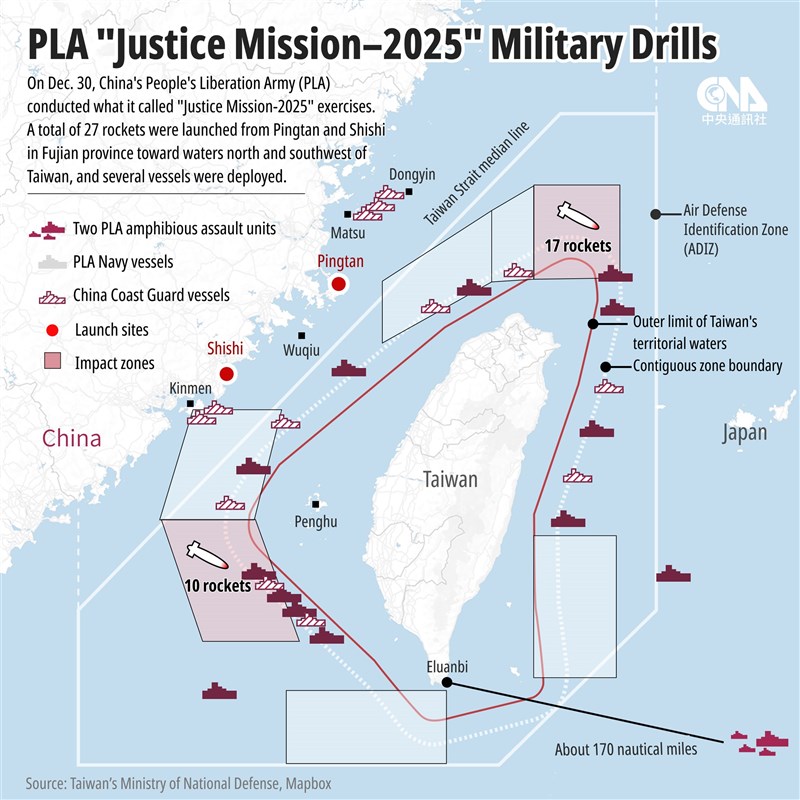
The People's Liberation Army (PLA) held two days of military drills code-named "Justice Mission-2025" on Monday and Tuesday (Taipei time), in areas surrounding Taiwan that included live-fire drills in five designated maritime and airspace zones on the second day.
They were notable in that several PLA Navy vessels and Chinese coast guard ships briefly entered waters within Taiwan's 24-nautical-mile contiguous zone, raising the stakes in its campaign of intimidation.
Ryan Fedasiuk, a former U.S. State Department China policy adviser now at the American Enterprise Institute, said the drills served three purposes, beginning with Beijing's effort to re-frame exercises it would have conducted anyway as retaliation for recent U.S. arms sales to Taiwan.
Chinese Foreign Ministry spokesman Lin Jian (林劍) described the drills as "severe punishment" for forces seeking Taiwan independence and criticized Washington for "arming Taiwan," referring to US$11 billion in arms sales it approved for Taiwan earlier this month.
Fedasiuk said the timing, 11 days after the arms sale announcement, was designed to portray the drills as a "justified" countermeasure to U.S. provocation, even though the sale was a routine implementation of U.S. policy under the Taiwan Relations Act.
• Analysis: PLA exercises send messages to Taiwan, Japan, U.S.: Experts
Second, Fedasiuk said, the exercises were "timed to provoke minimum U.S. response."
Holding the drills during the U.S. holiday period "ensured Washington would struggle to coordinate an immediate reply," Fedasiuk said.
But Beijing also understood "that [U.S. President Donald] Trump is committed to maintaining what the administration calls a 'mutually beneficial economic relationship with China' and hesitant to jeopardize hard-won stability ahead of his state visit in April," he said.
Third, Beijing is likely to use Washington's muted response to "undermine global confidence in U.S. resolve," Fedasiuk said.
Its message to Taiwan "is that resistance is futile, American support conditional, and accommodation with Beijing inevitable," he said.

Richard Bush, former chairman of the American Institute in Taiwan and now a nonresident senior fellow at the Brookings Institution, said China's primary motivation was to "punish Taiwan for making larger arms purchases from the United States."
Bush said Beijing hopes Taiwan's people "will feel less secure because of the Taiwan government's actions, not more."
The exercises also allowed the PLA to prepare for a potential military campaign against Taiwan, Bush said.
He was not sure, however, if Beijing was also motivated by comments by Japanese Prime Minister Sanae Takaichi that if Taiwan were attacked, it would be a "survival-threatening situation" for Japan that Tokyo would have to respond to.
Taiwan's Ministry of National Defense said it activated an emergency response center and launched combat-readiness drills, adding that PLA naval and coast guard vessels briefly entered waters within Taiwan's 24-nautical-mile contiguous zone and were closely monitored.
Trump said Monday he was aware of the exercises but not concerned, noting China has conducted naval drills in the region for years.
-
Business
ECCT urges Taiwan to strengthen energy resilience for AI era
05/26/2026 09:02 PM -
Business
Taiwan reports highest April industrial production on AI
05/26/2026 08:27 PM -
Society
MOFA raises travel alerts for DRC, Uganda over Ebola outbreaks
05/26/2026 08:13 PM -
Politics
KMT caucus proposes referendum on flogging for certain crimes
05/26/2026 07:32 PM -
Business
Taiwan shares end down as TSMC pulls back
05/26/2026 06:59 PM