Focus Taiwan App
Download

FEATURE / How a site of White Terror persecution became a human rights venue

02/12/2026 08:24 PM
To activate the text-to-speech service, please first agree to the privacy policy below.
The facade of the main interrogation building at the Ankang Reception House. CNA photo Feb. 12, 2026

By Teng Pei-ju, CNA staff reporter

The transformation of a dark remnant of Taiwan's authoritarian past into a venue for human rights education began in 2009, with the discovery of dozens of formalin jars containing human body parts inside an abandoned building in New Taipei's Xindian district.

The jars were found by a journalist exploring the ruins of the "Ankang Reception House" (安康接待室), a euphemistically named 0.85-hectare compound where, from its opening in 1974, some of Taiwan's most prominent political dissidents were interrogated and tortured.

Amid rumors -- later debunked -- that the preserved remains were the product of state-sanctioned human experimentation, public unease spread, and calls for authorities to do something about the decaying White Terror-era site grew louder.

Today, the former instrument of one-party rule has been repurposed as a monument to the ideals and people suppressed within its walls, with exhibits documenting its brutal past and guided tours organized by the National Human Rights Museum (NHRM).

Pocket of isolation

Together with accounts from its past detainees, Ankang illustrates how "the authoritarian government subjected individuals" to political persecution, Huang Lung-hsin (黃龍興), head of NHRM's exhibition and education division, told CNA.

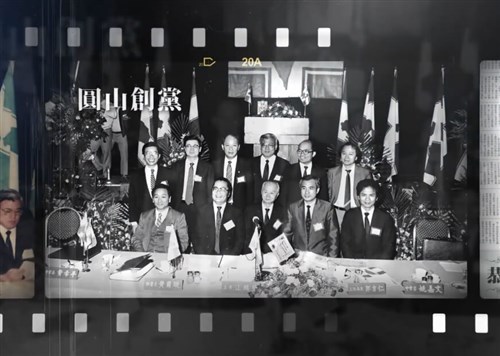
Speaking in 2022, Yao Chia-wen (姚嘉文), a lawyer and pro-democracy campaigner from the Kaohsiung Incident of 1979, recalled being confined to a single interrogation room for approximately 50 consecutive days, with only limited opportunities to leave for bathroom breaks.

Some of Taiwan's most prominent political dissidents during the White Terror period were interrogated by state security officers in Ankang's white, soundproofed rooms. CNA photo Feb. 12, 2026

He endured sleep deprivation and a loss of sense of time and space in the brightly-lit room with white soundproof walls and perpetually curtained windows, as security officers worked round the clock to extract a confession before sending him to military court on sedition charges.

Yao's fellow Kaohsiung Incident campaigner Chen Chu (陳菊), who was only 18 at the time of her detention, also spoke of enduring an agonizing interrogation before being escorted through a narrow passage linking the white rooms to tiny cells with limited ventilation and light.

During this time, Ankang existed as a pocket of isolation, Huang said, noting that the closest residential community, Hsi Yang Yang (喜洋洋), was only completed in 1982.

Some locals may have known that the hilltop compound was an Investigation Bureau facility, but its actual function remained a mystery to them, he said.

Site of injustice

Ankang was designated a historic site by the New Taipei City Government and a "site of injustice" -- a space where human rights violations by the state took place -- in 2022.

Despite calls from some residents to turn it into a green space with parking, Huang stressed the importance of preserving Ankang, as it is the only site used to interrogate civilians during Taiwan's martial law period from 1949 to 1987 still standing, making it a tangible testament to the political persecution of the era.

A narrow corridor lined with detention cells. CNA photo Feb. 12, 2026

Two other interrogation sites that predated Ankang, including a traditional private residence in Datong District requisitioned by the authorities and an official building in Xinyi District, have both been torn down and the sites repurposed, he said.

Through guided tours of Ankang and other sites, such as former military courts, prisons and execution grounds, the NHRM aims to help the public gain a deeper understanding of the hardships endured by political prisoners, Huang said.

He said the NHRM had organized more than 100 tours of Ankang, attracting nearly 500 participants since March 2025.

Human rights tours

Even though Ankang has fallen into a state of dereliction over the years, with its wooden structures crumbling and iron doors rusting, visitors can explore most of the compound.

They will also be shown the shelves where the formalin jars, since removed, were once kept and told that the facility had been used by the Ministry of Justice to store forensic evidence in the post-martial law era.

Visitors listen to a tour guide in front of the gate of the Ankang Reception House. CNA photo Feb. 12, 2026

Speaking with CNA after a December tour, a 31-year-old Hong Kong visitor surnamed Liu (廖) said visiting the site helped him better understand what the detainees had experienced.

"The oppressive atmosphere" in some of the spaces, he added, is "not something one can fully grasp by merely looking at photos or floor plans."

A Taiwanese woman, surnamed Hsia (夏), brought her two elementary school children on the same tour, hoping to expose them to the history of the White Terror, an era marked by violent political repression and pervasive surveillance and censorship under the KMT's authoritarian rule.

She said she had been unaware of this past -- a taboo in her family and schools -- until university and felt compelled to ensure that her children would not go through the same experience.

"I don't want my children to be like me, growing up in the dark."

Enditem/ASG

View All
0:00
/
0:00
We value your privacy.
Focus Taiwan (CNA) uses tracking technologies to provide better reading experiences, but it also respects readers' privacy. Click here to find out more about Focus Taiwan's privacy policy. When you close this window, it means you agree with this policy.
115