ANALYSIS/China's obstruction of Lai's trip aimed at reinforcing party lines: Scholars
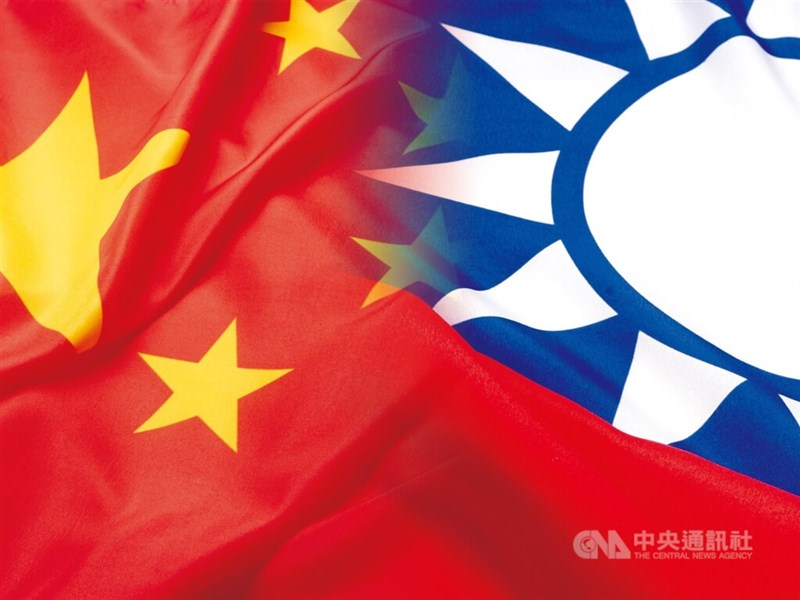
Taipei, April 23 (CNA) China's reported role in blocking President Lai Ching-te's (賴清德) planned visit to Eswatini this week was a reflection of its different approach to Taiwan's ruling and main opposition parties, Taiwanese scholars said Wednesday.
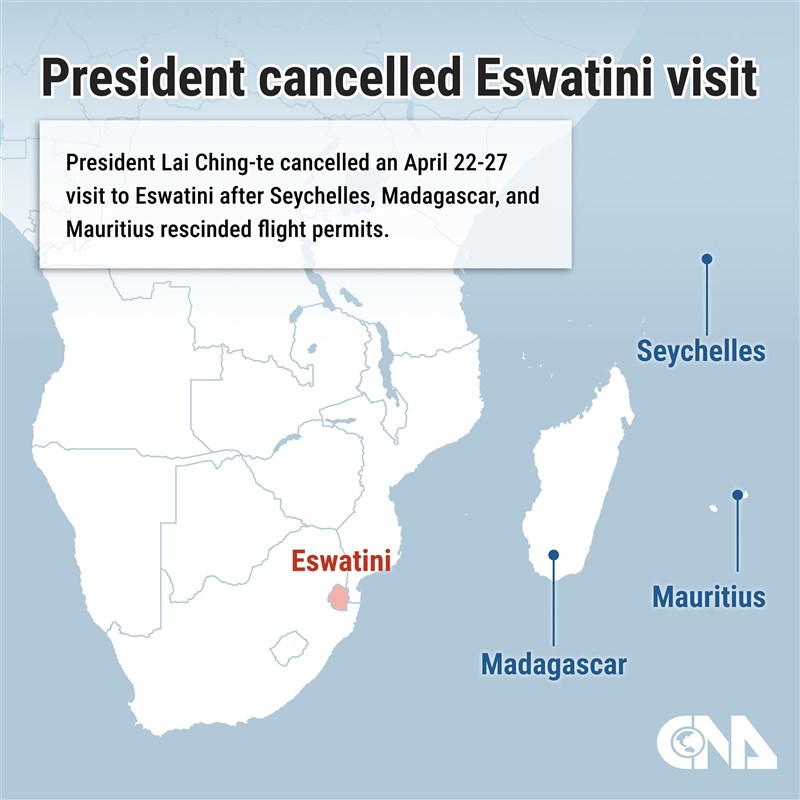
Lai was scheduled to depart on Wednesday for Eswatini, Taiwan's sole ally in Africa, but the trip was canceled after the Seychelles, Mauritius and Madagascar abruptly rescinded overflight permissions for his chartered plane.
Presidential Office Secretary-General Pan Men-an (潘孟安), who announced the cancellation on Tuesday, said it resulted from China's "strong pressure," including "economic coercion" of the three African countries.
• U.S. blasts countries as serving China's interests by blocking Lai's flight
The controversy arose less than two weeks after opposition Kuomintang (KMT) Chairperson Cheng Li-wun (鄭麗文) visited China and met with Chinese President Xi Jinping (習近平). At the conclusion of her six-day trip, Beijing announced on April 12 a set of 10 policy measures aimed at deepening ties with Taiwan in areas such as trade, fisheries and tourism.
Wang Hung-jen (王宏仁), a professor in the Department of Political Science at National Cheng Kung University, said that China's cross-strait advances and its efforts to block Lai's visit to Eswatini were all part of a broader plan to demonstrate its different approaches to the KMT and the ruling Democratic Progressive Party (DPP).
On one hand, China is using economic incentives to woo supporters of the main opposition KMT, swing voters, and those who favor a more China-friendly approach, Wang told CNA.
On the other hand, China is hoping to impose punishment on DPP supporters by making it clear that "a DPP president cannot simply go abroad," he said.
• Experts split on possible U.S. rhetoric shift on Taiwan at Trump-Xi summit
Hung Yao-nan (洪耀南), deputy director of Tamkang University's Institute of China Studies, also agreed that China was using hard and soft tactics simultaneously.
Beijing's pressure on the three African countries this week also signaled its intention to reinforce its "one China" principle, which leaves no room for the existence of a president of the Republic of China (Taiwan), Hung said.
Over the years, Taiwan presidents have invariably faced pressure from China during overseas trips or transit stops, often in the form of diplomatic suppression or military drills, Hung noted.
In the latest controversy, it seemed that Beijing handled the matter in a way that gave Taiwan no time to respond, resulting in the rare cancellation of a presidential trip after it was publicly announced on April 13, he said.
China would take a hard-line approach and do all it could to obstruct a Taiwan president's travel, regardless of the destination, Wang added.
He suggested that Taiwan deal with such interference by making technical adjustments, such as delaying the publication of certain travel details, while maintaining transparency.
![Okinawa vote likely to boost Japan's defense buildup, Taiwan security: Scholars]() Okinawa vote likely to boost Japan's defense buildup, Taiwan security: ScholarsThe anti-Henoko "All Okinawa" camp's 12-year hold on the Okinawa governorship ended Sunday when former Naha Deputy Mayor Genta Koja unseated two-term incumbent Denny Tamaki in a six-candidate race.09/15/2026 09:34 PM
Okinawa vote likely to boost Japan's defense buildup, Taiwan security: ScholarsThe anti-Henoko "All Okinawa" camp's 12-year hold on the Okinawa governorship ended Sunday when former Naha Deputy Mayor Genta Koja unseated two-term incumbent Denny Tamaki in a six-candidate race.09/15/2026 09:34 PM![Taiwan, U.S. must counter China gray-zone pressure: Stanford scholar]() Taiwan, U.S. must counter China gray-zone pressure: Stanford scholarTaiwan and the United States need to prepare for a crisis triggered by China's intensifying gray-zone pressure rather than focus only on deterring a full-scale conflict, a Stanford University scholar said Wednesday at a symposium in Taipei.09/09/2026 07:50 PM
Taiwan, U.S. must counter China gray-zone pressure: Stanford scholarTaiwan and the United States need to prepare for a crisis triggered by China's intensifying gray-zone pressure rather than focus only on deterring a full-scale conflict, a Stanford University scholar said Wednesday at a symposium in Taipei.09/09/2026 07:50 PM![China defense mobilization law signals preparations for full-scale conflict: Analysts]() China defense mobilization law signals preparations for full-scale conflict: AnalystsChina's revised National Defense Mobilization Law, which will take effect on Oct. 1, indicates that the Chinese Communist Party (CCP) plans to mobilize the country's full resources in the event of potential conflicts with external adversaries, including Taiwan, according to analysts.09/05/2026 07:24 PM
China defense mobilization law signals preparations for full-scale conflict: AnalystsChina's revised National Defense Mobilization Law, which will take effect on Oct. 1, indicates that the Chinese Communist Party (CCP) plans to mobilize the country's full resources in the event of potential conflicts with external adversaries, including Taiwan, according to analysts.09/05/2026 07:24 PM
- Politics
Taiwan-donated patrol vessel handed to Philippine Coast Guard: Source
09/22/2026 09:13 PM - Business
Taiwan's export orders hit record high in August, surge over 70%
09/22/2026 08:15 PM - Culture
Migrant workers' award-winning photos exhibited at NTCH
09/22/2026 07:46 PM - Politics
Army unveils Stinger simulators, highlights counter-drone role
09/22/2026 07:39 PM - Politics
Labor minister says no 'downgrading' at China APEC meeting
09/22/2026 07:19 PM