Nvidia ships TSMC-backed CPO switches to tackle AI data center bottlenecks
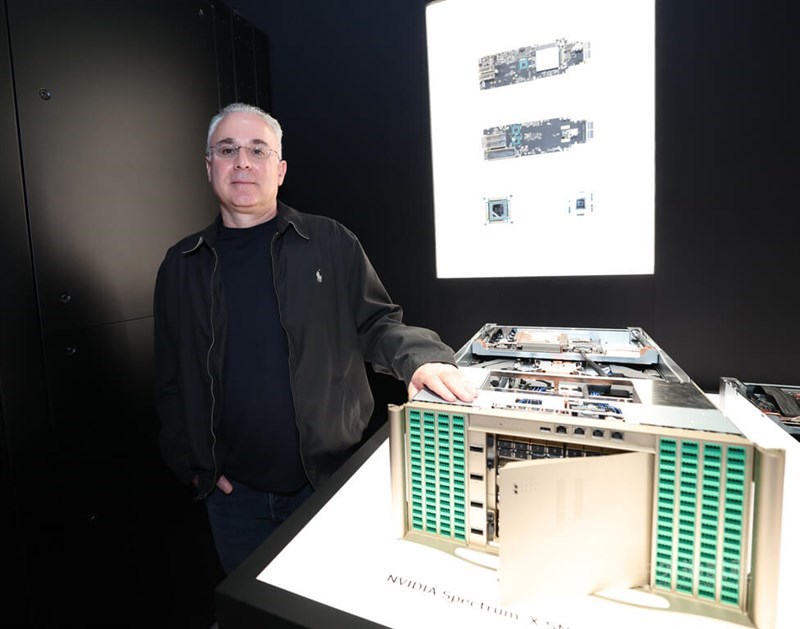
Taipei, June 3 (CNA) Nvidia Corp. said Wednesday it has begun shipping next-generation co-packaged optics (CPO) switches developed with Taiwan Semiconductor Manufacturing Co. (TSMC), as the U.S. tech giant seeks to tackle data transmission and power consumption challenges in AI data centers.
Speaking at Nvidia GTC Taipei, Gilad Shainer, the company's senior vice president of networking, said Nvidia has begun shipping its new Spectrum-X CPO switch to select partners.
The switch uses Nvidia's most advanced CPO technology and has a throughput of up to 400 terabits per second, he said, adding that production capacity is expected to expand in the second half of this year.
CPO switches are networking devices that integrate optical engines -- components that convert electrical signals into optical signals -- directly with switch chips, which route data between servers and processors, to transmit data more efficiently while reducing power consumption.
The push comes as AI factories rapidly expand their computing capacity, making bandwidth and power consumption between server racks in data centers key factors affecting AI performance, Shainer said.
Those server racks house equipment such as servers, GPUs and switches that process and transmit data in AI data centers.
Shainer noted that Nvidia is pushing ahead with CPO technology as a key way to maximize the performance-to-power ratio in AI factories.
He said CPO technology allows Nvidia to move beyond conventional designs that place optical transceivers outside switches by integrating and packaging optical engines directly with switch chips, thereby minimizing power consumption and transmission distances.
TSMC has played a crucial role in the packaging process, with the two companies working closely to adopt the chipmaker's new COUPE, or compact universal photonic engine, silicon photonics packaging platform, he said.
The innovation allows optical engines, switch chips and related components to be packaged together in a highly reliable and flexible way, paving the way for volume production, Shainer added.
Also at GTC Taipei, Shar Narasimhan, Nvidia's director of product marketing for data center GPUs and AI training, said Taiwan's technology ecosystem has been a great partner in enabling many remarkable technologies that allow the company to scale up the new systems on display.
He said Taiwan's supply chain has two core strengths -- being "hard-working" and having "very advanced technology" -- making it an indispensable partner for Nvidia.
With global demand for AI computing power already far exceeding available computing capacity, Nvidia needs Taiwan's ecosystem to help expand production for AI factories around the world, Narasimhan said.
- Politics
Taiwan needs a 'chain of guardian mountains' across industries: Lai
10/10/2026 01:19 PM - Business
New ECCT chair urges greater agility in Taiwan's software, energy sectors
10/10/2026 12:36 PM - Culture
BigBang throws concert in Taipei; Jay Chou shares photos with group
10/10/2026 11:50 AM - Politics
Full text of President Lai Ching-te's National Day address
10/10/2026 11:10 AM - Society
Taiwan headline news
10/10/2026 10:08 AM