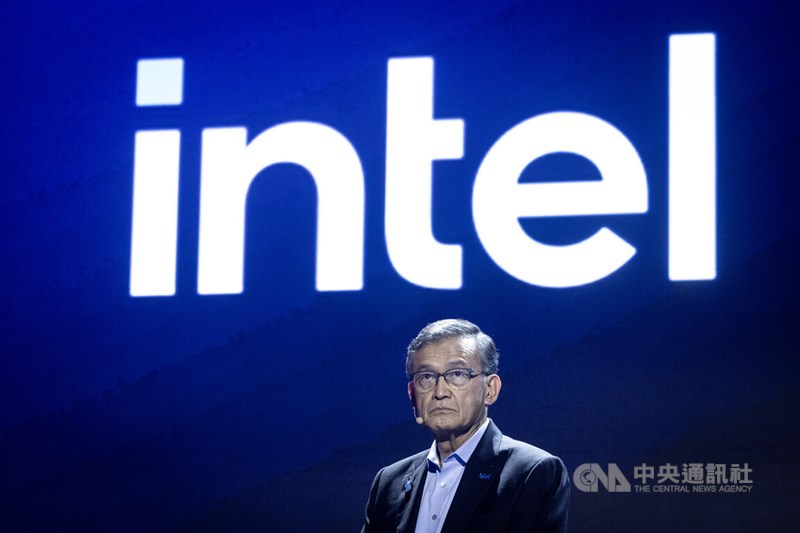
Taipei, June 2 (CNA) Agentic AI will drive demand for central processing units (CPUs) as artificial intelligence (AI) takes on increasingly complex tasks, Intel Corp. CEO Lip-Bu Tan (陳立武) said Tuesday, as the company unveiled new processors for AI infrastructure and personal computers.
Speaking at Computex Taipei 2026, Tan said the next wave of AI development will create opportunities across personal computers, data centers, edge devices and physical AI systems.
"Each of these ecosystems represents a generational opportunity," he added.
Tan said those systems will increasingly require purpose-built CPUs, graphics processing units (GPUs) and application-specific integrated circuits (ASICs) tailored to different workloads and applications.
At the same event, Intel executives argued that AI agents will increase demand for CPUs because they must coordinate tasks, retrieve information, access files and interact with software tools.
Unlike conventional AI inference, which is largely handled by GPUs, AI agents perform a broader range of computing tasks that require greater orchestration, Intel executives said.
"For agentic AI, the CPU orchestrates the show," said Kevork Kechichian, executive vice president and general manager of Intel's Data Center Group.
To support that vision, Intel introduced its latest Xeon 6 processors for data centers. Kechichian said the high-density version features up to 288 efficiency cores and 576 megabytes of L3 cache, which Intel said can support large-scale AI workloads and agent-based applications.
Intel also announced its Intel 18A process technology is now at full scale. The node powers the company's Core Ultra Series 3 processors, which are already shipping across hundreds of consumer and commercial designs to bring local AI capabilities to a broader range of personal computers.
Through a collaboration with AI search startup Perplexity, Intel demonstrated how AI agents could divide workloads between local devices and cloud servers. The companies said sensitive information could remain on users' computers while larger models run in the cloud, an approach they described as "hybrid agentic inference."
Beyond processors, Intel announced partnerships with companies including Foxconn, Google, Ericsson and SambaNova as it seeks to expand its presence in AI infrastructure and custom silicon.
Tan's keynote speech came as Intel works to regain momentum under Tan, who became Intel CEO in March 2025 and has sought to sharpen the company's focus on engineering execution and advanced manufacturing technologies.
The speech was the third of four keynote addresses scheduled for Computex Taipei 2026, one of the world's largest computer and technology exhibitions. The final keynote will be delivered Wednesday by NXP Semiconductors N.V. President and CEO Rafael Sotomayor, according to the event organizer.
- Politics
Taiwan needs a 'chain of guardian mountains' across industries: Lai
10/10/2026 01:19 PM - Business
New ECCT chair urges greater agility in Taiwan's software, energy sectors
10/10/2026 12:36 PM - Culture
BigBang throws concert in Taipei; Jay Chou shares photos with group
10/10/2026 11:50 AM - Politics
Full text of President Lai Ching-te's National Day address
10/10/2026 11:10 AM - Society
Taiwan headline news
10/10/2026 10:08 AM