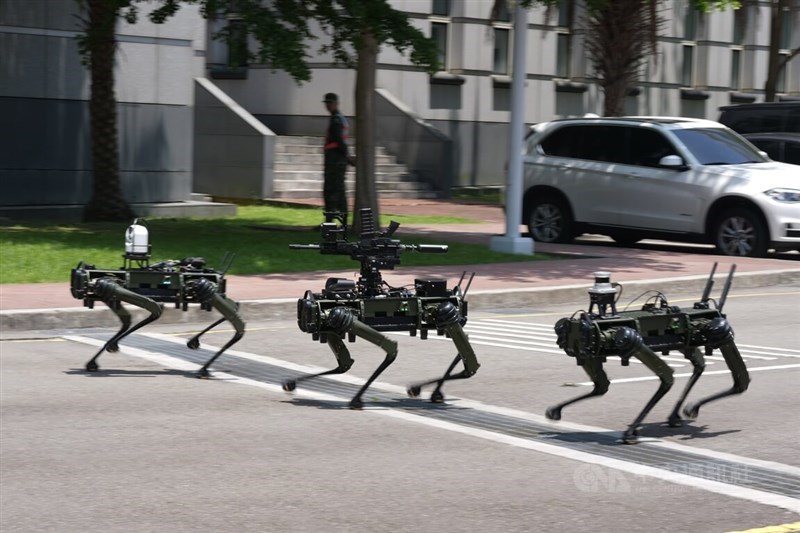
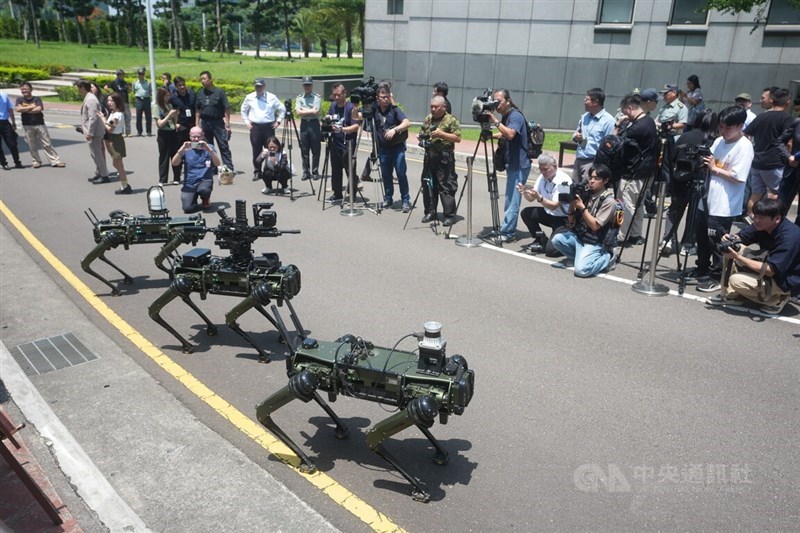
Taipei, June 2 (CNA) The National Chung-Shan Institute of Science and Technology (NCSIST), Taiwan's leading military research institute, unveiled three military-specific robot dog prototypes designed for surveillance, reconnaissance, and combat support missions in Taipei on Tuesday.
The models are based on the Vision 60 quadruped robot developed by U.S.-based Ghost Robotics and integrated with NCSIST-developed systems that provide intelligence-gathering, patrol, and monitoring capabilities, Jen Kuo-kuang (任國光), head of the institute's Missile and Rocket Systems Research Division, said at a press conference.
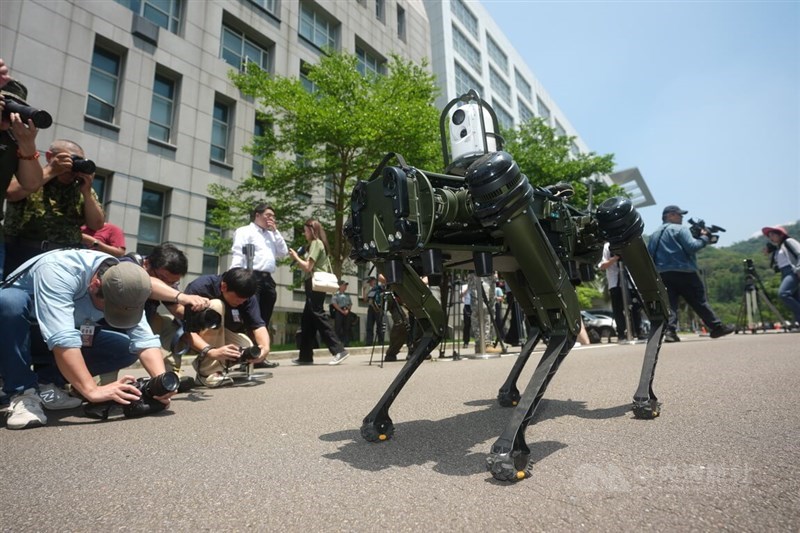
According to the institute, the first of the three robot dog variants is equipped with LiDAR (Light Detection and Ranging) and thermal imaging systems, enabling patrol operations, obstacle avoidance, environmental sensing, and 3D mapping.
The robot dog can be used for security patrols, facility surveillance and nighttime monitoring.
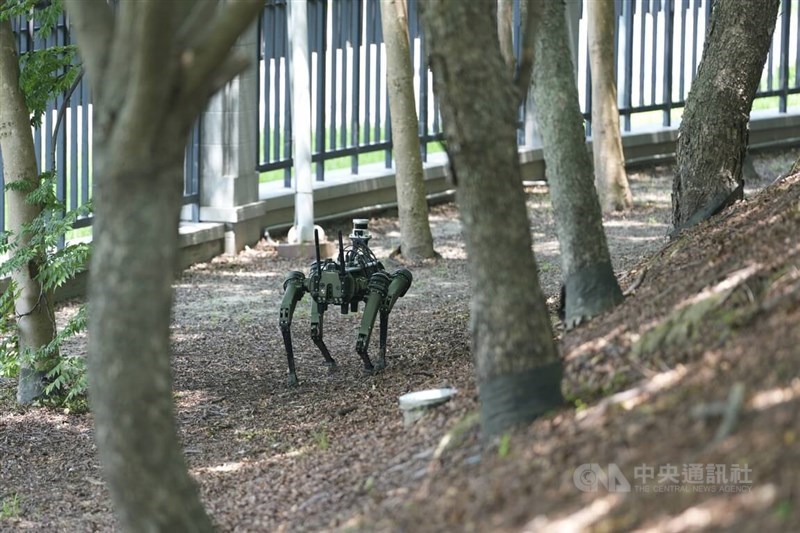
The second model is equipped with an electro-optical reconnaissance system developed by NCSIST. Designed for intelligence, surveillance and reconnaissance missions, it can search for, identify and track targets while transmitting information to a smart command-and-control system.
The NCSIST said the system could eventually be integrated with unmanned ground vehicles and drones to form a three-dimensional battlefield network.
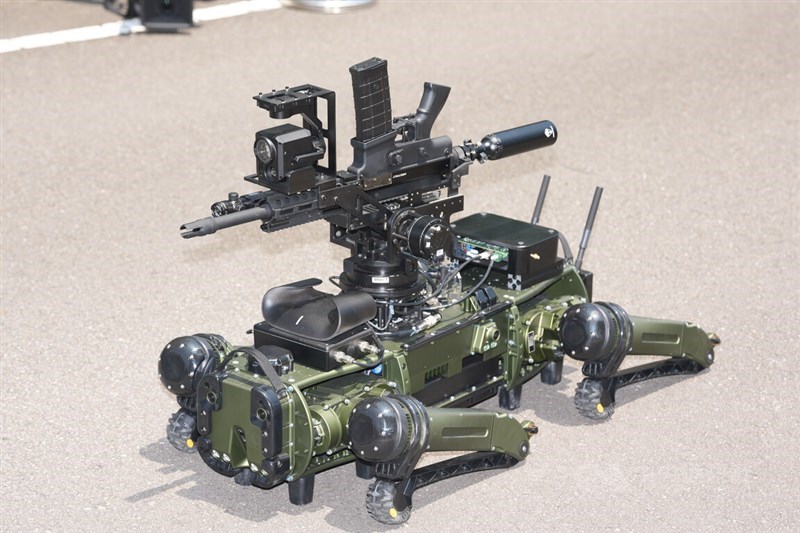
The third model features an NCSIST-developed remote-controlled weapon station, giving it both reconnaissance and strike capabilities. Potential applications include coastal defense, airfield security, riot control and urban warfare operations.
The robot dogs are capable of networking with one another, allowing them to share information and coordinate operations, the NCSIST said, adding that their deployment can also reduce personnel exposure to dangerous battlefield environments.
Jen said the Vision 60 platform is designed for high-intensity, high-risk and all-weather missions. The robot can operate in temperatures ranging from minus 40 degrees Celsius to 55 degrees Celsius and carries an IP67 rating, allowing it to function in rain, dust and muddy environments.
According to Jen, the robot dog can traverse a variety of terrain, including slopes and stairways, and is capable of self-righting after a fall.
Weighing about 52.4 kilograms, the platform can carry payloads of up to 10 kilograms while moving at speeds of up to 2.5 meters per second. It also has an operating endurance of eight to 10 hours, he said.
- Sports
Men's archery, esports give Taiwan 2 more bronzes at Asian Games
09/30/2026 08:32 PM - Society
Cooler, wetter weather forecast in northern Taiwan next week
09/30/2026 07:25 PM - Politics
Taiwan, Belize sign agreements to enhance collaboration during FM's visit
09/30/2026 07:08 PM - Society
AGC Display Glass employees protest at MOL ahead of 10/5 strike
09/30/2026 06:53 PM - Culture
CNA to relaunch Spanish-language Focus Taiwan with AI assistance
09/30/2026 05:59 PM