ANALYSIS/Cheap drones, costly defenses: Middle East war offers warning for Taiwan
By Sean Lin, CNA staff reporter
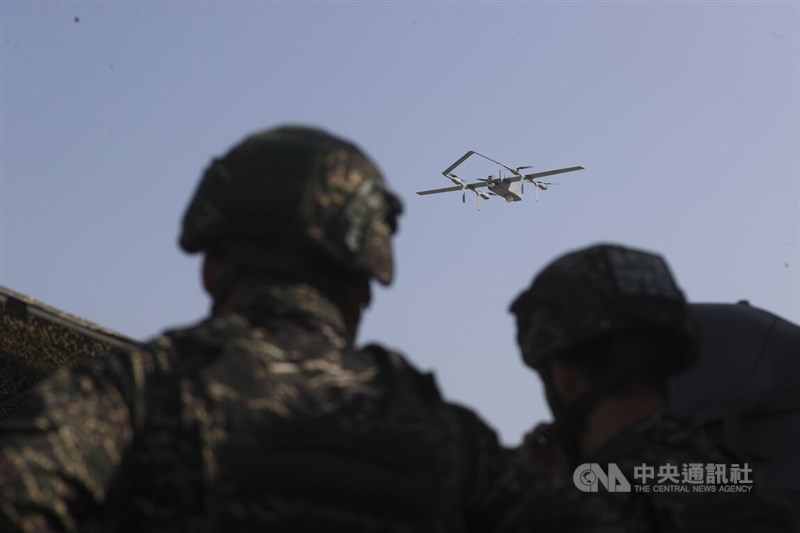
The ongoing war in the Middle East is exposing a costly imbalance in modern warfare, as the United States and its allies burn through multimillion-dollar air defense missiles to intercept waves of low-cost drones -- a dynamic that analysts warn could pose an even greater threat to Taiwan in a conflict with China.
Since the outbreak of war, Iran has launched around 1,500 ballistic missiles and 4,700 drones in strikes against Gulf countries, including U.S. military assets, in addition to approximately 765 drones and 640 missiles targeting Israel, according to the Israel-based think tank Institute for National Security Studies.
This has placed significant strain on interceptor stockpiles in the U.S. and the Persian Gulf.
The U.S.-based Payne Institute for Public Policy has projected that PAC-2 and PAC-3 interceptor inventories could be depleted in Gulf states by late April and in the U.S. by mid-June.
Taiwan faces drone threat from China
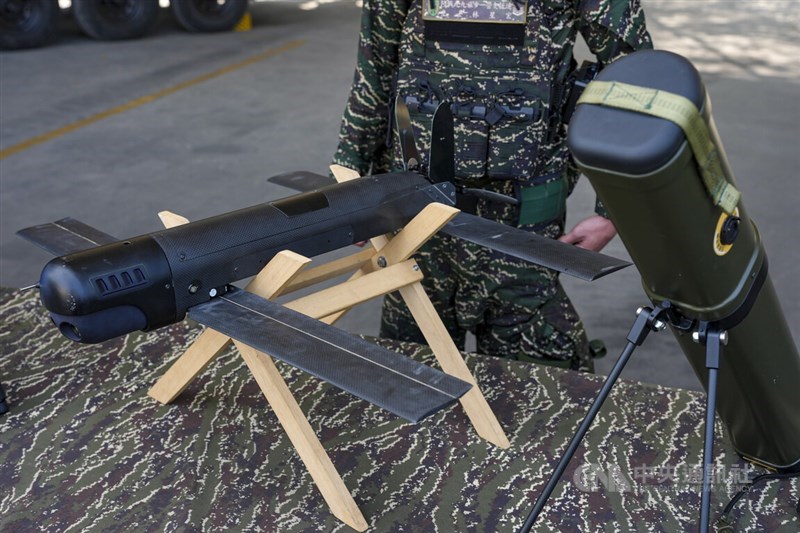
This dynamic has raised concerns in Taiwan, where experts warn that China could employ a similar strategy -- on a much larger scale -- in a potential cross-strait conflict.
Retired Colonel Richard Chou (周宇平) said the Chinese People's Liberation Army (PLA) possesses drone production capacity, diversity, and technological sophistication exceeding that of Iran, enabling what he described as "full-spectrum, heterogeneous and mass-scale" suppression capabilities.
"While Iran operates at the 'hundreds' scale, Taiwan could face tens of thousands of incoming drones, exponentially increasing pressure on conventional air defense systems," he said.
The PLA could deploy low-cost drones as initial "attrition waves" to exhaust Taiwan's air defenses, paving the way for follow-up strikes by cruise missiles or manned aircraft, Chou said.
Cost imbalance exposes defense gap
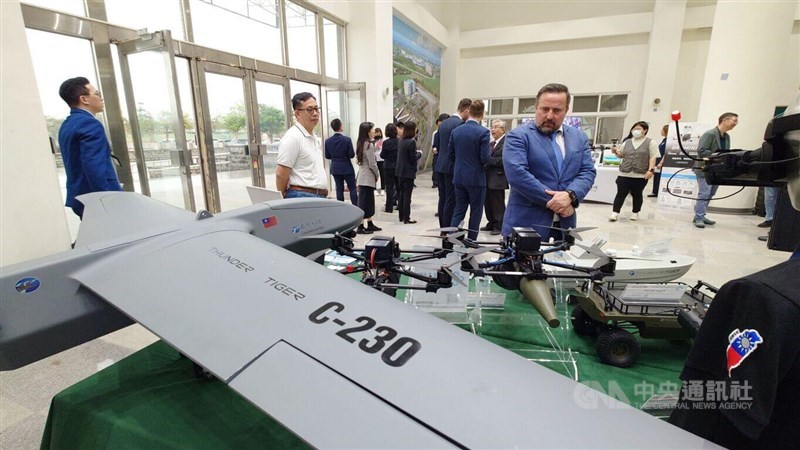
Furthermore, Chou argued that Taiwan's air defenses could be both outnumbered and economically strained, as the "disproportionate" cost exchange of using expensive interceptors against cheap kamikaze drones underscores the need for more cost-effective alternatives.
The U.S. and its partners have used Patriot missile system interceptors, which cost millions of dollars each, to shoot down Shahed 136 drones, estimated to cost around US$20,000-50,000 per unit, said Chou, a former Patriot missile battalion commander.
Meanwhile, Taiwan's high-altitude air defense relies on the indigenously developed Tien Kung II (TK II) and TK III surface-to-air missiles, which cost around US$1 million to US$1.5 million each, in addition to Patriot systems.
Asked why the U.S. and its partners are deploying such costly interceptors against relatively cheap drones, Shu Hsiao-huang (舒孝煌), an associate research fellow at the Institute for National Defense and Security Research, said it is not a choice but a "necessity," given the lack of more effective alternatives.
To address the shortage of cost-effective countermeasures, Shu suggested acquiring radar-guided mobile anti-aircraft systems similar to the Flakpanzer Gepard.
Meanwhile, Chou recommended that Taiwan deploy its GDF-006 35 mm twin cannons and upgrade its 40 mm anti-aircraft guns, which it began developing in the 2000s, for counter-unmanned aerial system (C-UAS) purposes.
These systems, Chou noted, can be deployed more quickly than short-range air defense missiles, and they are employed in high-volume barrages rather than single-point intercepts, increasing the likelihood of downing drones at close range.
However, Chou noted that the GDF-006 cannons require urgent upgrades to address outdated radar systems and improve mobility.
Another option, Shu said, would be to procure advanced command-and-control systems, such as the Maneuver Short-Range Air Defense (M-SHORAD) developed by a team of U.S. contractors including Leonardo DRS.
These systems, he said, could be mounted on armored platforms such as Taiwan's CM-32 Clouded Leopard and integrated with a range of counter-UAS capabilities, including jammers, anti-aircraft guns, and APKWS 2.75-inch rockets.
Such mobile systems would be effective in protecting high-value assets, such as presidential motorcades or the Air Force Surveillance Warning Center, which plays a critical role in detecting airborne threats, he said.
Shu also pointed to low-cost, compact drone interceptors used by Ukrainian forces against Russian drones as a model Taiwan could emulate.
To prevent its air defense resources from being depleted by Chinese drone harassment, Taiwan's Ministry of National Defense said it is drawing on lessons from the Russia-Ukraine war by adopting a dual-track approach that combines active countermeasures with passive defense.
On the active side, the military has launched programs to develop remote-controlled counter-drone systems and is procuring portable and more advanced C-UAS technologies to strengthen protection of critical military facilities, the ministry said in a report submitted to the Legislature last month.
On the passive side, it is enhancing measures such as deploying decoys, using smoke screens, installing protective netting, and reinforcing shelters to ensure continued operation of command-and-control systems and key infrastructure, the ministry said.
The ministry will continue to introduce the latest counter-drone technologies through its Defense Innovation Unit, while leveraging international industry exchanges and cooperation to tap into mature technologies in domestic and overseas commercial markets.
Enditem/AW
!['Hao-yu like that?' A deep dive into Lee's rookie MLB season]() 'Hao-yu like that?' A deep dive into Lee's rookie MLB seasonOne of the biggest stars on the Detroit Tigers' Threads account is infielder Lee Hao-yu (李灝宇), with posts featuring the Taiwanese rookie rarely drawing fewer than 5,000 likes, far more than the 1,000 likes posts featuring other players only occasionally draw.10/03/2026 10:00 AM
'Hao-yu like that?' A deep dive into Lee's rookie MLB seasonOne of the biggest stars on the Detroit Tigers' Threads account is infielder Lee Hao-yu (李灝宇), with posts featuring the Taiwanese rookie rarely drawing fewer than 5,000 likes, far more than the 1,000 likes posts featuring other players only occasionally draw.10/03/2026 10:00 AM![F-16Vs vital for Taiwan despite rise of drones: Experts]() F-16Vs vital for Taiwan despite rise of drones: ExpertsF-16C/D Block 70 fighter jets remain relevant in modern warfare even as drones are playing an increasingly prominent role, an expert told CNA, citing their ability to conduct combat air patrols (CAPs) and threaten conventional surface warships, including Chinese aircraft carriers deployed in waters off Taiwan's east coast.10/02/2026 12:39 PM
F-16Vs vital for Taiwan despite rise of drones: ExpertsF-16C/D Block 70 fighter jets remain relevant in modern warfare even as drones are playing an increasingly prominent role, an expert told CNA, citing their ability to conduct combat air patrols (CAPs) and threaten conventional surface warships, including Chinese aircraft carriers deployed in waters off Taiwan's east coast.10/02/2026 12:39 PM![Xi's WWII account obscures ROC role, evokes Japan tensions: Scholars]() Xi's WWII account obscures ROC role, evokes Japan tensions: ScholarsWhen Chinese President Xi Jinping (習近平) recalled U.S.-China cooperation during World War II at a White House state dinner Thursday, he left out a name central to that history: the Republic of China (ROC).09/29/2026 04:30 PM
Xi's WWII account obscures ROC role, evokes Japan tensions: ScholarsWhen Chinese President Xi Jinping (習近平) recalled U.S.-China cooperation during World War II at a White House state dinner Thursday, he left out a name central to that history: the Republic of China (ROC).09/29/2026 04:30 PM

- Politics
- Society
Scattered showers expected in Greater Taipei, eastern Taiwan Saturday
10/03/2026 10:41 AM - Society
Taiwan headline news
10/03/2026 10:22 AM - Sports
'Hao-yu like that?' A deep dive into Lee's rookie MLB season
10/03/2026 10:00 AM - Sports
Taiwan boosts medal haul in multiple events at Asian Games on Friday
10/02/2026 08:55 PM