TANG PRIZE/Taiwan's Nobel equivalent, the Tang Prize, honors pioneers of cancer immunotherapy
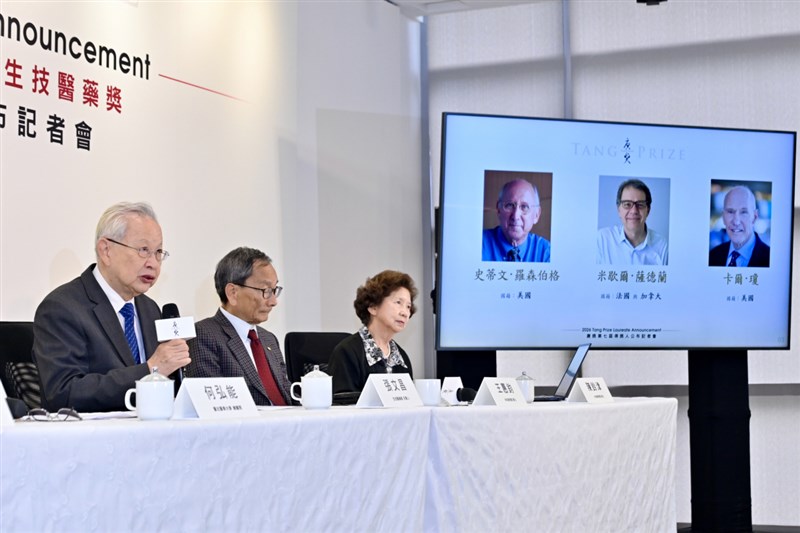
Taipei, June 16 (CNA) The 2026 Tang Prize in Biopharmaceutical Science was awarded to three scientists for their pioneering work in developing cancer immunotherapies that can harness patients' own immune cells to fight cancer, the award's selection committee announced on Tuesday.
Steven A. Rosenberg, Michel Sadelain, and Carl H. June were honored "for the discovery and development of tumor-infiltrating lymphocyte (TIL) and chimeric antigen receptor T-cell (CAR-T) therapies," said Chang Wen-chang (張文昌), chair of the Tang Prize Selection Committee for Biopharmaceutical Science.
Rosenberg, 86, currently serves as chief of the U.S. National Cancer Institute's Surgery Branch, while Sadelain, 66, and June, 73, are professors of medicine at Columbia University and the University of Pennsylvania, respectively.
TIL and CAR-T therapies have "revolutionized treatment for blood cancers and solid tumors," Chang told a press conference in Taipei.
The achievements
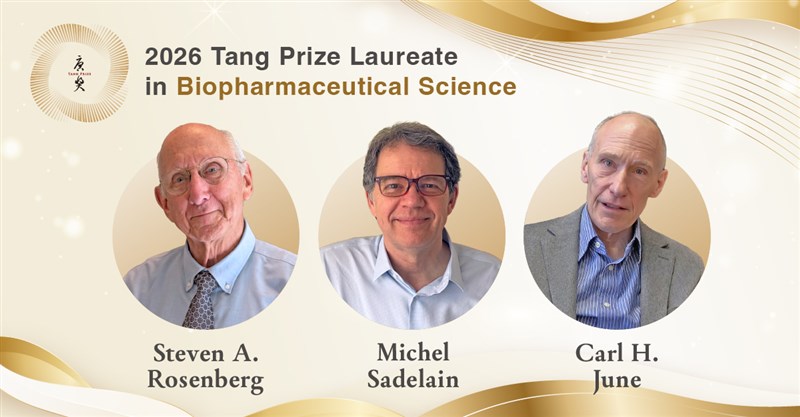
According to the Tang Prize Foundation, the laureates' discoveries have helped transform cancer treatment by turning the patient's immune system into "a powerful medicine."
The foundation described Rosenberg and June, both American scientists, and Sadelain, who holds French and Canadian citizenship, as "leading scientists" in the field of cellular immunotherapy, saying their contributions have laid the foundation for a new era of "living drugs."
In CAR-T therapy, a patient's T cells -- a type of white blood cell that helps kill infected or diseased cells -- are collected and genetically modified in a laboratory so that they carry special receptors that can better recognize cancer cells.
The modified cells are then multiplied and infused back into the patient, where they seek out and attack cancer cells.
TIL therapy, meanwhile, involves collecting immune cells that have already entered a tumor, expanding them in large numbers in a laboratory and infusing them back into the patient to attack cancer cells.
In simple terms, CAR-T therapy gives T cells a new tool to find cancer, while TIL therapy expands immune cells that have already shown they can recognize the tumor. Both therapies boost the cells' ability to kill cancer cells.
Since the first U.S. Food and Drug Administration's approval of a CAR-T therapy in 2017, the treatment has benefited more than 30,000 patients with blood cancers worldwide, the foundation said.
CAR-T therapies have provided "life-saving" options for patients with recurrent or refractory blood cancers, while TIL therapy has opened a new path for "treating advanced solid tumors, especially metastatic melanoma," the foundation said, referring to a form of skin cancer.
The Tang Prize -- established by the late Taiwanese entrepreneuer Samuel Yin (尹衍樑) in 2012 -- honors individuals who have made prominent contributions in four categories -- sustainable development, biopharmaceutical science, sinology, and the rule of law.
The biennial award is sometimes referred to as Taiwan's version of the Nobel Prizes, and awards achievements in areas not covered by its better-known counterpart.
The Tang Prize laureates in each category will share a cash award of NT$40 million (US$1.27 million), meaning each of them will receive NT$13.3 million, and a NT$10 million research grant, which will also be shared among them.
![U.S. research funding cuts hurt scientific progress: Tang Prize laureates]() U.S. research funding cuts hurt scientific progress: Tang Prize laureatesThe 2026 Tang Prize laureates in Biopharmaceutical Science warned Saturday that cuts to U.S. government research funding could slow scientific progress and reduce opportunities for young researchers, with potentially long-term consequences for the scientific workforce.09/19/2026 07:39 PM
U.S. research funding cuts hurt scientific progress: Tang Prize laureatesThe 2026 Tang Prize laureates in Biopharmaceutical Science warned Saturday that cuts to U.S. government research funding could slow scientific progress and reduce opportunities for young researchers, with potentially long-term consequences for the scientific workforce.09/19/2026 07:39 PM![Find pivotal moments that shape history: Tang Prize Sinology laureate]() Find pivotal moments that shape history: Tang Prize Sinology laureateGe Zhaoguang (葛兆光) used his platform as the 2026 Tang Prize laureate in Sinology on Saturday to encourage historians to broaden their perspective and focus on identifying pivotal moments that shape history's course.09/19/2026 07:02 PM
Find pivotal moments that shape history: Tang Prize Sinology laureateGe Zhaoguang (葛兆光) used his platform as the 2026 Tang Prize laureate in Sinology on Saturday to encourage historians to broaden their perspective and focus on identifying pivotal moments that shape history's course.09/19/2026 07:02 PM![Ozone recovery a rare success story: Tang Prize laureate Susan Solomon]() Ozone recovery a rare success story: Tang Prize laureate Susan SolomonThe recovery of the Antarctic ozone layer represents a rare example of science and international policy successfully addressing a global environmental threat, said Susan Solomon, whose research on chlorofluorocarbons (CFCs) earned her the 2026 Tang Prize in Sustainable Development.09/19/2026 05:25 PM
Ozone recovery a rare success story: Tang Prize laureate Susan SolomonThe recovery of the Antarctic ozone layer represents a rare example of science and international policy successfully addressing a global environmental threat, said Susan Solomon, whose research on chlorofluorocarbons (CFCs) earned her the 2026 Tang Prize in Sustainable Development.09/19/2026 05:25 PM
- Society
Typhoon Champi to turn away from Taiwan, will still bring heavy rain
10/19/2026 07:53 PM - Society
Taiwan, Philippines sign animal husbandry research pact
10/19/2026 07:26 PM - Society
Workers rally in Taipei for pension reform, profit-sharing rules
10/19/2026 07:00 PM - Politics
Ho proposes bus reforms; Chiang outlines smart safety network in Taichung
10/19/2026 06:21 PM - Sports
Xiao Xiang-wen wins Taiwan's 1st gold at Nagoya Asian Para Games
10/19/2026 06:04 PM