Autonomous platforms, electronic warfare key to unmanned systems: Experts
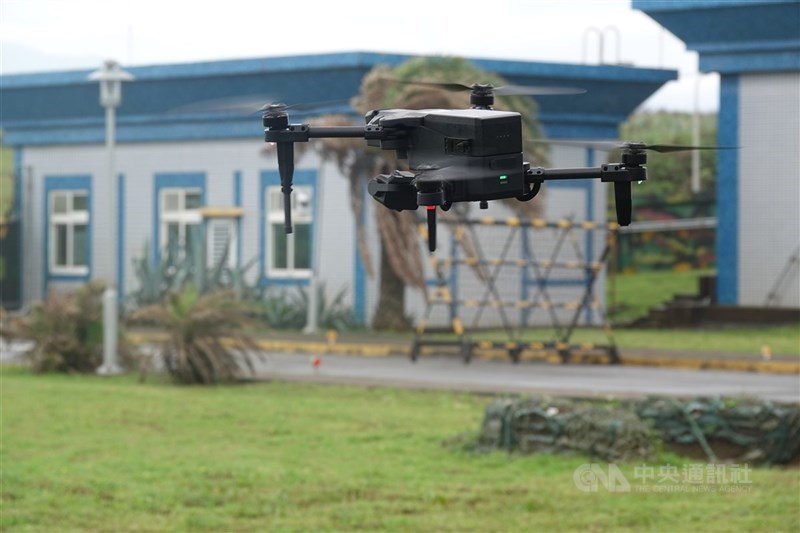
Taipei, Aug. 4 (CNA) Autonomous platforms and electronic warfare capabilities will be crucial to the development of effective unmanned systems, Taiwanese technology executives said Tuesday.
At a seminar organized by the Taipei Computer Association, Lin Hong-pei (林宏沛), general manager of YUAN High-Tech Development Co., said unmanned vehicles are complex systems requiring the integration of sensors, artificial intelligence, navigation, communications and control technologies.
While aircraft and other hardware remain important, the industry should devote greater attention to platforms that enable unmanned systems to perceive and interpret their surroundings, make decisions, carry out tasks, manage operations and continue evolving, Lin said.
"Real strength lies in the autonomous system platform," he said.
Such platforms must integrate data from cameras, radar, lidar and audio sensors while enabling different types of unmanned vehicles to coordinate their routes and tasks, Lin said.
AI agents could increasingly manage those functions and reduce the need for human intervention as unmanned systems become more complex, he added.
Meanwhile, K-Best Technology Inc. CEO Tung Yu-wei (童玉瑋) emphasized another challenge facing unmanned systems: electronic warfare.
Electronic warfare primarily involves jamming and counter-jamming of communications, positioning and navigation, and radar systems.
"Any technology or product that has not been tested by war may already be outdated by the time it is deployed on the battlefield," he said.
Taiwan needed both long-range jamming capabilities and systems able to maintain communications and positioning under interference, according to Tung.
No single approach can counter every form of jamming, he said, adding that resilient communications should employ multiple frequencies, bandwidths and time slots, as well as techniques such as frequency hopping and spread spectrum.
Thunder Tiger Group General Manager Gene Su (蘇聖傑) presented the company's work with U.S. drone software company Auterion as an example of platform integration.
The two companies have jointly developed technology integrating flight-control modules with software and hardware to improve autonomous capabilities and flight stability, according to Su's presentation.
Thunder Tiger has completed swarm flight testing and real-world aircraft verification using the technology, he said.
Su also stressed the need to scale up production of low-cost unmanned vehicles, arguing that recent conflicts have shown they can overwhelm expensive air defense systems through sheer force of numbers.
In addition, the company is developing fiber-optic drones that are less vulnerable to radio-frequency interference, with a current range of 20 km and a target range of 50 km, he said.
- Politics
Opposition leaders criticize DPP, Lai in National Day remarks
10/10/2026 04:48 PM - Politics
Ex-President Tsai calls for deeper ties between Taiwan, Silicon Valley
10/10/2026 04:25 PM - Society
Filipino worker hospitalized, over 300 evacuated in Tainan dorm fire
10/10/2026 03:59 PM - Politics
Speaker Han makes 3 wishes for Taiwan, calls for political compromise
10/10/2026 03:52 PM - Politics