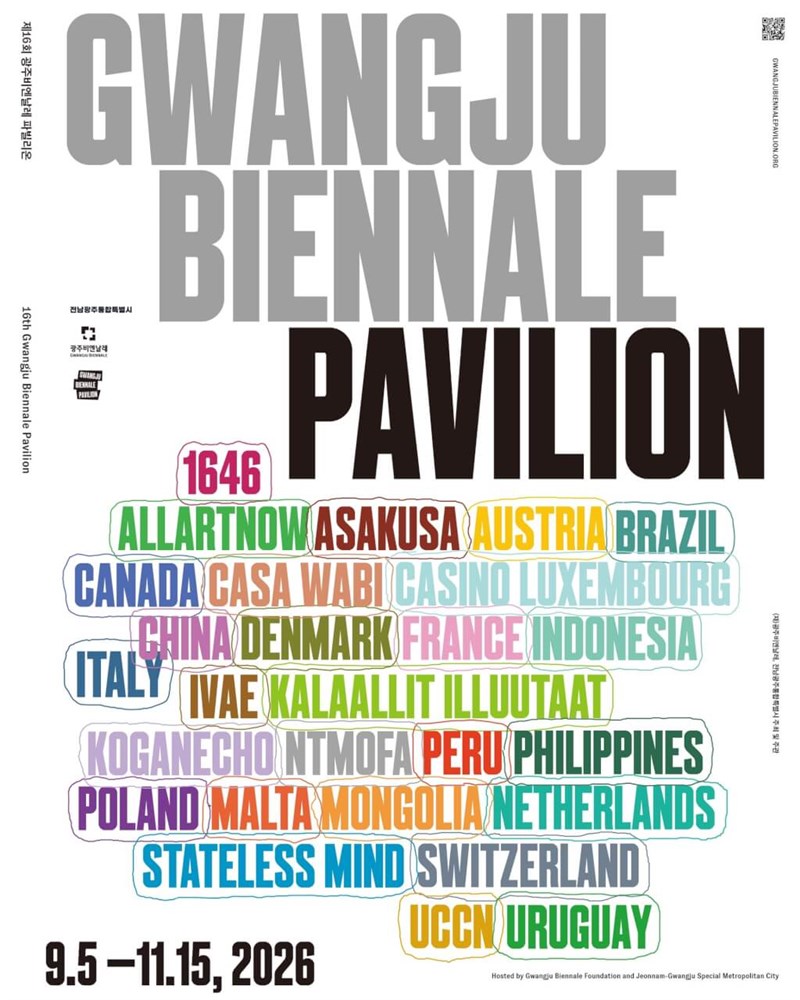
Paris, Aug. 15 (CNA) Taiwanese artists and curators on Saturday issued a joint statement protesting what they called the "political censorship" of the Taiwan Pavilion by the Gwangju Biennale, which removed "Taiwan" from its promotional materials and replaced it with NTMoFA, the abbreviation for the National Taiwan Museum of Fine Arts.
The statement, signed by 10 Taiwanese artists and curators invited to participate in the biennale in South Korea, accused the Gwangju Biennale Foundation of politically censoring an art exhibition.
The artists said the museum had communicated with the organizers under the name "Taiwan Pavilion" since the proposal stage, but "Taiwan" was removed from the official poster released in August without prior notice and replaced with "NTMoFA," while all other participating institutions and countries were identified accurately.
"We believe that a biennale founded on the historical values of democracy, human rights and the 'Gwangju spirit' has a responsibility to explain why participants' self-identification should be politically restricted," the statement said.
It said the foundation had ignored repeated protests from the museum.
Drawing on cases they had heard about from international peers, the artists said artworks at other exhibitions in recent years had been edited or removed because of artists' nationality, gender, religion or political views, arguing that such forms of political interference have become increasingly prevalent in the international art community.
They said the "erasure" of the Taiwan Pavilion was not an isolated incident, arguing that it represented not only the removal of a name but also a threat to freedom of expression and the global art community.
The 10 artists and curators who issued the statement were Li Yi-fan (李亦凡), Juan Po-yuan (阮柏遠), Lin Yu-liang (林瑜亮), Chang Wen-hsuan (張紋瑄), Hsu Che-yu (許哲瑜), Chen Hsiang-wen (陳湘汶), Chen Wan-yin (陳琬尹), Cheng Hsien-yu (鄭先喻), Chen Ting-ting (鄭亭亭) and Su Hui-yu (蘇匯宇).
On Aug. 9, Taiwan's Ministry of Culture said it had asked its overseas representative office and the National Taiwan Museum of Fine Arts to continue expressing strong protests to the organizers.
Chang Wen-hsuan, one of the artists who signed the statement, told CNA that the organizers had not publicly responded to their protests and that the dispute could affect upcoming preparations for the exhibition.
She said artists around the world were watching to see whether the Taiwan Pavilion's name would be restored, as leaving the change in place could raise concerns about "political censorship" at the exhibition.
Chang said the Gwangju Biennale's handling of the Taiwan Pavilion issue could undermine its reputation in the international art community.
She noted that the biennale, South Korea's largest and an internationally renowned event, is scheduled to run from Sept. 5 to Nov. 15, when many international art professionals will be focusing on South Korea.
As a participating artist, Chang said her work represented not only herself but would be understood as part of a broader and more complex narrative alongside the works of other artists.
She said the international audience would be watching how Taiwanese artists respond to information warfare and geopolitics through their participation in the Gwangju Biennale, as well as how contemporary politics is reflected through their artworks.
- Science & Tech
Nvidia, Hon Hai use robots to improve GB300 assembly success rates
10/05/2026 01:15 PM - Culture
Taiwanese artists featured at 'She Makes Noise' festival in Spain
10/05/2026 01:02 PM - Sports
Taiwan's Chou wins second women's 9-ball world title
10/05/2026 12:25 PM - Society
Heavy rain alert issued Monday for parts of Taiwan
10/05/2026 11:07 AM - Business
U.S. dollar down in Taipei trading
10/05/2026 10:12 AM