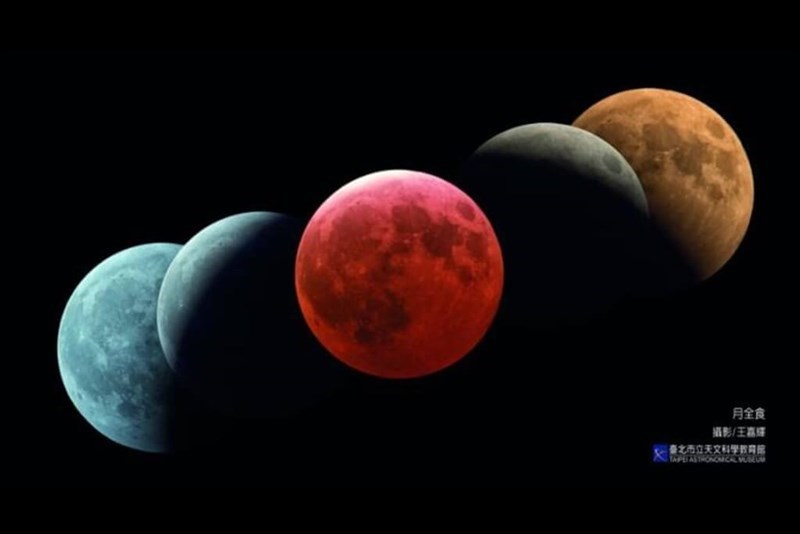
Taipei, Feb. 15 (CNA) A total lunar eclipse coinciding with the Lantern Festival on March 3 will be the most notable celestial event visible in Taiwan in 2026, according to the Taipei Astronomical Museum, which has urged skywatchers not to miss it.
Data from the museum's official website show that there will be four eclipses worldwide in 2026 -- two solar eclipses and two lunar eclipses. Taiwan will be able to observe one of the lunar eclipses in its entirety.
The total lunar eclipse will be visible as the moon rises at 5:50 p.m. on March 3, already partly shaded by Earth's shadow, the museum said.
At its peak around 7:30 p.m., the full moon will be completely within Earth's shadow, taking on a reddish hue often called a "blood moon," the museum said.
It added that the total phase is expected to last just under an hour.
A lunar eclipse occurs when Earth passes directly between the sun and the moon, casting a shadow that temporarily darkens the moon. The moon will not be fully hidden, however, as sunlight scattered by Earth's atmosphere falls on its surface, giving it a characteristic reddish glow.
In addition to the March eclipse, 2026 will feature an annular solar eclipse on Feb. 17, visible only from remote parts of Antarctica, and a total solar eclipse on Aug. 12 that can be seen from parts of the Arctic, Greenland, Iceland and Spain.
There will also be a partial lunar eclipse on Aug. 28, though this event will not be as prominent as the March total eclipse.
The museum also highlighted several major meteor showers that will offer good viewing opportunities in 2026.
Among them are the Perseids, expected to peak on Aug. 13 with up to 100 meteors per hour under dark skies, and the Geminids, forecast to reach peak activity on Dec. 14 with up to 150 meteors per hour. Conditions for both showers are expected to be favorable for viewing.
Other showers worth watching include the Lyrids on April 23, the Eta Aquariids on May 6, the Southern Delta Aquariids on July 31, and the Orionids on Oct. 21, the museum said.
The Quadrantid meteor shower, which peaks on Jan. 4, may be less easily seen in 2026 due to moonlight interference, but is still listed among the year's notable events.
The museum advised skywatchers to seek out locations with minimal light pollution and wide, unobstructed scenes of the sky to get the best views of these celestial phenomena.
- Society
Magnitude 5.6 earthquake shakes northern Taiwan
07/26/2026 08:52 PM - Sports
36-year-old Chou Tien-chen becomes oldest winner of BWF Super 1000 title
07/26/2026 07:48 PM - Society
Heavy rain forecast in parts of central, northern Taiwan Monday
07/26/2026 07:21 PM - Society
Taiwanese actor Wang Kai found dead at Taipei home
07/26/2026 07:09 PM - Society
Miaoli Mazu temple becomes Taiwan's 1st temple to retire carbon credits
07/26/2026 07:06 PM