DEFENSE/Military simulates tunnel blockade to stop Chinese advance on Taipei
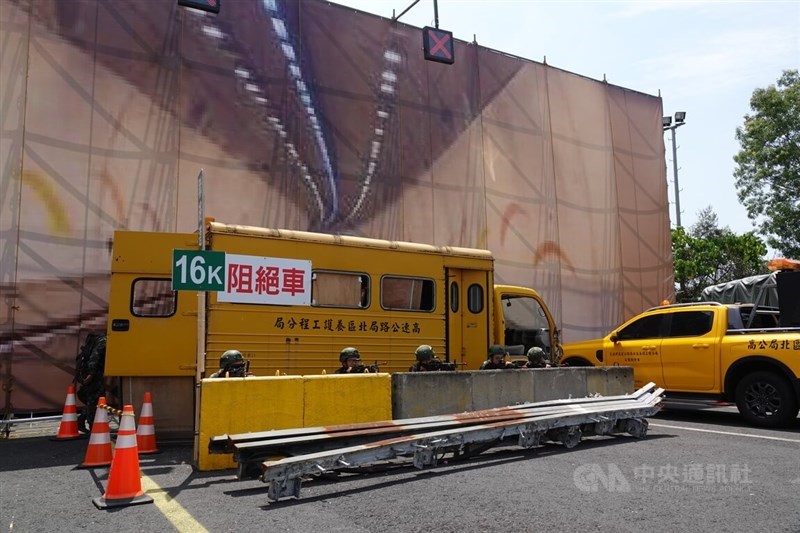
Taipei, Aug. 13 (CNA) Taiwan's military on Thursday conducted an exercise in Yilan County to simulate the blocking of Hsuehshan Tunnel and prevent Chinese forces from using it to advance on Taipei, as part of the annual Han Kuang exercises.
The exercise brought together officials from central and local government agencies to set up three barriers under a simulated scenario in which enemy forces attempted to advance through the tunnel.
According to Lin Ta-shun (林大順), an official with the Freeway Bureau's Northern Region Branch Office, the exercise was not physically held inside the tunnel due to heavy traffic during the summer vacation period, but instead in an open area near the bureau's Toucheng branch office.
The office and the military worked together to block an enemy attack, repair potholes before the bureau hand control of the highway over to the military, Lin said. The drill was designed to test how well the highway system could respond in an emergency.
The exercise scenario reflected various stages of the Urban Resilience Exercise, from initial mobilization and force protection to counter-landing operations and sustained defense.
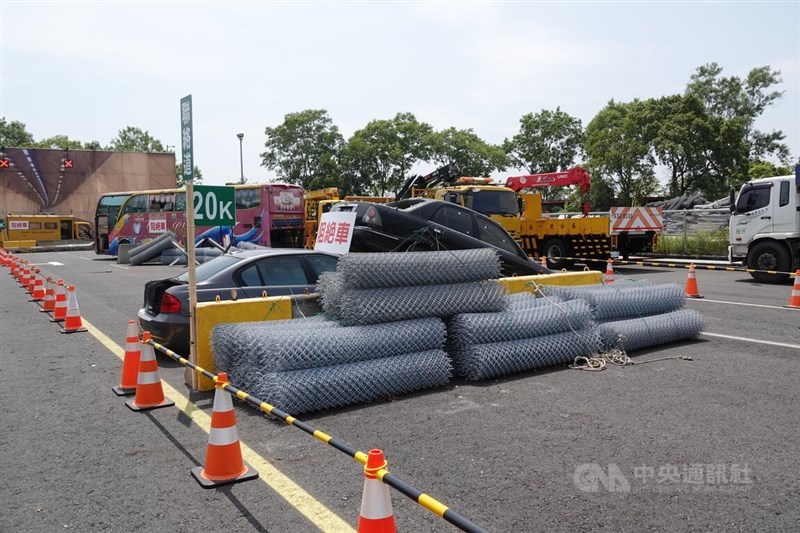
A CNA reporter at the scene observed that a special protection unit simulated setting up three barriers at different points along Hsuehshan Tunnel. It also simulated emergency repairs to potholes caused by explosions.
Army units taking part included the Army Lanyang Regional Command based in Yilan and the 153rd Infantry Brigade, with both active-duty and reserve personnel participating.
During the exercise, drones were also used to conduct reconnaissance on the approaching simulated Chinese armored force.
Troops then lured the force into an area portrayed as Hsuehshan, where drones equipped with first-person-view cameras carried out a simulated attack before ground forces engaged the enemy at a barrier.
Military drills test defenses across central Taiwan
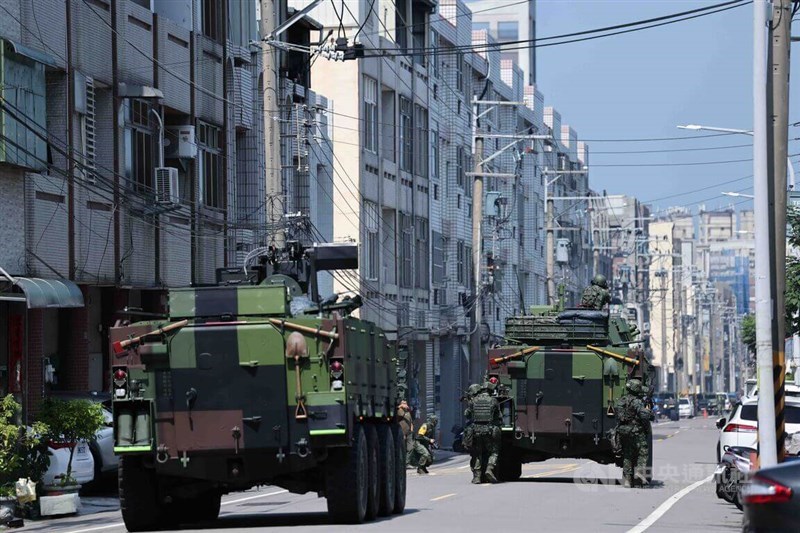
Elsewhere, the Fifth Combat Theater Command conducted an exercise in central Taiwan against a simulated airborne assault, deploying ground forces, attack helicopters and drones to repel the invading force.
The exercise tested command and control, coordination among different military branches and the protection of key areas, with drones providing real-time surveillance and helping to identify targets.
Speaking to reporters, military expert Chi Tung-yun (紀東昀) said the exercise demonstrated how drones can complement traditional military capabilities, particularly during the early stages of a conflict.
Military tests wartime medical evacuation system
Military medical units also conducted a mass-casualty drill in Taoyuan, simulating a situation in which a military unit came under attack and suffered heavy casualties.
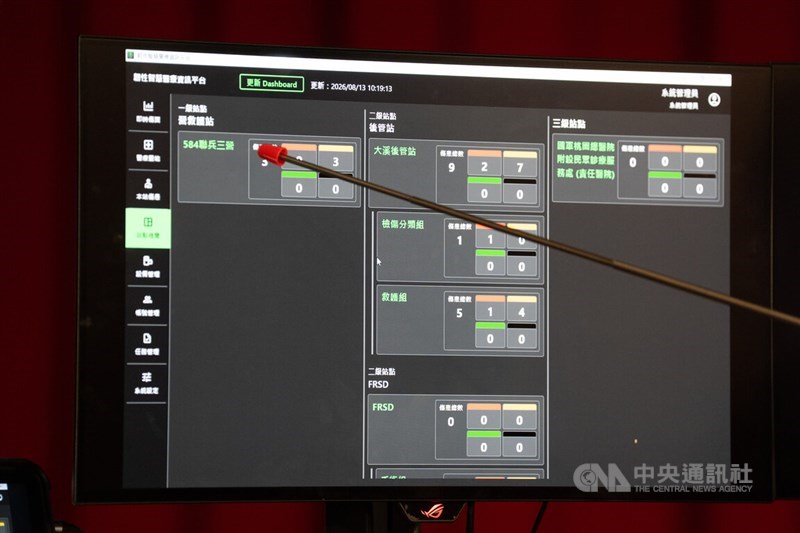
The drill tested the military's three-level medical evacuation system, including unit-level medical stations, regional medical facilities and military hospitals.
When roads were blocked, simulated casualties were transferred to a casualty evacuation control station, where forward surgical teams provided emergency treatment before the wounded were moved to hospitals once routes were reopened.
The exercise also tested an electronic casualty-tag system that allows medical units to track wounded personnel in real time, including their condition and movement through the medical system. The military said backup communications would allow it to switch to paper records, radio or fax if wartime networks were disrupted.
Penghu drill tests civilian aid and shelter operations
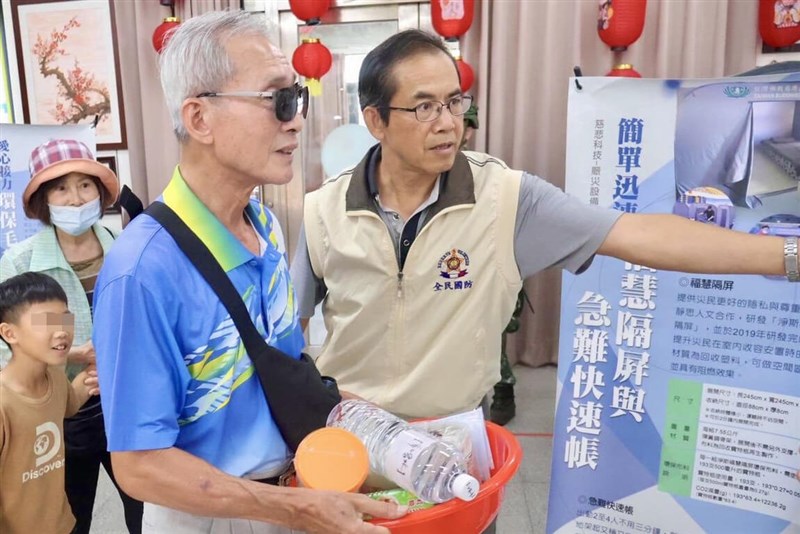
In Taiwan's outlying Penghu County, the reserve command worked with the Tzu Chi Foundation and local community groups to rehearse setting up a relief station for civilians requiring emergency shelter and assistance.
The drill simulated the mass influx of civilians needing shelter and practiced registration, accommodation, distribution of supplies and other support services. The exercise was designed to strengthen coordination between military and civilian organizations during an emergency.
A day earlier, an amphibious reconnaissance unit responsible for Penghu's defense also conducted a joint fire-strike drill, using the Tactical Assault Kit (TAK) to transmit battlefield images and identify targets for long-range targeting.
The drill tested the sequence of infiltrating an area, acquiring targets and directing fire, according to the Military News Agency.
The annual Han Kuang exercises, which began Aug. 5 and are scheduled to conclude Friday, are designed to test Taiwan's military readiness and its ability to coordinate with civilian authorities under a range of wartime scenarios.
![Taiwan watching for large-scale PLA drills as peak season nears]() Taiwan watching for large-scale PLA drills as peak season nearsThe Ministry of National Defense (MND) said Thursday that it was closely monitoring the possibility of large-scale Chinese military exercises near Taiwan as the traditional peak season for People's Liberation Army (PLA) drills approaches.10/15/2026 03:30 PM
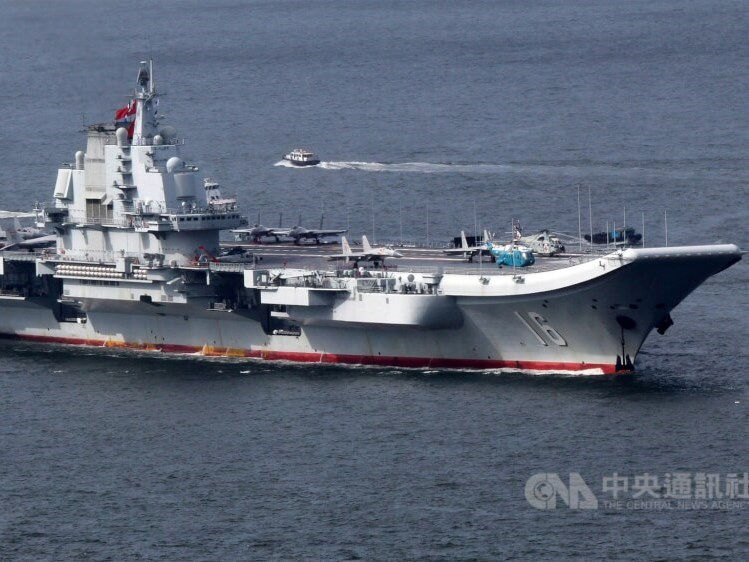
Taiwan watching for large-scale PLA drills as peak season nearsThe Ministry of National Defense (MND) said Thursday that it was closely monitoring the possibility of large-scale Chinese military exercises near Taiwan as the traditional peak season for People's Liberation Army (PLA) drills approaches.10/15/2026 03:30 PM![Ex-U.S. national intelligence director praises Han Kuang reforms]() Ex-U.S. national intelligence director praises Han Kuang reformsDennis Blair, director of national intelligence under former U.S. President Barack Obama, on Wednesday praised Taiwan's decision in recent years to transform its large-scale annual military exercises into a whole-of-society defense effort.10/14/2026 01:27 PM
Ex-U.S. national intelligence director praises Han Kuang reformsDennis Blair, director of national intelligence under former U.S. President Barack Obama, on Wednesday praised Taiwan's decision in recent years to transform its large-scale annual military exercises into a whole-of-society defense effort.10/14/2026 01:27 PM![Defense ministry releases images of jets escorting new F-16Vs]() Defense ministry releases images of jets escorting new F-16VsThe Ministry of National Defense on Saturday released footage and photos of an F-16V Block 20 and Brave Eagle advanced jet trainers escorting two F-16V Block 70s that Taiwan received a day earlier.10/03/2026 03:05 PM
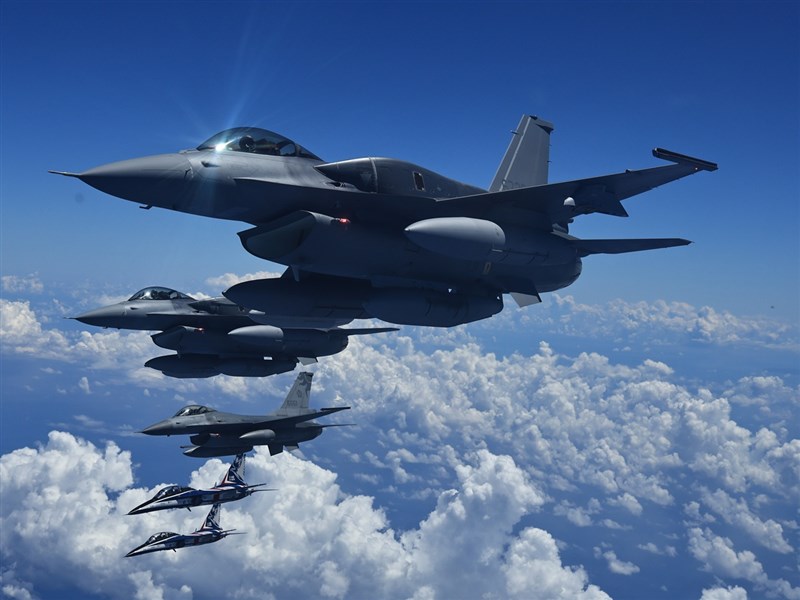
Defense ministry releases images of jets escorting new F-16VsThe Ministry of National Defense on Saturday released footage and photos of an F-16V Block 20 and Brave Eagle advanced jet trainers escorting two F-16V Block 70s that Taiwan received a day earlier.10/03/2026 03:05 PM

- Sports
Jeremy Lin joins ESPN's NBA analyst lineup for new season
10/16/2026 10:53 AM - Business
U.S. dollar up sharply in Taipei trading
10/16/2026 10:22 AM - Society
Taiwan headline news
10/16/2026 10:19 AM - Business
Taiwan shares open higher
10/16/2026 09:11 AM - Politics
Cabinet approves upgraded dementia care plan targeting '888' goals by 2035
10/15/2026 09:03 PM