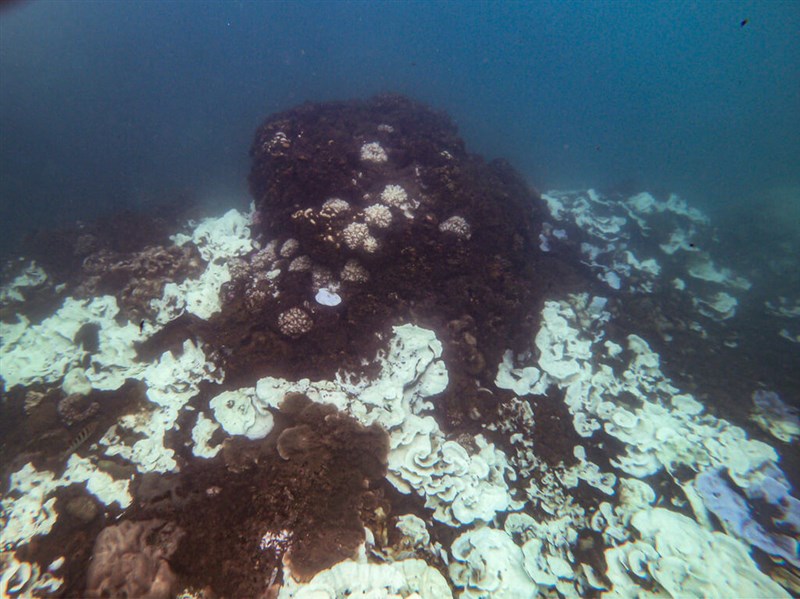
Taipei, Aug. 3 (CNA) An Academia Sinica research team has identified how a strain of symbiotic bacteria helps corals survive rising ocean temperatures, a finding that could help scientists protect and restore coral reefs threatened by climate change-induced bleaching.
The study, led by Academia Sinica Distinguished Research Fellow Tang Sen-lin (湯森林), was published in The ISME Journal in July, Academia Sinica, Taiwan's leading research institution, said in a statement Monday.
According to the academy, healthy corals depend on symbiotic algae, known as zooxanthellae, which provide most of their energy through photosynthesis.
When seawater temperatures rise, this relationship breaks down, causing corals to expel the algae and turn white in a process known as coral bleaching.
Although bleached corals do not die immediately, losing their main source of nutrients leaves them much weaker and more vulnerable to disease and death, the academy said.
To explore ways of helping corals survive warmer waters, researchers studied a strain of bacteria known as Endozoicomonas acroporae Acr-14, which naturally lives inside healthy coral tissue, Tang said.
While scientists had previously suspected the bacterium helped corals regulate nutrients and withstand environmental stress, the study provides direct evidence that the bacterium acts like a probiotic, protecting corals from extreme heat, Tang said.
The research began nearly a decade ago after Tang's research team and National Kaohsiung University of Science and Technology professor Chen Wen-ming (陳文明) successfully isolated the bacterium from coral, Tang said.
Subsequent laboratory and ecological studies showed that Acr-14 has strong antioxidant properties and helps reduce the effects of heat stress, Tang added.
Tang's team later overcame a major technical challenge by culturing the fragile bacterium in the laboratory and successfully reintroducing it into corals to confirm its protective effects.
Using single-cell gene analysis, the team also found that Acr-14 helps maintain a stable microbial community within corals, reducing microbial imbalance caused by heat stress.
After developing improved methods for preparing high-quality samples, the team identified 31 coral cell types for analysis, Academia Sinica said.
The team also produced a chromosome-level reference genome for a Taiwanese population of cauliflower coral, which Academia Sinica said will support future research into coral adaptation, coral-microbe interactions and the effects of climate change.
The researchers said the findings provide an important foundation for developing coral probiotics to help protect and restore reefs increasingly threatened by global warming.
- Politics
Lai's WWII remarks warn of China's bid to reshape world order: Analysts
10/10/2026 07:27 PM - Business
Gasoline, diesel prices to remain unchanged next week: CPC
10/10/2026 06:09 PM - Politics
Opposition leaders criticize DPP, Lai in National Day remarks
10/10/2026 04:48 PM - Politics
Ex-President Tsai calls for deeper ties between Taiwan, Silicon Valley
10/10/2026 04:25 PM - Society
Filipino worker hospitalized, over 300 evacuated in Tainan dorm fire
10/10/2026 03:59 PM