DEFENSE/NCSIST unveils upgraded Kestrel launcher with improved performance
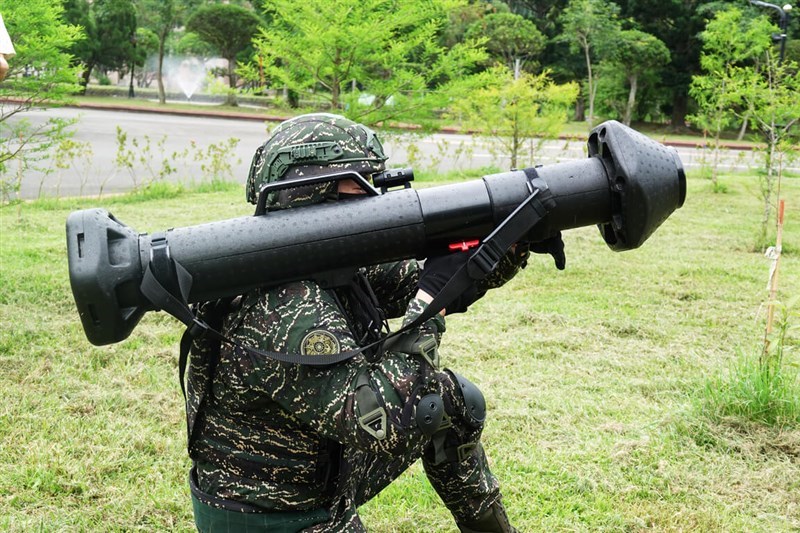
Taipei, May 19 (CNA) Taiwan's National Chung-Shan Institute of Science and Technology (NCSIST) has unveiled a second-generation Kestrel rocket launcher system that can penetrate 67 centimeters of armor and has an effective range of 500 meters.
At a recent media unveiling of the second-generation system, the NCSIST said developmental testing for the second-generation launcher is still ongoing but should be completed by the end of June.
The new Kestrel has a larger launcher tube than its previous version to accommodate the increase in rocket caliber from 66 millimeters to 96 mm, and tube is also six centimeters longer than previously at 116 cm.
At 7.4 kilograms, the unit also weighs 2.3 kg more than its predecessor.
Despite being slightly heavier and bigger, however, the new launcher remains shoulder-carried with a strap, and it is a disposable, single-use system that is discarded after firing.
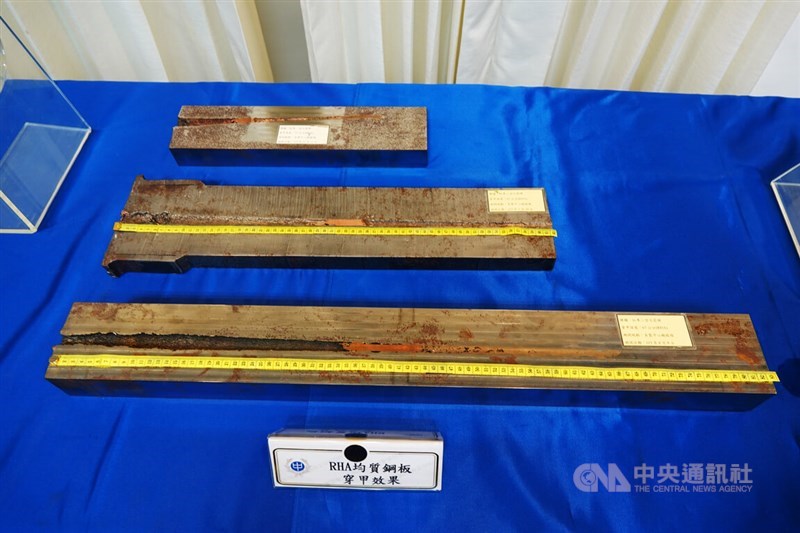
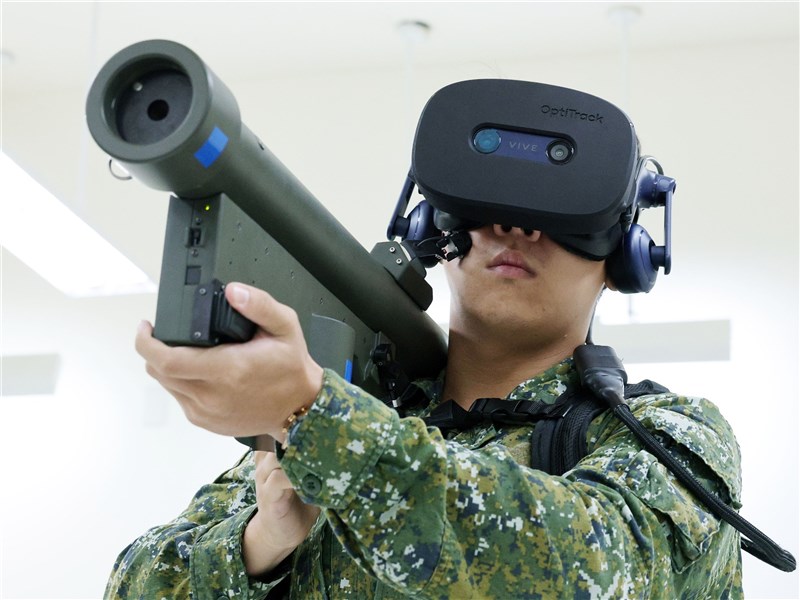
It packs a powerful punch. The NCSIST's Systems Manufacturing Center displayed a 67-centimeter rolled homogeneous armor (RHA) steel plate illustrating penetration performance, along with a thermal imaging sight attachment, training rounds, and a VR simulation system.
Line of sight
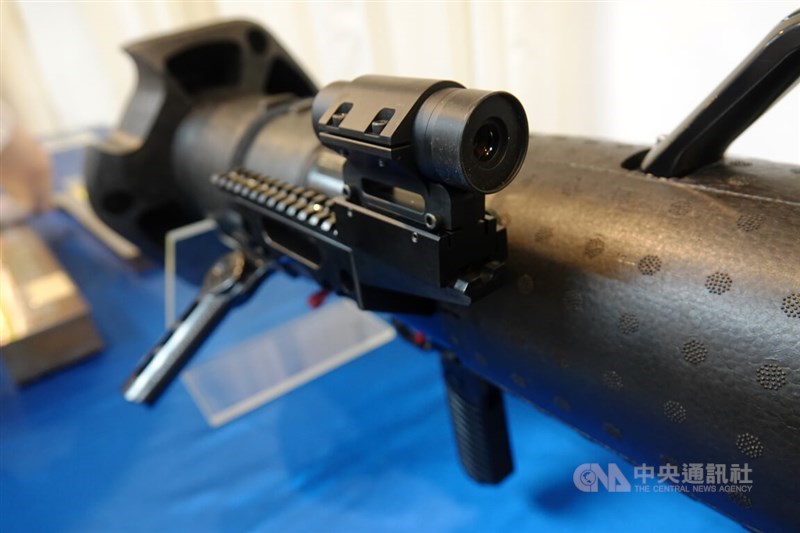
Another improved feature is its 5x optical zoom sight that has a predicted line of sight (PLOS) reticle (the pattern of markings inside an eyepiece), allowing users to track moving targets.
The sight is mounted on a tactical rail on the launcher and can be detached after firing for use on other rail-equipped units for observation purposes.
The NCSIST has also developed an infrared thermal imaging sight for night operations, which is likewise equipped with a PLOS reticle.
Confined-space Kestrel variant
Shoulder-launched weapon systems generally come in two primary variants: open-space systems, which generate dangerous backblast, and confined-space (CS) variants.
The NCSIST said it is also developing a CS variant of the new Kestrel, which is fitted with a blast suppression module to reduce backblast flame, heat and pressure. Testing for this variant is expected to be completed in the second half of this year.
Based on information provided by the institute, the two variants will feature identical caliber rockets, weight and expected penetration performance.
But the CS launcher will be much heavier because it is fitted with a blast suppression mechanism. It will weigh 10 kg, and its overall length will go from 116 cm to 145 cm.
Chang Chia-hua (張家華), who heads the institute's manufacturing center, said the second-generation Kestrel would be the world's fourth rocket launcher capable of being fired from enclosed spaces, after the M72A8 LAW, the AT4 and Carl-Gustaf.
![Taiwan completes production of 66 Brave Eagle advanced jet trainers]() Taiwan completes production of 66 Brave Eagle advanced jet trainersTaiwan completed production of all 66 domestically developed Brave Eagle advanced jet trainers Thursday, with Aerospace Industrial Development Corp. (AIDC) Chairman Tsao Chin-pin (曹進平) personally piloting one of the final two aircraft to the Air Force Academy in Kaohsiung's Gangshan District.09/24/2026 03:18 PM
Taiwan completes production of 66 Brave Eagle advanced jet trainersTaiwan completed production of all 66 domestically developed Brave Eagle advanced jet trainers Thursday, with Aerospace Industrial Development Corp. (AIDC) Chairman Tsao Chin-pin (曹進平) personally piloting one of the final two aircraft to the Air Force Academy in Kaohsiung's Gangshan District.09/24/2026 03:18 PM![Army unveils Stinger simulators, highlights counter-drone role]() Army unveils Stinger simulators, highlights counter-drone roleTaiwan's Army unveiled simulators for United States-made Stinger missile systems Tuesday, highlighting their use in training personnel to engage airborne targets, including drones.09/22/2026 07:39 PM
Army unveils Stinger simulators, highlights counter-drone roleTaiwan's Army unveiled simulators for United States-made Stinger missile systems Tuesday, highlighting their use in training personnel to engage airborne targets, including drones.09/22/2026 07:39 PM![MQ-9B 'SkyGuardian' drones undergo flight testing in Taiwan: Source]() MQ-9B 'SkyGuardian' drones undergo flight testing in Taiwan: SourceThe first two of the four MQ-9B "SkyGuardian" drones Taiwan purchased from the United States underwent their first flight tests at an air base in eastern Taiwan early Monday, a source familiar with the matter told CNA.09/14/2026 12:47 PM
MQ-9B 'SkyGuardian' drones undergo flight testing in Taiwan: SourceThe first two of the four MQ-9B "SkyGuardian" drones Taiwan purchased from the United States underwent their first flight tests at an air base in eastern Taiwan early Monday, a source familiar with the matter told CNA.09/14/2026 12:47 PM
- Society
Taiwan headline news
10/03/2026 10:22 AM - Sports
'Hao-yu like that?' A deep dive into Lee's rookie MLB season
10/03/2026 10:00 AM - Sports
Taiwan boosts medal haul in multiple events at Asian Games on Friday
10/02/2026 08:55 PM - Society
Workers at Taiwan snack maker Kuai Kuai extend strike over relocation
10/02/2026 08:45 PM - Business
Chain businesses association seeks more foreign workers
10/02/2026 08:04 PM