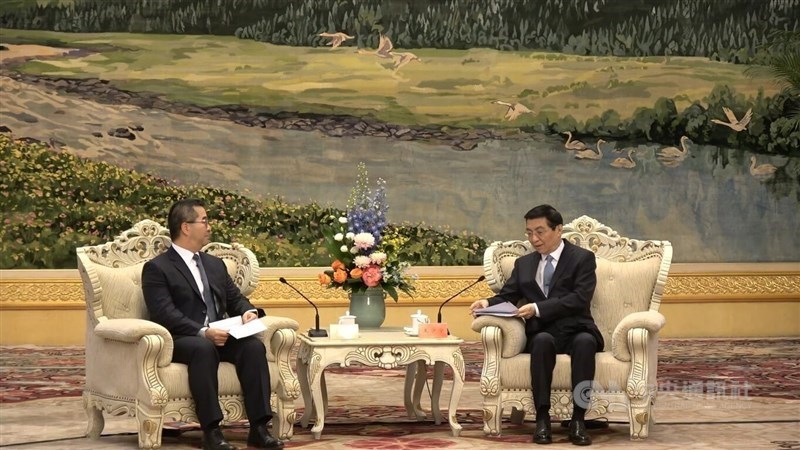
Taipei, Feb. 7 (CNA) The recently concluded forum between the Kuomintang (KMT) and the Chinese Communist Party (CCP) in Beijing aimed to reshape Washington's perception of its relationship with Taiwan ahead of a scheduled meeting between Donald Trump and Xi Jinping (習近平) in April, scholars said Friday.
The Feb. 3 forum saw the KMT and CCP reach 15 "joint recommendations" on cooperation in various fields, most notably a consensus to broaden industrial and academic exchanges in artificial intelligence (AI)-powered manufacturing and to build a "world-class AI innovation cluster."
The forum was the first of its kind since 2016, when then-KMT Chairwoman Hung Hsiu-chu (洪秀柱) met with Xi in Beijing.
Speaking at a Taipei press event, Hung Pu-chao (洪浦釗), former chief executive officer of Tunghai University's Center for Mainland China and Regional Development Research, argued that Washington was the forum's target audience.
Hung Pu-chao said that the timing of the forum and a Feb. 4 telephone call between Xi and Trump was no coincidence.
Citing a press release by China's state-run Xinhua News Agency, which quoted Xi as telling Trump that "the Taiwan question is the most important issue in China-U.S. relations," Hung Pu-chao argued that just as China sought to set the tone on Taiwan ahead of a possible Xi-Trump meeting, so too did the KMT-CCP forum.
"It was a tool to create an image that public opinion in Taiwan is pivoting, and that I [the CCP] am capable of making deals with Taiwan," Hung Pu-chao said.
Washington views Taiwan-U.S. relations as rooted in shared democratic values, but the forum sought to replace that perception with one in which "Taiwan can be traded," if the KMT returns to power in the 2028 presidential election, he said.
Tzeng Wei-feng (曾偉峯), an associate research fellow at National Chengchi University's Institute of International Relations, also noted that if the 15 recommendations reached at the forum were to be implemented, the KMT would first have to regain political power.
While Washington might not necessarily view the forum as reflective of mainstream public opinion in Taiwan, it is important that opinion polls be presented to Trump's aides, U.S. politicians and think tanks to counter China's narrative of Taiwan with the reality on the ground, Tzeng said.
Joseph Tsai (蔡榮祥), a political science professor at National Chung Cheng University, said AI is the lifeline of Taiwan, a leading manufacturer of advanced semiconductors.
It would be "ironic," Tsai said, if China were to attack Taiwan using advanced weapons systems developed through the proposed AI cooperation.
- Society
MOL stands by ban on migrant-paid recruitment fees despite petition
07/28/2026 06:31 PM - Business
U.S. dollar closes higher on Taipei forex market
07/28/2026 06:18 PM - Society
Sheep feed found to contain dioxin in Yunlin contamination case
07/28/2026 06:13 PM - Business
TSMC's Japan fab evacuates staff after strong earthquake
07/28/2026 05:51 PM - Society
COVID-19 wave in Taiwan expected to peak in early August: CDC
07/28/2026 05:46 PM