FEATURE/Amid obstacles, Taiwan businessman still seeking WWII tragedy closure
By Sean Lin, CNA staff reporter
World War II may have ended 80 years ago, but for businessman Hsu Shun-lung (許順隆), it continues to echo in Taiwan through a tragedy that has yet to be brought to a final resolution.
Hsu, a Taitung native who lives in Taipei, remains intent on recovering the remains of men who died on a remote mountain in eastern Taiwan trying to rescue freed prisoners of war killed in a plane crash there in 1945.
The dream remains in limbo, however, stalled by a lack of government support after initial interest, but Hsu has continued the fight, convinced that the rescuers who died are owed a proper burial.
WWII history
On Sept. 10, 1945, eight days after Japan formally surrendered at the end of World War II, 20 prisoners of war were headed for Manila on an American B-24 bomber that took off from Okinawa, excited that their wartime ordeal was finally over.
Joy quickly turned to tragedy, however, when the aircraft was caught in Typhoon Ursula and crashed into the 3,496 meter-high Sancha Mountain in eastern Taiwan, killing the five crew members and 11 American, five Australian, and four Dutch POWs on board.
The tragedy was compounded when the Japanese colonial government in Taiwan, in its final days, sent a 97-man search and rescue team up the remote mountain at the behest of the U.S. government to recover the remains and look for possible survivors.
But the team was stranded on the mountain on Sept. 30 when another powerful storm, Typhoon Jean, began lashing eastern Taiwan. Twenty-six members perished during the mission, many of whom froze to death.
According to historical accounts, of the 26 rescuers who died, nine were Japanese police and military police officers, 15 were Indigenous peoples (12 Amis, one Bunun, one Pinuyumayan and one Pingpu), one was of Hakka origin and one was Hoklo (Taiwanese).
The mission eventually succeeded in recovering the remains of 22 of the foreign victims and handing them over to the U.S. in November 1945. They were later cremated and buried, but the rescuers who died were left behind, except for select body parts.
Standing up for the dead
After learning of the history from a neighbor who happened to be a descendant of a deceased search team member, Hsu began in November 2024 to coordinate efforts to recover the remains of the deceased rescuers.
Part of that involved lobbying the government, which eventually paid dividends.
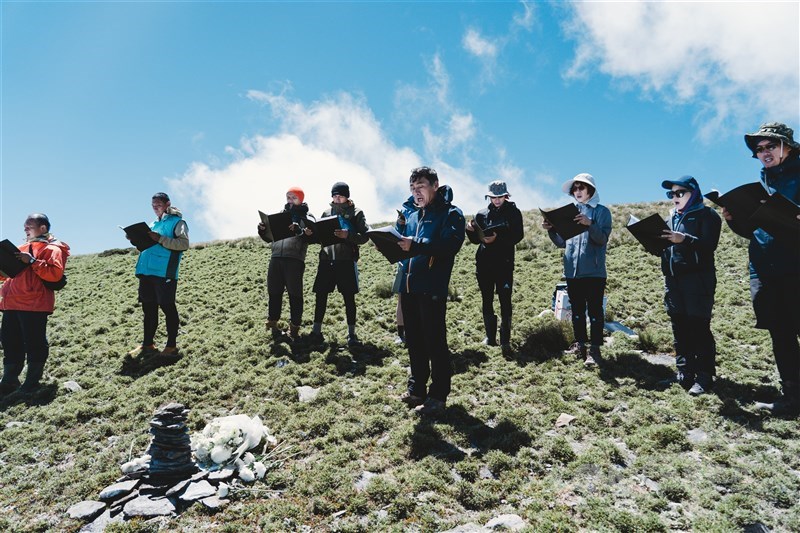
Among the events it held to mark the 80th anniversary of the end of World War II, Taiwan's government honored the humanitarian effort by sending a team to the mountain in June to perform a ritual and offer prayers for the deceased team members.
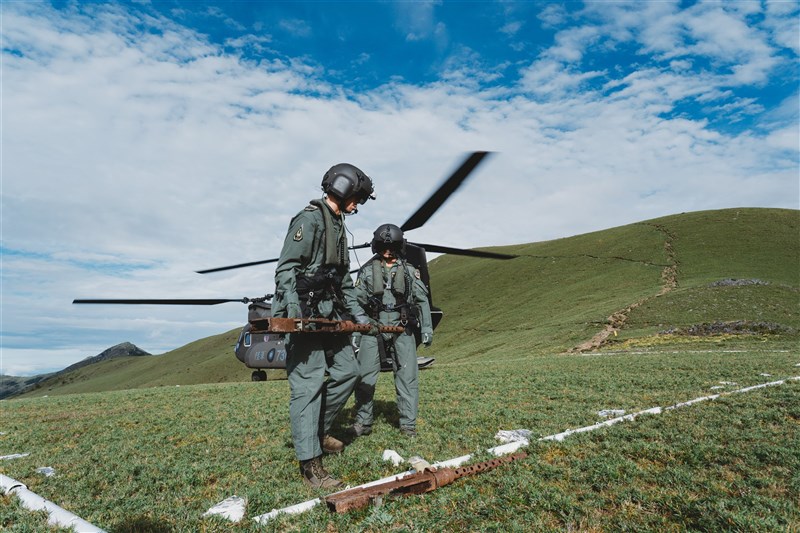
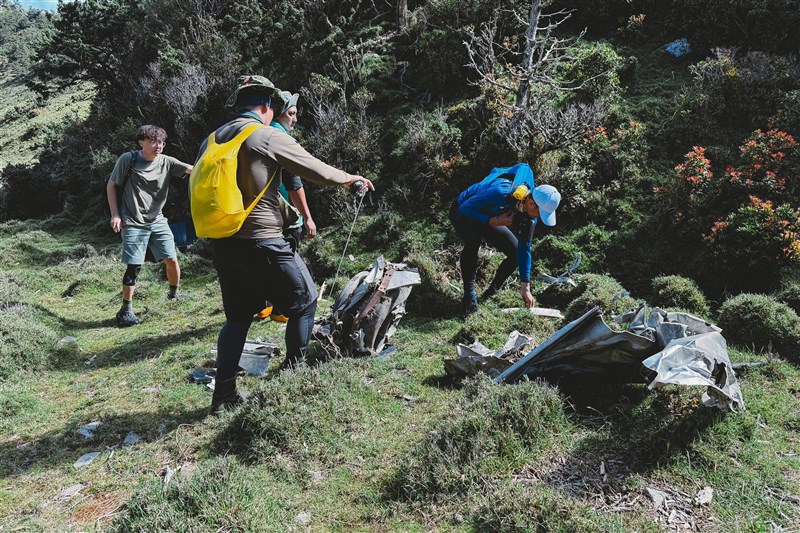
Then in September, the Ministry of National Defense sent a chopper to retrieve machine guns dislodged from the B-24 during the crash. The guns will be displayed at the National Military Museum, which is currently under construction in Taipei.
These actions were documented on film and shared by President Lai Ching-te (賴清德) on social media, with Lai also hailing the ill-fated mission as a transnational humanitarian rescue effort that serves as a reminder of the importance of resisting authoritarianism.
For Hsu, those actions were a start but not enough to honor the deceased rescuers, whose remains, Hsu believes, are still in pristine condition on Sancha Mountain.
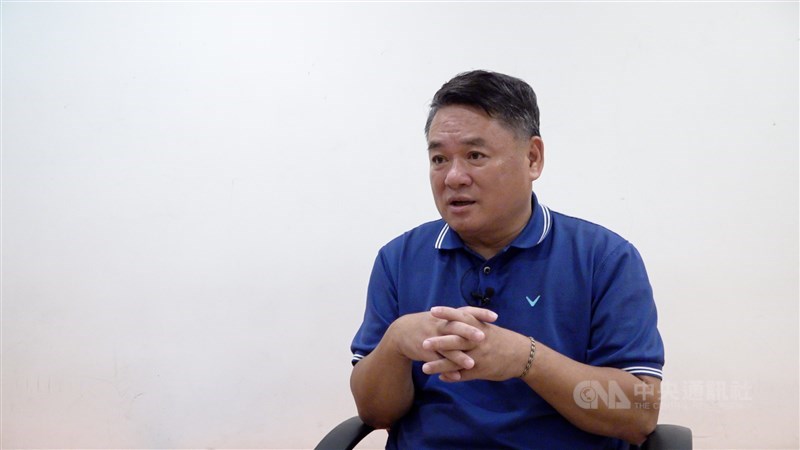
As he sees it, the Taiwanese rescuers embodied the kind nature of the Taiwanese people, given that the United States bombed Taiwan, then a Japanese colony, during World War II.
"The down-to-earth Taiwanese people didn't distinguish between 'you' and 'me.' They just had a single-minded focus to save lives," Hsu said.
"I hope that it will serve as a reminder of unity, of trying to achieve something together, in this turbulent world."
Will the government help?
To honor that spirit, Hsu wants to hold a ceremony where all five countries involved in the incident could be represented by relatives of the deceased, but organizing it requires government help.
"Because it involves five countries, it could take civilians three to five years to arrange with limited resources, but if the government steps in to help or take ownership, it would only take a matter of months," he said.
Hsu said that promoting the obscure humanitarian rescue effort could help raise Taiwan's international profile, but the government's interest in the incident seems to have waned, with no actions pursued since September.
A government spokesperson declined to comment when contacted by CNA about the prospect of an international commemorative ceremony.
That has not discouraged him from pursuing his primary goal -- to give the deceased rescuers a proper burial, Hsu said.
Looking for closure
For the bereaved families, meanwhile, recovering the remains is important but beyond their capabilities.
Li Kuang-hsiang (黎光祥), the grandson of deceased search team member Li Wei-chin (黎維錦), said the efforts mounted to date have fallen short of bringing peace to the deceased.
According to his relatives, Li said, the surviving members of the search and rescue team left the bodies of their dead colleagues behind due to the long journey back, choosing instead to cut their ears, noses and fingers and bring them back to their villages to be cremated.
Li Kuang-hsiang said the Japanese recruited his grandfather, the sole deceased Hakka, as a member of the search team because he "looked sturdy."
"My father still gets emotional when he talks about it ... because of how much it impacted his life," Li Kuang-hsiang said.
His father, who was only 2 years old at the time of the accident, ended up being brought up by his great-uncle, he said.
"The government should take further action so that bereaved families can have closure," he said.
Enditem/ls
![Extra time: The rise and fall of Taiwanese football]() Extra time: The rise and fall of Taiwanese footballFootball is the most popular sport in the world, but in Taiwan it struggles to command the attention enjoyed by other sports.06/12/2026 01:35 PM
Extra time: The rise and fall of Taiwanese footballFootball is the most popular sport in the world, but in Taiwan it struggles to command the attention enjoyed by other sports.06/12/2026 01:35 PM![Taiwan seeking way to coexist with bears as they come closer to humans]() Taiwan seeking way to coexist with bears as they come closer to humansFormosan black bear encounters with humans are on the rise in Taiwan as the animal's population expands to habitats at lower elevations, leaving public agencies scrambling to figure out how ways to prevent such encounters from becoming more frequent.05/29/2026 06:10 PM
Taiwan seeking way to coexist with bears as they come closer to humansFormosan black bear encounters with humans are on the rise in Taiwan as the animal's population expands to habitats at lower elevations, leaving public agencies scrambling to figure out how ways to prevent such encounters from becoming more frequent.05/29/2026 06:10 PM![Two years in, Lai faces new hurdles in overseas travel]() Two years in, Lai faces new hurdles in overseas travelBeijing is unlikely to again block an overseas trip by President Lai Ching-te (賴清德) as it did when he tried to visit Eswatini, but Lai may not secure a stopover in the contiguous United States anytime soon, analysts said at the halfway mark of Lai's first term in office.05/20/2026 05:57 PM
Two years in, Lai faces new hurdles in overseas travelBeijing is unlikely to again block an overseas trip by President Lai Ching-te (賴清德) as it did when he tried to visit Eswatini, but Lai may not secure a stopover in the contiguous United States anytime soon, analysts said at the halfway mark of Lai's first term in office.05/20/2026 05:57 PM
- Sports
Taiwan mixed team wins compound gold at Archery World Cup event
06/13/2026 07:39 PM - Politics
KMT official's 'shared heritage' pitch at China forum draws MAC rebuke
06/13/2026 07:16 PM - Culture
NTU forms AI governance group focused on access, shared resources
06/13/2026 06:24 PM - Society
Taiwan mangoes enter French market, targeting premium channels
06/13/2026 06:17 PM - Society
Over 1.3 million kidney disease tablets recalled over quality issues
06/13/2026 04:45 PM