PLA's exercises simulate blocking energy, foreign aid: U.S. institute

Washington, Jan. 2 (CNA) China's military drills around Taiwan earlier this week signaled potential strategies to cut the island off from energy supplies and foreign military assistance, according to a recent United States think tank report.
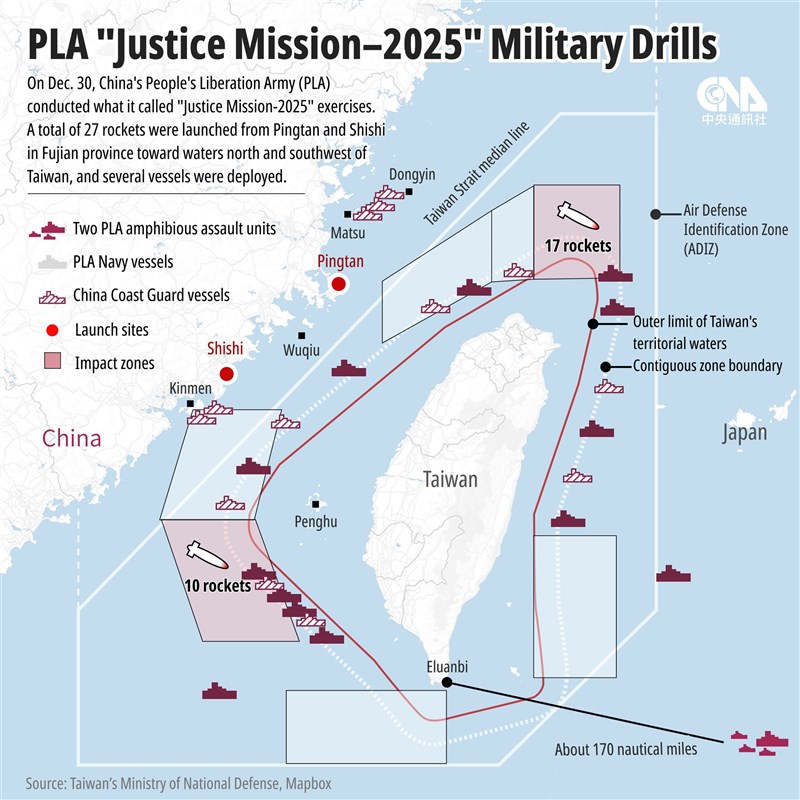
The People's Liberation Army (PLA) conducted what it called "Justice Mission-2025" exercises from Monday to Tuesday in five maritime zones and airspace around Taiwan, calling them a warning to "Taiwan independence" forces.
In a report released on Wednesday, the Institute for the Study of War said the exercises effectively simulated blocking shipping routes to "major port cities," including Kaohsiung, Keelung and Hualien.
Taiwan would be highly vulnerable under such a blockade because it relies "overwhelmingly" on energy imports, the institute said.
Nearly 96 percent of Taiwan's energy was imported in 2024, according to data from the Ministry of Economic Affairs' Energy Administration.
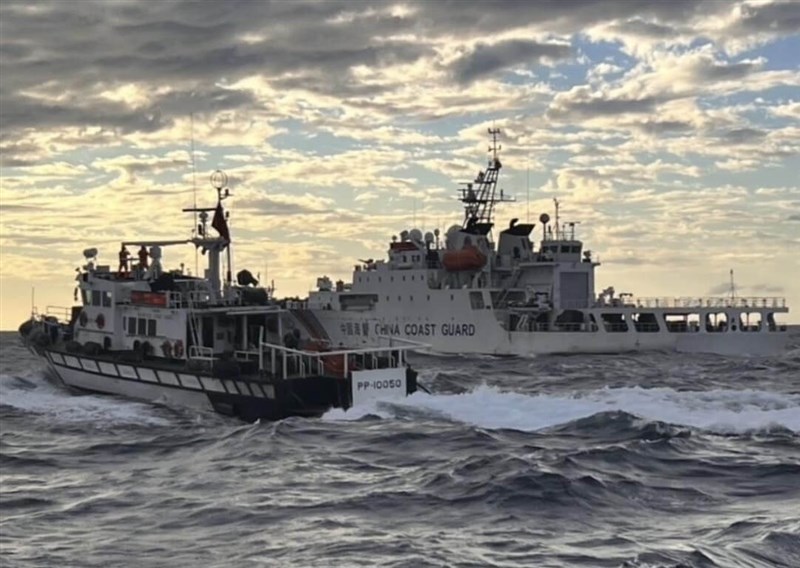
The drills also featured China Coast Guard vessels operating alongside PLA Navy ships, reflecting Beijing's strategy of combining civilian law-enforcement forces with military assets during a blockade.
The institute said China has used similar tactics in the South China Sea, with coast guard ships confronting foreign vessels directly while naval forces maintain an outer security perimeter.
In the event of a Taiwan blockade, the coast guard would likely intercept Taiwanese commercial and government vessels, while the navy would seek to deter foreign military intervention, the report said.
Additionally, it said the deployment of precision-strike, anti-submarine and anti-ship weapons suggested the PLA may have been practicing countering U.S. submarines and surface ships attempting to breach a blockade.
However, the absence of aircraft carriers indicated the drills may represent only one element of a "larger, multi-domain" effort to isolate Taiwan, according to the report.
Meanwhile, retired U.S. Navy Rear Adm. Mark Montgomery recently told CNA that the scale and intensity of the drills were likely a response to a US$11 billion U.S. foreign weapons sales package to Taiwan and recent comments by Japan's prime minister suggesting Japan could get involved in the event of a naval blockade by China against Taiwan.
Montgomery, now a senior fellow at the Foundation for Defense of Democracies, said Taiwan and the U.S. should ignore China's "public bullying" and continue arms sales to Taipei, to raise the cost of conflict for China.
-
Cross-Strait
MAC condemns retired officer's China trip, backs legal changes
04/26/2026 09:05 PM -
Society
Suspect ordered detained for attack on 3-year-old Filipino child
04/26/2026 06:47 PM -
Business
Taiwan drone exports top US$100 million in Q1: MOEA
04/26/2026 06:05 PM -
Politics
Lai thanks Eswatini in video address for its support of Taiwan
04/26/2026 04:48 PM -
Society
Rockslide damages Suhua Highway tunnel; traffic limited to one lane
04/26/2026 02:39 PM