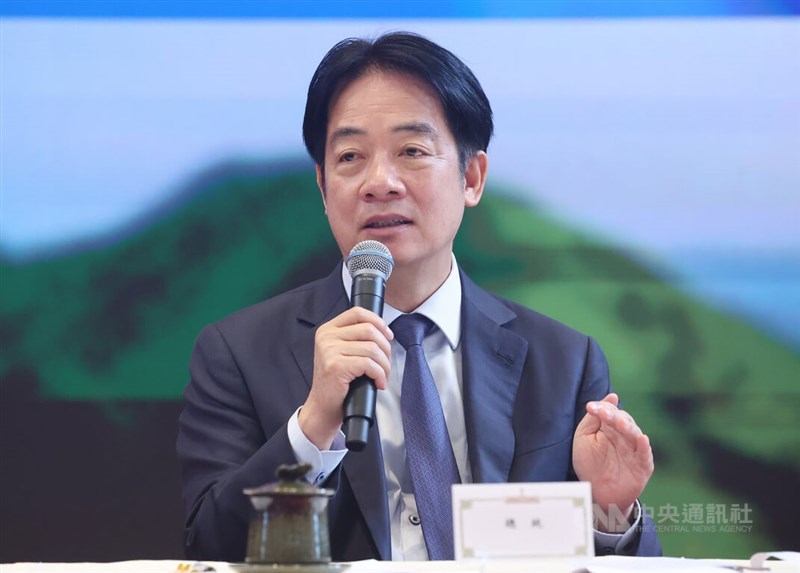
Taipei, Feb. 13 (CNA) President Lai Ching-te (賴清德) on Friday highlighted the benefits of a trade agreement reached between Taiwan and the United States, including securing equal tariff rates with Taiwan's major trade competitors and strengthening integration into the global market.
Speaking at a news conference at the Presidential Office in Taipei, following the signing of the Agreement on Reciprocal Trade (ART) in Washington, D.C., Lai said the deal would bring "significant benefits for Taiwan's industries and its overall economy."
Under the agreement, U.S. tariffs on Taiwanese goods will be lowered from the previously imposed 20 percent to 15 percent -- the same rate applied to Japan, South Korea and the European Union -- and there will be no stacking of tariffs on goods eligible for most-favored-nation (MFN) treatment, Lai said.
In addition, 2,072 types of Taiwanese exports will be exempt from reciprocal tariffs, including 261 agricultural products, such as orchids, tea, pineapples, and mangoes, and 1,811 industrial products, he said.
Taiwanese semiconductors have also secured the most favorable treatment under Section 232 of the Trade Expansion Act, he added.
Lai said the agreement would help Taiwan compete on an equal footing with its major competitors and eliminate disadvantages stemming from the lack of a free trade agreement with the U.S.
The deal, however, still requires approval from the opposition-controlled Legislature.
Meanwhile, Taiwan will expand its market access to U.S. pork and beef by adjusting ractopamine residue limits to align with Codex and other international standards, Lai said.
The president said this change, along with aligning regulations on trade, digital commerce, intellectual property, labor and environmental standards with international practices, would enhance Taiwan's trade competitiveness.
Asked why the government agreed to open the local market to 15 U.S. pork products, Lai said his administration only lifted import restrictions on agricultural products that Taiwan does not produce, or where domestic producers have a clear comparative advantage, and only when consumer health would not be affected.
Speaking of Taiwan's agreement to eliminate tariffs on passenger vehicles imported from the U.S., Economics Minister Kung Ming-hsin (龔明鑫) said Taiwan faced "strong demands" on this issue during the trade talks and that Taiwan, along with Japan and South Korea, was compelled to make concessions.
However, Taiwan's negotiating team successfully excluded U.S. light trucks from the agreement, thereby reducing the impact on domestic automakers, he said at the same news conference.
Kung added that locally manufactured passenger vehicles are generally more affordable than imported models, and, with tariffs on U.S.-exported auto parts used by domestic manufacturers set to be waived, local automakers could benefit from the expected cost reductions.
- Society
More camellia oil batches fail carcinogen test; sales suspended
07/27/2026 08:57 PM - Politics
Concerns over Chinese sea operations raised with Beijing, Taiwan says
07/27/2026 08:46 PM - Culture
Yu Kan-ping to receive Golden Horse lifetime achievement award
07/27/2026 08:38 PM - Business
Economic monitoring indicators stay red for 7th straight month
07/27/2026 08:18 PM - Society
TFDA releases findings on Central Union cooking oil contamination
07/27/2026 05:59 PM