Taipei, Jan. 26 (CNA) Taiwanese companies will have to increase their foreign direct investments given the limited availability of land in Taiwan and growing external demand, the president of Taiwan Institute of Economic Research (TIER) said Monday.
Chang Chien-yi (張建一) made the remarks at a press event in Taipei for the January domestic economic forecast, when asked about the potential domestic impact of a tentative United States-Taiwan trade agreement.
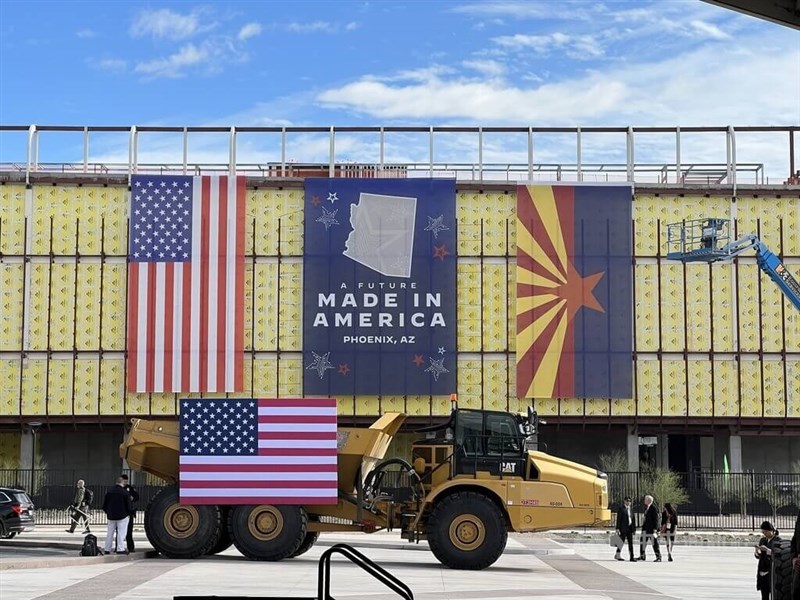
According to a memorandum of understanding reached during trade talks, Taiwan's semiconductor and technology companies will invest at least US$250 billion in the U.S., while a 15 percent levy will be imposed on Taiwanese goods -- the same rate that applies to Taiwan's main competitors South Korea and Japan, as well as to the European Union.
"Regardless of tariffs, these companies would not necessarily invest in Taiwan, as limited land availability remains a constraint on domestic investment," Chang said on Monday. "After all, we are not going to have a TSMC facility in Taipei's Xinyi District."
He denied reports that Taiwan's government asked domestic companies such as TSMC, the world-leading advanced chipmaker, to invest in the U.S., and that such a move would hollow out Taiwan's economy.
Despite U.S. Commerce Secretary Howard Lutnick's remark that Washington seeks to bring 40 percent of Taiwan's semiconductor supply chain to the U.S. by the end of Donald Trump's second presidential term, Chang said it is estimated that at least 75-80 percent would remain in Taiwan in 2030.
Citing TSMC Chairman C.C. Wei (魏哲家), Chang said TSMC's investments in the U.S. are driven primarily by customer demand.
According to Taiwan's Ministry of Finance, 30.9 percent of Taiwan's exports went to the U.S. in 2025, accounting for the largest percentage of any single country. This is the first time the U.S. has surpassed China (including Hong Kong) to become Taiwan's largest market abroad.
The recent tentative U.S. tariff arrangement was a "good" development, Chang said, adding that one particularly positive aspect was the most favorable treatment granted for semiconductors and related products, under Section 232 of the U.S. Trade Expansion Act.
However, the formal U.S.-Taiwan trade pact expected to be signed in the coming weeks will most likely be more controversial, as it aims to open Taiwan's market to American goods, including vehicles and agricultural products.
Such a move would benefit Taiwanese consumers but pose challenges to some local companies, Chang said.
Political uncertainty remains the biggest variable, he said, as the Kuomintang and the Taiwan People's Party -- the two main opposition parties that together hold a majority of seats in the Legislature -- have expressed skepticism about the agreement and the pending trade pact.
If the trade agreement fails to pass the Legislature, there is no telling whether the U.S. would raise its tariffs on Taiwan again, Chang said, urging the Legislature to work toward a consensus with domestic industries.
"That is the only way for us to navigate the challenges ahead amid an ever-changing geopolitical landscape," he said.
-
Society
Man arrested after attempted bank robbery using BB gun, fake grenade
04/24/2026 09:32 PM -
Culture
3 generations of Kyogen masters present 3/11 tribute work in Kaohsiung
04/24/2026 08:47 PM -
Business
Newly employed graduates earn NT$39,000 on average in 2025: Ministry
04/24/2026 08:35 PM -
Society
Taiwan groups donate 68 emergency vehicles to Ukraine
04/24/2026 08:30 PM -
Culture
Exhibition tracing a century of surrealism to open in Taipei Saturday
04/24/2026 07:14 PM