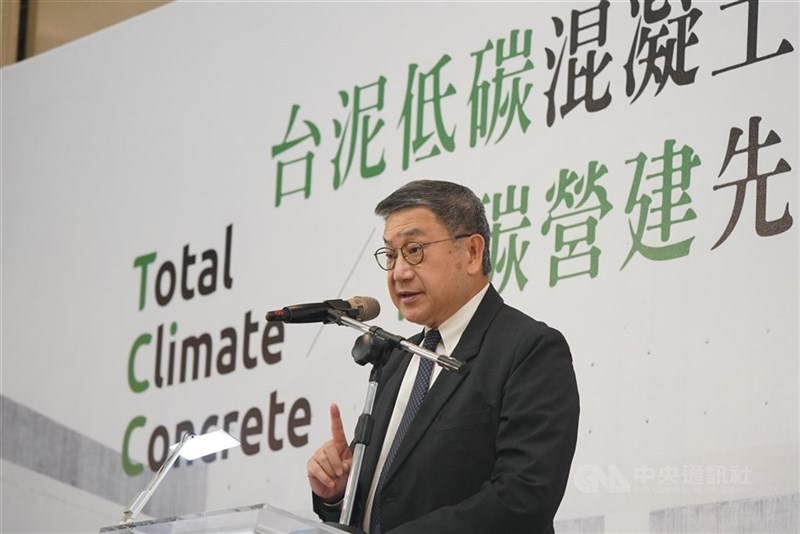
Taipei, Dec. 17 (CNA) Taiwan Cement Corp. (TCC) Chairman Nelson Chang (張安平) on Wednesday urged curbs on cement imports, warning that otherwise Taiwan runs the risk of becoming a dumping ground for overseas excess capacity, undermining the domestic cement industry and threatening tens of thousands of jobs.
Chang said he strongly agreed with Environment Minister Peng Chi-ming's (彭啟明) call to reduce reliance on imported cement, stressing that the issue extends beyond environmental protection and carbon reduction.
In a statement issued by TCC, Chang said that if Taiwan becomes a destination for surplus foreign production, the local cement industry and its workforce will be adversely impacted.
Citing Ministry of Finance customs import pricing and domestic sales data, TCC said that super low-priced cement imported from countries including Vietnam, Indonesia and Japan showed clear signs of dumping.
Based on a comparison covering the second half of 2024 through the first half of 2025, Japanese cement was sold domestically at about NT$3,800 (US$120) per metric ton, while exports to Taiwan were priced at just NT$1,400 per ton, or NT$2,400 less, representing a dumping margin of up to 106 percent, the company said.
Indonesian cement clinker sold domestically at around NT$1,200 per ton, but exports to Taiwan were priced at only NT$680, nearly half the local price, TCC added.
The company also said that despite the government's imposition of anti-dumping duties on Vietnamese cement in July to curb unfair trade practices, import prices continued to fall.
According to customs data cited by TCC, the price of Vietnamese cement dropped 15 percent after the duties took effect, while clinker prices fell 22 percent.
Indonesian suppliers followed with a 5 percent price cut, further widening the price gap, which previously ranged from NT$500 to NT$700 per ton.
Chang said Taiwan continues to maintain zero tariffs on imported cement, calling the policy neither reciprocal nor fair to domestic producers.
Turning to environmental oversight, Chang said that as the government prepares to introduce new carbon footprint reporting requirements, stricter controls are needed on cement used in public construction projects.
He called for enforceable, traceable single-source material requirements to prevent the mixing of imported cement, saying this is important for construction quality and structural safety, as well as to avoid unnecessary environmental impacts.
Chang also said imported cement should be required to meet internationally recognized carbon footprint standards and undergo third-party verification, noting that some overseas producers use net emissions calculations, while Taiwanese producers follow stricter gross emissions standards.
TCC said its Heping plant in Hualien and Suao plant in Yilan have invested in facility upgrades to process industrial waste from multiple sectors, including semiconductors, converting waste into alternative raw materials and fuels, responsibilities that imported cement suppliers do not share, the company said.
-
Politics
Minister declines to set targets for birth rate proposals
05/28/2026 08:41 PM -
Politics
Over 85% in Taiwan support cross-strait peace as top priority: MAC
05/28/2026 08:00 PM -
Society
Rain forecast for northern, central Taiwan from Thursday night
05/28/2026 07:52 PM -
Business
Taiwan's economic monitoring indicator stays red in April on strong AI demand
05/28/2026 07:01 PM -
Business
Keelung-Ishigaki ferry to make maiden voyage Thursday
05/28/2026 06:42 PM