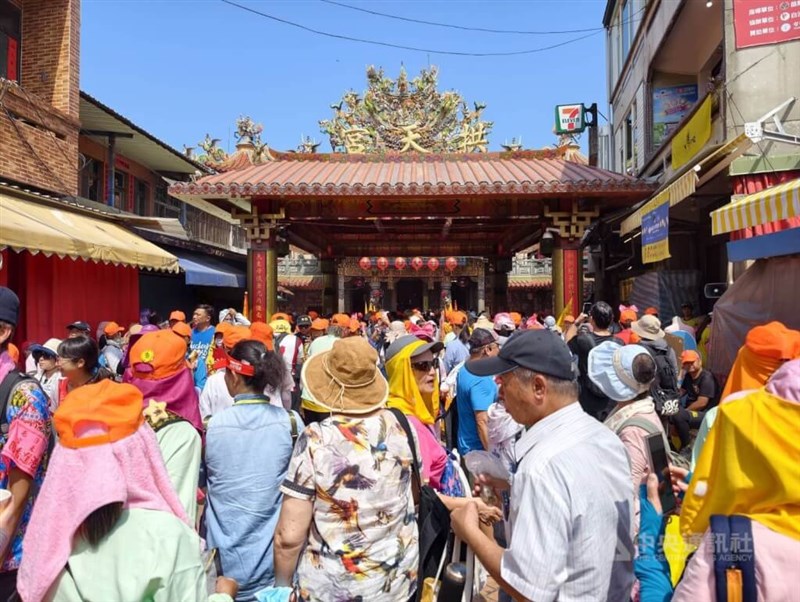
Taipei, July 26 (CNA) Baishatun Gongtian Temple in Miaoli County has become the first temple in Taiwan to offer visitors the option of offsetting their carbon emissions through the retirement of Gold Standard (GS) carbon credits.
In a news release Sunday, the Tourism Innovation Association of Taiwan (TIATW) said that the average visitor to the Mazu temple generated about 0.04 kilograms of carbon dioxide equivalent (CO2e), according to research by National Taiwan University's Huang Wen-hung (黃文弘) verified by the Sustainable Tourism Research Center at the Taipei City University of Science and Technology.
Under the new scheme, government agencies, businesses, schools, organizations and religious groups visiting the temple for worship, company outings, or cultural tours can apply to retire carbon credits based on the number of participants.
To offset unavoidable emissions, participants purchase carbon credits equivalent to their remaining carbon footprint and retire them, TIATW Chairman Lee Chi-yueh (李奇嶽) told CNA.
TIATW has also partnered with the Miaoli County government's Culture and Tourism Bureau to develop three travel itineraries centered on Gongtian Temple that have likewise obtained carbon credit retirement certification.
The itineraries follow the "ARO" approach: avoid unnecessary travel or high-emission activities by optimizing itineraries, reduce emissions through measures such as using public transportation, local food and environmentally friendly accommodations, and offset any remaining emissions by purchasing and retiring carbon credits, according to TIATW.
The itineraries include attractions such as the Xihuxi Bicycle Iron Bridge, the Taiyen Tongxiao Tourism Factory, Houlong Cape of Good Hope, Guogang Tunnel and Shuiwei Community, combining religious, coastal, industrial, railway and community experiences.
Lee said travel products that complete carbon footprint assessments, third-party verification and carbon credit retirement can provide businesses with traceable carbon emissions data from corporate travel, helping strengthen their green procurement practices and environmental, social and governance (ESG) performance.
- Sports
Taiwan boosts medal haul in multiple events at Asian Games on Friday
10/02/2026 08:55 PM - Society
Workers at Taiwan snack maker Kuai Kuai extend strike over relocation
10/02/2026 08:45 PM - Business
Chain businesses association seeks more foreign workers
10/02/2026 08:04 PM - Politics
Shen unveils Taipei education platform, Chiang defends free lunches
10/02/2026 06:45 PM - Politics
Taiwan receives first 2 F-16V Block 70s (update)
10/02/2026 06:39 PM