EXPLAINER/Legal rights, safety resources for domestic violence survivors in Taiwan

Taipei, May 31 (CNA) For many foreign residents in Taiwan, escaping an abusive home can feel like an impossible choice, as fears of losing residency or custody of their children weigh heavily, while the language barrier can compound the sense of isolation and uncertainty about where to seek help.
The legal architecture and social safety net in Taiwan provide these individuals with essential protections.
From emergency shelters and multilingual hotlines to immigration rules that safeguard residency, survivors of domestic violence have access to mechanisms designed to help them secure safety, stability, and a path to rebuilding their lives.
Here is an explainer on how the system works.
Q: Does divorce due to domestic violence lead to deportation?
A: Foreign victims of domestic violence can retain their residency in Taiwan after divorce, regardless of whether they have children. To change their residency status on their Alien Resident Certificate (ARC), they must provide a police report.
The protections are guaranteed under Article 31 of the Immigration Act, National Immigration Agency's (NIA) Senior Executive Officer Lee Ming-fang (李明芳) told CNA.
Before amendments to the Immigration Act, including to Article 31, took effect in 2024, survivors were generally required to have minor children and a court-certified divorce in order to remain in Taiwan, with exceptions granted on a case-by-case basis, the NIA said.
Q: How can domestic violence survivors extend their residency in Taiwan?
A: During divorce proceedings, foreign spouses can apply for an extension of their ARC by providing proof of marriage, such as a household registration transcript or a protection order. If such documents are unavailable, the NIA may verify the individual's status through internal records to allow continued legal residency.
After the divorce is finalized, a police report can be used to change residency status from "dependency" -- based on a spouse or family member -- to "other reasons." This status is typically valid for one year. It can be renewed indefinitely and may later be adjusted if circumstances change, such as securing employment or remarriage.
Application timelines vary depending on nationality. Applicants from China and other countries must apply for an extension at least three months before their ARC expires, while those from Hong Kong and Macau must apply at least 30 days in advance.
After five years of legal residency, survivors can apply for permanent residency, or an Alien Permanent Resident Certificate (APRC), without meeting standard financial requirements, such as proving assets of NT$5 million (US$156,200) or an income equivalent to twice the minimum wage, which is NT$29,500 per month.
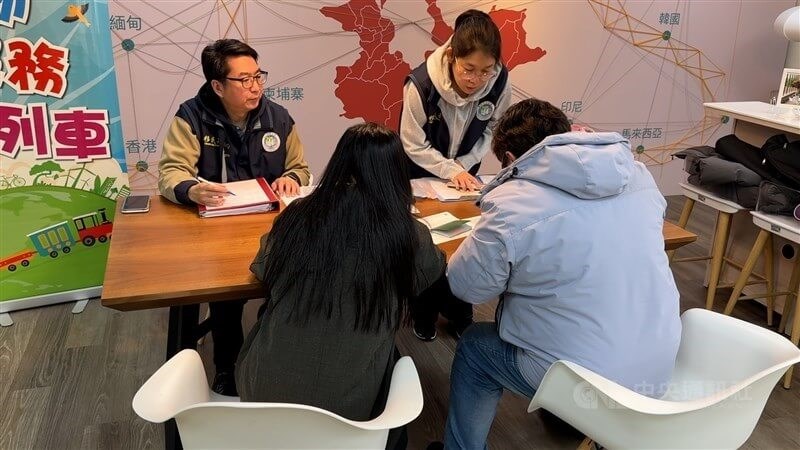
Q: How can cases of domestic violence be reported?
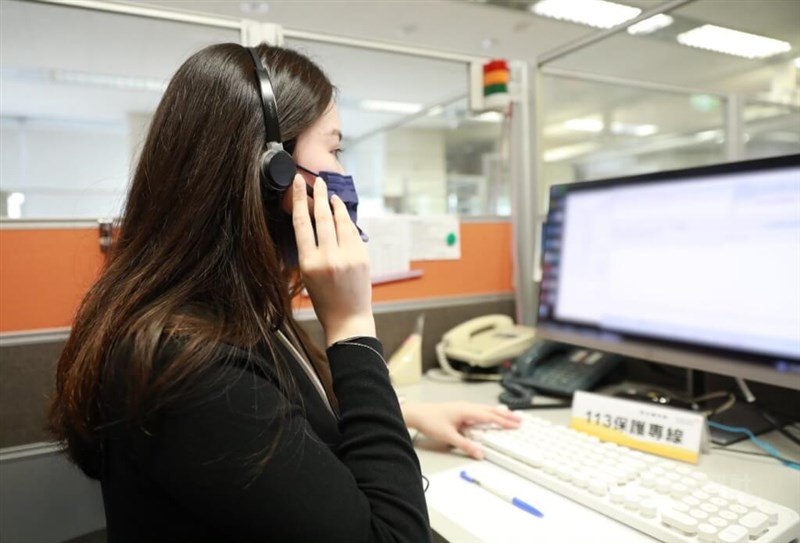
A: In emergencies, individuals are advised to call 110 for police assistance. For non-emergencies, cases can be reported through the Ministry of Health and Welfare's (MOHW) 113 Protection Hotline. The hotline serves as a centralized intake system and refers cases to local authorities for follow-up.
The 113 hotline provides 24/7 multilingual services for foreign nationals, according to Kuo Tsai-jung (郭彩榕), director-general of the MOHW's Department of Protective Services.
The service offers translation in English, Vietnamese, Indonesian, Thai and Japanese, and is available via online chat and SMS, Kuo said.
Q: How are domestic violence cases processed?
A: Under Taiwanese law, professionals, including medical personnel, social workers, police officers, educators and immigration officials, are required to report suspected domestic violence cases encountered in the course of their duties within 24 hours.
Once a case is reported to local authorities, a designated social worker serves as the primary point of contact, coordinating support services, including shelter placement, translation and other assistance, based on the victim's needs.
Q: What resources are available to domestic violence victims?
A: Taiwan's Domestic Violence Prevention Act requires local governments to establish prevention centers that provide a range of services such as emergency assistance, shelter, legal aid, psychological counseling, and vocational training.
These services are delivered through coordination among government agencies, in cooperation with nongovernmental organizations (NGOs), forming a broad safety net for victims.
NGOs have noted that the scope of support can vary by region, as local governments adjust programs based on budget and cost-of-living considerations. However, Kuo said all local authorities must operate under ministry guidelines and oversight.
For example, shelter stays range from short-term emergency accommodation of up to three months to mid- and long-term housing of up to two years. Where capacity is limited, local governments may instead provide rental subsidies.
Q: How can domestic violence survivors obtain medical injury reports?
A: Domestic violence survivors seeking medical injury reports should visit hospitals equipped to conduct examinations, as smaller clinics may lack the necessary facilities. Both public and private hospitals can provide these services.
Medical reports and receipts should be submitted to local governments to apply for subsidies that are not covered by national health insurance, according to the MOHW.
Kuo said people can still seek medical treatment even if their national health insurance card has been suspended.
Tu Ying-chiu (杜瑛秋), CEO of the Taipei Women's Rescue Foundation, urges survivors to disclose domestic violence during medical examinations so the authorities can assess the abuse, report the case, and provide necessary intervention.
Q: What should survivors know about divorce and custody lawsuits?
A: According to Legal Aid Foundation attorney Yen Yi-hua (嚴怡華), if mediation fails to resolve divorce or custody disputes, the case proceeds to court. A first trial typically takes about one year. If the case is appealed, the process may be further prolonged.
Yen advises survivors to preserve digital evidence such as LINE messages, photos and recordings stored on their phones, as these are commonly used in legal proceedings.
In custody cases, Yen said judges consider the "best interests of the child," including the child's wishes, the established caregiving environment, and their emotional and physical well-being, rather than financial capacity alone.
If an individual is coerced or misled into signing an agreement waiving custody rights, that individual can ask the court to invalidate it, Yen said, noting that before divorce, parents generally share joint custody by default.
Eligibility for pro bono legal representation via the Legal Aid Foundation is subject to a financial means test.
Q: What is a protection order and how does it work?
A: A protection order is a court order designed to protect victims of domestic violence, according to Yen.
There are three main types of protection orders. Courts can issue an Emergency Protection Order within four hours in cases of immediate danger. Ordinary Protection Orders are valid for two years and require a court hearing, while Temporary Protection Orders may be granted while a case is under review to provide interim protection.
A protection order sets legally binding restrictions on the respondent -- including limits on contact and specific prohibited actions -- and serves as a key deterrent to further abuse, as violations carry criminal penalties, Yen said.
Q: Where can victims find support resources?
A: The following websites and hotlines provide support and resources for victims of domestic violence in Taiwan:
• Social Safety Net -- ecare / 113 Online Counseling Service
An online reporting and consultation system linked to the 113 Protection Hotline.
• National Immigration Agency portal
Provides support for foreign nationals, including service center locations, the 1990 consultation hotline, and resources for daily life and integration.
• Foreigners In Taiwan Hotline 1990
Offers multilingual assistance: Chinese, English and Japanese services are available 24/7, while Vietnamese, Indonesian, Thai and Cambodian services are available Monday to Friday, 9 a.m. to 5 p.m. (excluding national holidays).
• Court-based Domestic Violence Service Centers (Chinese) Directory of court-based support services.
• NGOs supporting domestic violence survivors:
• The Garden of Hope Foundation
• Taipei Women's Rescue Foundation
(By Shih Hsiu-chuan)
Enditem/AW
![What to know about Taiwan's 1st mobile internet disruption drill]() What to know about Taiwan's 1st mobile internet disruption drillFor the first time, the nationwide Urban Resilience Exercises and air raid drills on Aug. 10 and 13 will include a simulation of a major slowdown in mobile internet speeds in 14 cities and counties across northern and central Taiwan.07/21/2026 03:29 PM
What to know about Taiwan's 1st mobile internet disruption drillFor the first time, the nationwide Urban Resilience Exercises and air raid drills on Aug. 10 and 13 will include a simulation of a major slowdown in mobile internet speeds in 14 cities and counties across northern and central Taiwan.07/21/2026 03:29 PM![What is Taiwan's tainted cooking oil scandal?]() What is Taiwan's tainted cooking oil scandal?Hundreds of food products have been recalled after excessive levels of the carcinogen benzo[a]pyrene (BaP) were found in cooking oil produced by Central Union Oil Corp. Here is what happened and what it means.07/14/2026 06:47 PM
What is Taiwan's tainted cooking oil scandal?Hundreds of food products have been recalled after excessive levels of the carcinogen benzo[a]pyrene (BaP) were found in cooking oil produced by Central Union Oil Corp. Here is what happened and what it means.07/14/2026 06:47 PM![The Legislature's motion to impeach President Lai Ching-te]() The Legislature's motion to impeach President Lai Ching-teTaiwan's opposition-controlled Legislative Yuan will vote Tuesday in a rare but largely symbolic motion to impeach President Lai Ching-te (賴清德).05/17/2026 03:14 PM
The Legislature's motion to impeach President Lai Ching-teTaiwan's opposition-controlled Legislative Yuan will vote Tuesday in a rare but largely symbolic motion to impeach President Lai Ching-te (賴清德).05/17/2026 03:14 PM


- Sports
Taiwan falls to Japan 7-3, to play China for Asian Games baseball bronze
09/26/2026 09:41 PM - Politics
Marshall Islands, Tuvalu voice support for Taiwan at U.N. assembly
09/26/2026 07:59 PM - Sports
Taiwan's Kuo wins Asian Games esports bronze in Puyo Puyo Champions
09/26/2026 07:33 PM - Business
CPC to keep domestic gasoline, diesel prices unchanged next week
09/26/2026 06:01 PM - Politics
White House fact sheet omits Taiwan in Xi-Trump talks
09/26/2026 05:53 PM