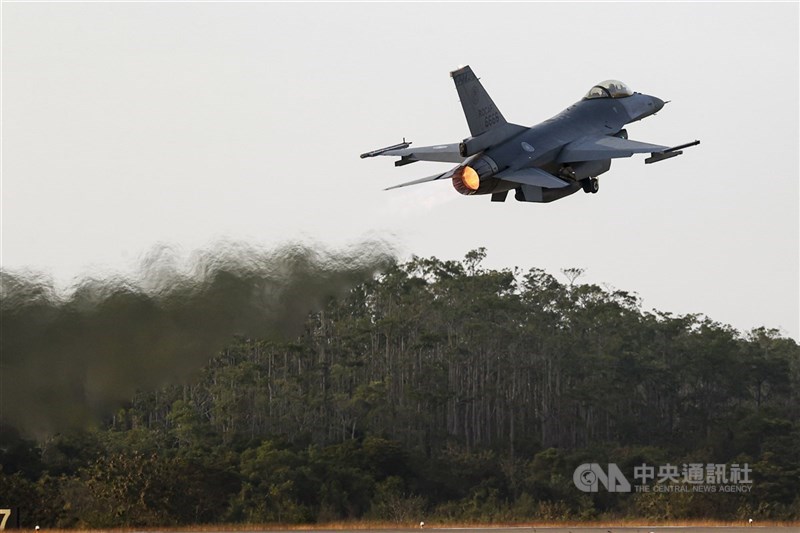
Taipei, July 23 (CNA) The Control Yuan on Thursday proposed corrective measures against the Air Force, citing serious shortcomings in risk management and maintenance procedures related to a January training accident that killed F-16V pilot Hsin Po-yi (辛柏毅).
Hsin's fighter jet crashed during a nighttime training mission off eastern Taiwan in January. Search and rescue operations were unsuccessful, and his body was never recovered.
In a news release, Control Yuan members Yeh Yi-jin (葉宜津) and Lai Ting-ming (賴鼎銘) said that although analysis of the aircraft's flight data recorder, or "black box," was not yet complete, available evidence showed repeated navigation-system malfunctions in the week leading up to the accident.
While Air Force maintenance personnel completed troubleshooting procedures and the aircraft passed safety checks, the investigators concluded that the military failed to adequately assess and control the risks associated with conducting a nighttime flight under those circumstances.
The investigation also found multiple violations of maintenance regulations, including failing to complete maintenance records and improperly preserving evidence related to the crash, warranting the corrective measures.
According to available records, Hsin switched to visual formation flying after the aircraft's navigation system malfunctioned. He later became separated from the lead aircraft while flying through clouds, suffered spatial disorientation and ultimately crashed.
The members of the top government watchdog body also cited a December 2023 F-16 accident at the U.S. Air Force's Kunsan Air Base in South Korea, in which a pilot safely ejected shortly after experiencing a navigation-system malfunction.
They said the U.S. military's "leave no one behind" culture emphasizes conservative flight dispatch decisions, rigorous maintenance practices and prompt ejection in emergencies, supported by confidence that every effort will be made to rescue downed pilots.
They said Taiwan's Air Force should create a similar safety culture to protect both pilots and aircraft.
The Control Yuan also addressed two issues that had drawn public attention following the crash: cold-weather flight suits and the aircraft's Automatic Ground Collision Avoidance System (Auto GCAS).
The investigators said Hsin had been issued a cold-weather flight suit and that water temperatures at the time did not make the equipment necessary. They also noted that the suit would only have been effective had the pilot successfully ejected. As a result, they found no misconduct by the Air Force regarding the flight suit.
Regarding Auto GCAS, the investigators said records showed technical challenges remained with the system's implementation. Although the technology would not have directly addressed a navigation-system failure, they urged the Air Force to press its U.S. modernization partners to accelerate related work to improve the safety of Taiwan's F-16 fleet.
In response, Air Force Command said it respected the Control Yuan's proposals and had already begun reviewing its shortcomings, including nighttime flight risk management, maintenance procedures, flight simulator training and policies on post-travel recovery time for aircrews.
The command said the crash remains under investigation by a dedicated task force. Meanwhile, it is strengthening personnel training, enhancing oversight of maintenance quality, introducing a flight safety management system and continuing to urge its U.S. partners to accelerate the implementation of the Auto GCAS.
Hsin, 29, took off from Hualien Air Base at 6:17 p.m. on Jan. 16 for the training mission. At 7:27 p.m., he reported that he had become separated from the lead aircraft before the jet rapidly lost altitude. He radioed that he was preparing to eject shortly before the aircraft disappeared from radar at around 7:28 p.m.
Hsin was posthumously promoted from captain to major, awarded the Order of Loyalty and Valor, and honored with a presidential citation presented by President Lai Ching-te (賴清德), who attended his funeral on July 19.
Under the Control Act, the Control Yuan may propose corrective measures to the Executive Yuan or its subordinate agencies after identifying deficiencies in their operations or administration through an investigation.
Agencies receiving such proposals are required to promptly implement improvements or take appropriate action and report back to the Control Yuan within two months in a written document.
- Sports
Taiwan boosts medal haul in multiple events at Asian Games on Friday
10/02/2026 08:55 PM - Society
Workers at Taiwan snack maker Kuai Kuai extend strike over relocation
10/02/2026 08:45 PM - Business
Chain businesses association seeks more foreign workers
10/02/2026 08:04 PM - Politics
Shen unveils Taipei education platform, Chiang defends free lunches
10/02/2026 06:45 PM - Politics
Taiwan receives first 2 F-16V Block 70s (update)
10/02/2026 06:39 PM