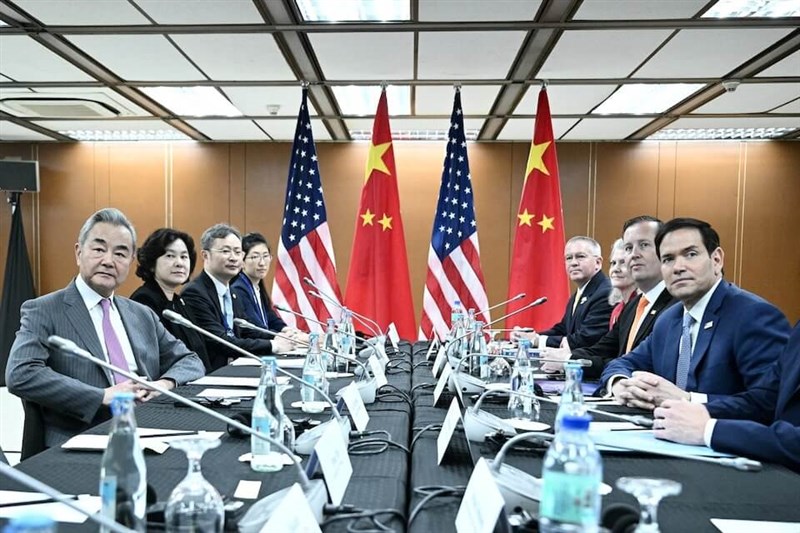
Taipei, July 23 (CNA) The United States has made clear to Beijing its opposition to China's recent deployment of coast guard vessels to waters near Taiwan, as Washington believes the operations undermine regional stability, U.S. Secretary of State Marco Rubio said Wednesday.
"It [the issue] always comes up in every one of our meetings because we obviously disagree with those actions. And we actually think that they run contrary to the spirit of what we're trying to work out with them with regards to strategic stability," Rubio told reporters during a press event in Manila on Wednesday.
Rubio made the remarks when asked whether he had raised the issue during his meeting earlier that day with Chinese Foreign Minister Wang Yi (王毅) on the sidelines of the ASEAN summit.
During Wednesday's press event, Rubio reiterated the United States' long-standing position on freedom of navigation, saying Washington will never accept that "international waterways are somehow under the control of other countries."
Rubio said the issue highlighted ongoing policy differences between Washington and Beijing.
"Those need to be managed very carefully because obviously a conflict, be it economic or otherwise, between the U.S. and China would have a dramatic global impact."
Starting in June, China launched a series of "special maritime law enforcement operations" in waters east of Taiwan in response to what it described as unilateral moves by Japan and the Philippines to begin talks on maritime boundary delimitation in the area.
China, which views Taiwan as part of its territory, said the talks seriously infringed upon its territorial sovereignty and maritime rights.
According to Taiwan's Coast Guard Administration, Chinese coast guard and other official vessels have in recent weeks operated in waters east of Taiwan and around Taiwan-controlled islands in the South China Sea, and even broadcast radio messages to passing merchant ships telling them to leave the area.
In addition to the United States, the de facto embassies of the United Kingdom, Germany and France in Taiwan jointly expressed concern on June 24 over China's "special maritime law enforcement operations" in waters east of Taiwan, saying the actions threatened regional stability.
"We reiterate our opposition to any unilateral change to the status quo, particularly by threat or use of force or coercion. It is fundamental that all navigational rights and freedoms and the safety of seafarers and vessels are guaranteed and respected," the statement said.
Meanwhile, Rubio said his meeting with Wang focused primarily on laying the groundwork for Chinese President Xi Jinping's planned visit to Washington in September.
China's state-run Xinhua News Agency reported Wednesday that both Wang and Rubio viewed the meeting as "practical, positive and constructive."
"They agreed to give play to the role of political and diplomatic channels, make good preparations for the next stage of China-U.S. high-level exchanges, and advance substantive progress in building a constructive China-U.S. relationship of strategic stability," Xinhua reported.
Rubio is on a four-day visit to Manila from Sunday through Thursday to attend the ASEAN Foreign Ministers' Meeting, the East Asia Summit and the ASEAN Regional Forum.
- Business
Amazon taking part in Taiwan PCB maker's private placement
09/29/2026 09:06 PM - Sports
Taiwan snatches 2 more silvers in shooting, Kurash at Asian Games
09/29/2026 08:42 PM - Business
Taiwan economic indicators stay strong for 9th straight month: NDC
09/29/2026 07:44 PM - Politics
AIDC, Corrections Agency hold counter-drone drill
09/29/2026 07:15 PM - Politics
KMT, TPP legislators reject all 27 of Lai's Control Yuan nominees
09/29/2026 06:55 PM