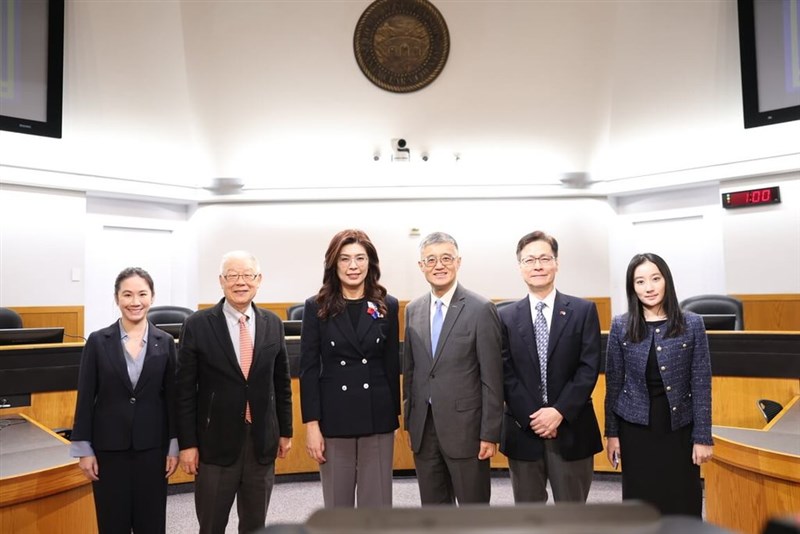
Taipei, June 4 (CNA) Opposition Kuomintang (KMT) Chairperson Cheng Li-wun (鄭麗文) met with officials in Santa Clara on Thursday, seeking deeper strategic cooperation with the California county, during her visit to the United States, according to a KMT news release.
Cheng met with Santa Clara City Mayor Lisa Gillmor and Otto Lee (李洲曉), the first ethnic Chinese county supervisor in Silicon Valley, on Thursday, Taipei time, the party said.
The KMT chairperson said she hoped to see Taiwan engaging in deeper strategic cooperation with Santa Clara by leveraging Taiwan's strengths as a "Silicon Shield," according to the press release.
She also noted that Santa Clara county has a sisterhood relationship with Hsinchu County in Taiwan, where the Hsinchu Science Park is located.
In turn, Lee said many top innovations in Silicon Valley were made in Taiwan, and that he has strong ties to Taiwan, the KMT said.
Santa Clara county has an operating budget of US$15 billion and an outstanding public health system, Lee said, expressing hope that it will make further progress in technological innovation and global cooperation with Taiwan, according to the KMT.
Meanwhile, Gillmor noted that tech giants including Nvidia, Intel, and AMD are all headquartered in the City of Santa Clara, which is also set to host six key FIFA World Cup matches, underscoring the city's world-class capacity, the press release said.
The city has begun energy transitions in order to meet growing demand from AI computing, aiming to double its electricity capacity by 2028, Gillmor said.
In response, Cheng said that Taiwan is facing a serious power shortage crisis due to what she described as flawed energy policies pursued by the ruling Democratic Progressive Party. Taiwan should learn from Santa Clara's experience to stabilize its power supply, she added.
Turning to regional security issues, Cheng said one of the main goals of her visit is to help ease cross-strait tensions, reduce conflict risks, and advance technology integration under a stable environment, which in turn will bring a "peace bonus" to the Indo-Pacific region.
During the Cold War, the "first island chain," which includes Japan, South Korea and Taiwan, served as a strategic front line, Cheng noted. In the 21st century, however, Taiwan should move beyond that Cold War mindset and help transform the island chain into a "chain of peace and prosperity" that brings together talent, technology and capital, she said.
On Wednesday in Washington, the U.S. State Department responded to CNA questions about Cheng's visit, saying "travel to the United States by officials from all of Taiwan's political parties is routine and fully consistent with our longstanding policy."
The department declined to comment on any potential meetings between Cheng and U.S. officials.
Cheng and her delegation arrived Monday in the U.S. for a two-week visit, during which she will meet with U.S. lawmakers, officials, and policy experts across the country, according to the KMT.
- Business
Taiwan shares open higher
10/02/2026 09:08 AM - Business
Taiwan's manufacturing activity expands at fastest pace in 5 years
10/01/2026 09:12 PM - Culture
Drama film 'Arrested Memory' leads 11 Golden Horse nominations
10/01/2026 09:09 PM - Politics
- Sports
Taiwan's medal standing at 2026 Aichi-Nagoya Asian Games
10/01/2026 08:46 PM