President Lai outlines proposals to address Taiwan's declining birth rate
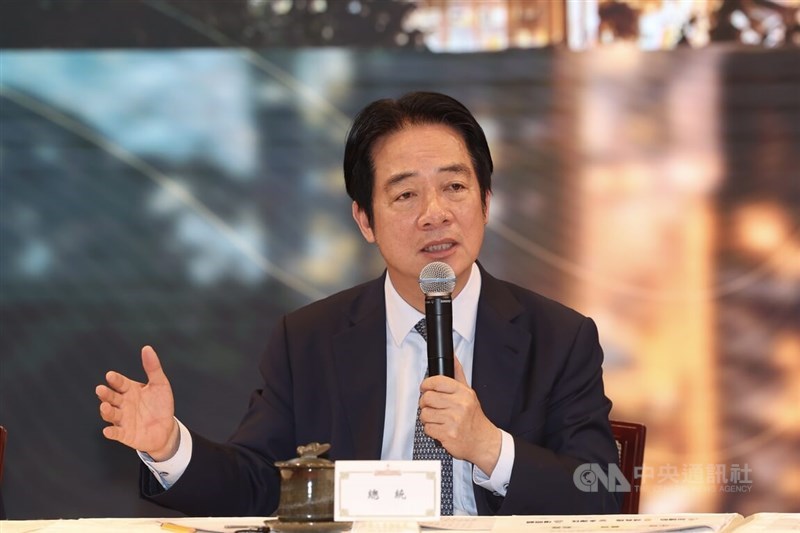
Taipei, May 27 (CNA) President Lai Ching-te (賴清德) on Wednesday proposed a series of measures aimed at reversing Taiwan's declining birth rate, including extended maternity and paternity leave and monthly subsidies of NT$5,000 (US$159) for children aged 17 and under.
Statistics released by the Ministry of the Interior showed that Taiwan's birth rate slumped to 0.69 last year, one of the lowest in the world.
Central to the proposals is a monthly NT$5,000 "growth subsidy" for each child aged 17 and under.
• Public questions government proposals to reverse declining birth rate
Lai said at a news conference at the Presidential Office that the NT$5,000 subsidy will be paid in cash to families with children aged 5 and under.
From ages 6 to 17, half of the monthly subsidy will be deposited into a savings account for each child, Lai said.
Funds in these accounts will be managed by professional financial institutions commissioned by the government and guaranteed to earn at least the interest rate of a two-year fixed-term deposit, Lai said.
"Upon turning 18, the account holder will be able to withdraw the funds as a coming-of-age gift from the nation," he said.
Cabinet Secretary-General Xavier Chang (張惇涵) said each account would have at least NT$360,000 at the end of the subsidy program, which recipients can use to pay for university tuition or start their first business.
According to Lai, the subsidy will be paid on top of Taiwan's existing monthly "child rearing subsidy," which is NT$5,000 for the first child, NT$6,000 for the second child, and NT$7,000 for the third child and beyond from ages 0 through 4.
Another highlight was a proposal to increase assisted reproduction subsidies.
According to the proposal, each recipient under 40 will receive NT$150,000 for her first three IVF treatments, and NT$60,000 from the fourth through sixth attempts. Those between the ages of 40 and 44 would receive up to three subsidies of NT$130,000 each.
Under the existing subsidy rules, each IVF recipient under 39 can receive up to six subsidies, with the first one set at NT$150,000, the following two at NT$100,000, and the remaining three at NT$60,000.
Recipients ranging in age from 39 to 44 will receive NT$130,000 for their first IVF treatment, and two NT$80,000 subsidies for each treatment thereafter.
Lai said the measures will cost around NT$380 billion annually, which is roughly equivalent to 1 percent of Taiwan's GDP -- the same size of expenditure used by South Korea to boost its birth rate.
The spending plans would ultimately have to obtain the approval of Taiwan's opposition-controlled Legislative Yuan.
Lai also outlined a series of "parent-friendly" workplace policy proposals, including extending maternity leave from eight to 12 weeks and paternity leave from seven to 14 days.
Notably, parents who have each been on parental leave for the statutory maximum of six months will each be given an additional three months.
Premier Cho Jung-tai (卓榮泰) explained that the measure was designed to encourage both parents to take parental leave so the burden of caring for infants does not fall entirely on mothers.
- Sports
Taiwan beats China 9-1 in Asian Games baseball super round
09/25/2026 09:11 PM - Sports
Taiwan bags 5 more bronze medals at Asiad
09/25/2026 08:15 PM - Sports
Taiwan swimmer Wang Kuan-hung bags men's 200m butterfly gold (update)
09/25/2026 07:48 PM - Sports
Taiwan swimmer Wang Kuan-hung bags men's 200m butterfly gold
09/25/2026 06:37 PM - Politics
MOFA rejects Xi remarks on Taiwan during U.S. visit
09/25/2026 06:24 PM