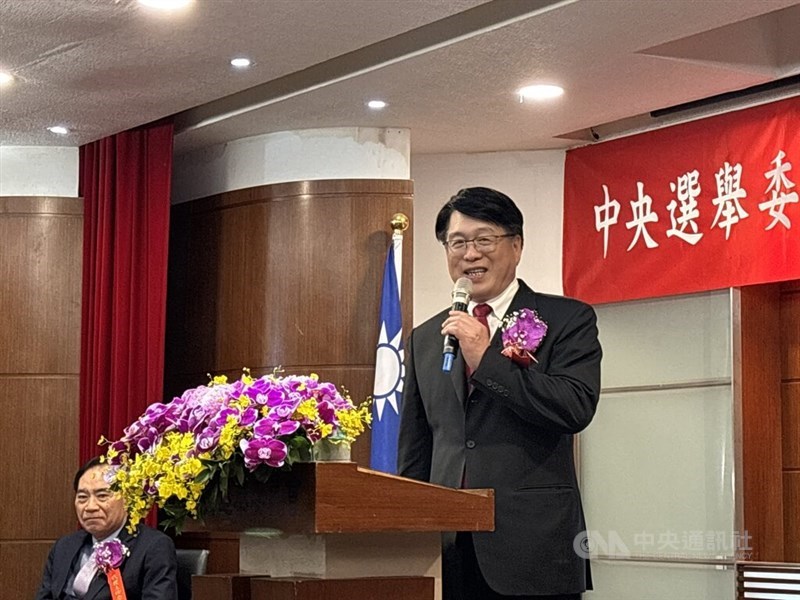
Taipei, April 27 (CNA) Michael You (游盈隆), the newly appointed chairperson of the Central Election Commission (CEC), outlined the agency's key priorities on Monday, including upcoming elections, referendum procedures, and the political rights of naturalized Chinese spouses in Taiwan.
At the handover ceremony, You thanked President Lai Ching-te (賴清德) and Premier Cho Jung-tai (卓榮泰) for their support and pledged to lead the CEC as a neutral, fair, objective and professional body. He can serve a maximum of two four-year terms.
You said the two main tasks during his tenure will be to oversee the local elections scheduled for November 2026 and the presidential election in 2028. With the local elections just seven months away, preparations will need to proceed at an accelerated pace, he said.
You also highlighted several issues facing the commission, including ongoing debate over the political rights of naturalized Chinese spouses in Taiwan.
Referring to the recent case of Li Chen-hsiu (李貞秀), who lost her legislative seat after being expelled from the Taiwan People's Party, You said similar controversies could arise again unless constitutional and legal ambiguities are addressed at their root. He described reliance on the Nationality Act in such cases as "far-fetched" and "highly controversial."
Speaking to reporters after the ceremony, You said Li's case exposed gaps in existing laws and called on relevant authorities to establish clearer legal standards to guide the CEC's review of candidates.
On referendums, You said the commission must act cautiously when handling proposals from the Legislative Yuan, given its role as the competent authority.
He noted that the CEC rejected a referendum proposal on the death penalty in May 2025, but said whether the commission has the authority to do so remains "a highly contentious open question."
While no law explicitly requires the CEC to accept all referendum proposals from the Legislature, You said the principle should be to approve them in general, with rejection as the exception.

Regarding absentee voting, You said Taiwan's elections are increasingly complex, often involving multiple ballots held simultaneously. While describing absentee voting as a progressive idea, he said implementing it in major elections would be challenging and suggested it could first be tested in referendums.
Other challenges include combating AI-generated disinformation and preventing external interference, particularly from China, in Taiwan's elections, You said.
You, 69, previously served as chairman of the Taiwan Public Opinion Foundation and stepped down in March after his appointment as CEC chair was approved.
You is also a former member of the ruling Democratic Progressive Party, having left the party in 2019 after criticizing its decision to separate referendums from national elections.
He was nominated by the Cabinet as CEC chair, along with six other commissioner candidates, but the Legislative Yuan approved only his appointment and those of three others, while rejecting the remaining nominees in March.
*A correction was made to the 14th paragraph of this story on April 28, 2026: An earlier version of this paragraph incorrectly stated that You was the only nominee approved by the Legislative Yuan in March.
- Politics
- Society
Scattered showers expected in Greater Taipei, eastern Taiwan Saturday
10/03/2026 10:41 AM - Society
Taiwan headline news
10/03/2026 10:22 AM - Sports
'Hao-yu like that?' A deep dive into Lee's rookie MLB season
10/03/2026 10:00 AM - Sports
Taiwan boosts medal haul in multiple events at Asian Games on Friday
10/02/2026 08:55 PM