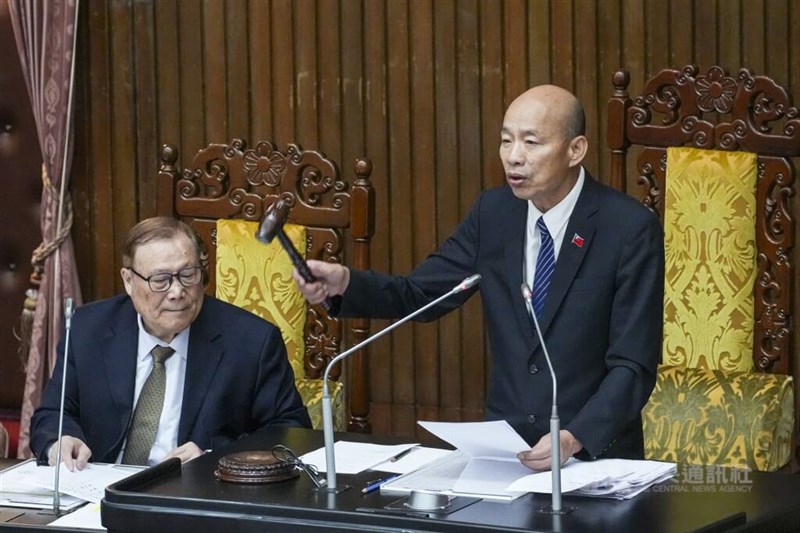
Taipei, July 24 (CNA) The Legislature on Friday passed a law establishing two government-funded savings accounts that will receive annual deposits of NT$60,000 (US$1,854) for citizens under age 18, in an effort to address Taiwan's declining birthrate.
The Special Act on Taiwan Future Accounts, proposed in December last year, was passed with support from the opposition Kuomintang (KMT) and Taiwan People's Party (TPP), which together hold a majority in the Legislature.
Under the law, eligible citizens younger than 8 will receive annual deposits of NT$60,000 into a Growth Allowance Account. Those aged 7-17 will receive NT$30,000 in a Growth Allowance Account and NT$30,000 in a Future Account each year.
The law also mandates an initial NT$60,000 deposit into a Future Account for each recipient born after it takes effect.
The law will take effect after President Lai Ching-te (賴清德) promulgates it.
The act applies to Republic of China (Taiwan's official name) nationals under age 18 who reside in Taiwan for at least 183 days a year.
The TPP estimated that the program would cost NT$200 billion annually.
Funds in a Growth Allowance Account can be withdrawn by the account holder's legal representative at any time.
Funds in a Future Account, however, cannot be withdrawn before the account holder turns 18, except under special circumstances, according to the law.
The Bureau of Labor Insurance under the Ministry of Labor will manage funds in Future Accounts and guarantee returns no lower than two-year domestic bank time-deposit rates. The national treasury will cover any shortfall.
Before an account holder turns 12, family members can make unlimited annual deposits into a Future Account, while employers of the account holder's legal representatives can contribute up to NT$50,000 per year.
The opposition lawmakers dropped a provision in the original bill that would have granted tax exemptions for voluntary deposits into Future Accounts after ruling Democratic Progressive Party (DPP) lawmakers raised concerns about potential tax evasion.
The law instead leaves tax incentives for voluntary deposits and business donations to be determined by the government.
DPP lawmakers voted against the opposition parties' version.
In May, Lai proposed a program providing a monthly NT$5,000 "growth subsidy" for each child under age 18. Under the plan, families with children age 5 and under would receive the full subsidy, while half of the monthly subsidy for children aged 6-17 would be deposited into individual savings accounts.
The program is expected to roll out in 2027 and cost NT$200 billion annually, according to information previously released by the government.
DPP lawmaker Fan Yun (范雲) said the KMT-TPP proposal to allow additional deposits into Future Accounts by parents and businesses has prompted social welfare scholars to warn that it could worsen inequality through reverse redistribution.
KMT caucus leader Fu Kun-chi (傅崐萁) said the law was intended to tackle Taiwan's declining birthrate, which he described as a serious national security crisis.
Fu said Taiwan Semiconductor Manufacturing Co. (TSMC)-driven tax revenue growth could bring more than NT$1 trillion in excess revenue this year, potentially helping encourage young people to start families.
TPP caucus leader Chen Ching-lung (陳清龍) said Lai's proposal would be implemented only through administrative measures rather than legislation, leaving its future uncertain: it could exist this year and next year but disappear the year after.
- Politics
Chinese exchange student deported over video showing him 'pinching Lai'
10/16/2026 08:45 PM - Politics
Chiang proposes easing urban renewal threshold; Shen questions bottlenecks
10/16/2026 08:22 PM - Society
Champi expected to become typhoon within 24 hours; path remains uncertain
10/16/2026 07:40 PM - Politics
10 local election candidates fail eligibility review: CEC
10/16/2026 07:27 PM - Politics
Taiwan lawmakers pass health insurance premium subsidies for seniors
10/16/2026 07:24 PM