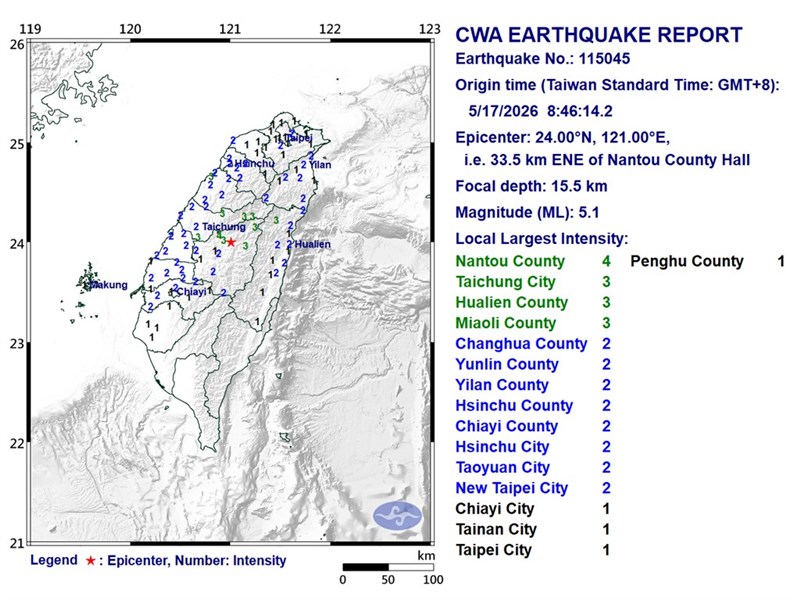
Taipei, May 17 (CNA) The magnitude 5.1 earthquake that hit Nantou County on Sunday morning was an isolated event, according to the Central Weather Administration (CWA), but it warned of possible aftershocks measuring between magnitude 4 and 4.5 over the next week.
According to the agency, the earthquake struck at 8:46 a.m. at a depth of 15.5 kilometers. The epicenter was located 33.5 kilometers east-northeast of Nantou County Hall, in Puli Township, where it measured a 4 on Taiwan's 7-tier intensity scale.
Chen Da-yi (陳達毅), a section chief at the CWA's Seismological Center, said at a press conference that the earthquake was caused by the northwestward collision of the Philippine Sea Plate with the Eurasian Plate.
The temblor's epicenter was located in an area with relatively active seismic activity, where long-term stress accumulation and fracturing in geological formations triggered the quake, Chen said.
He noted that the Seismological Center issued national-level alerts for Nantou County, Changhua County, and Taichung following the earthquake.
"Although the earthquake registered an intensity of 4 near the epicenter, the shaking did not last long," Chen said.
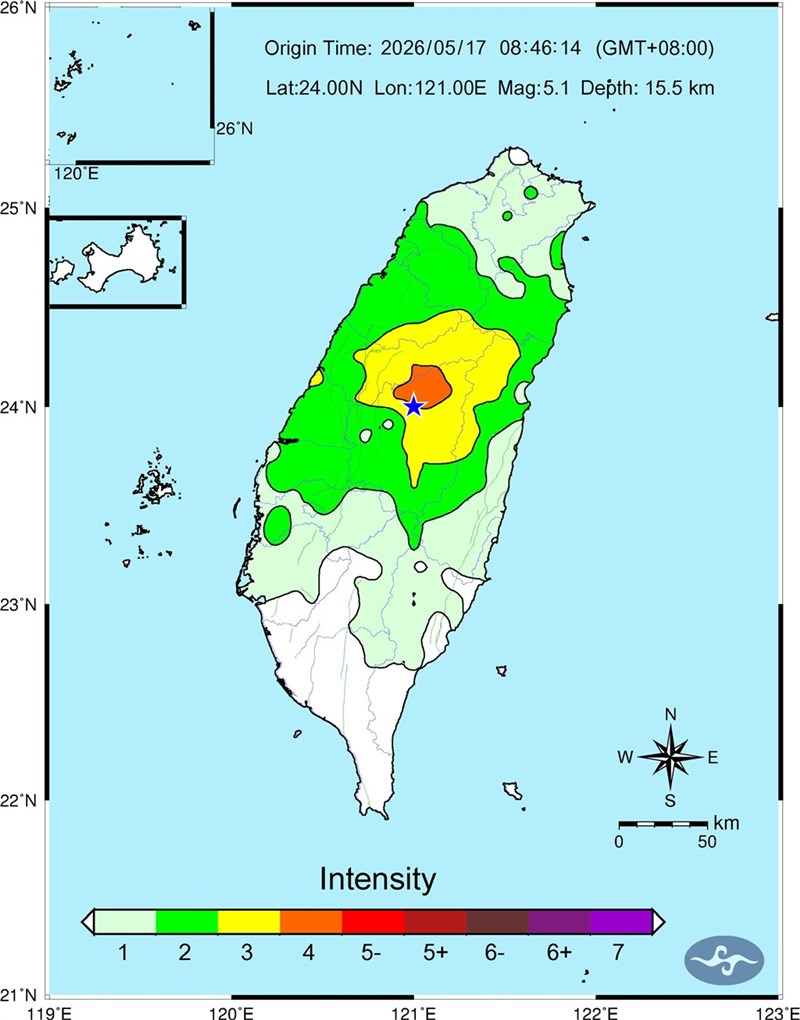
The seismologist added that the quake has been regarded as a single, isolated seismic event. However, he cautioned that aftershocks measuring between magnitude 4 and 4.5 could still occur over the next week.
Citing statistics, Chen pointed out that since 2000, there have been 15 earthquakes of magnitude 5 or above within a 30-kilometer radius of Sunday's epicenter, with the most recent one occurring in 2021.
While Sunday's earthquake did not occur in an area without a history of seismic activity, under such conditions where seismic activity already exists, stress accumulation in relatively fragile geological zones can cause deformation, Chen said.
When the stress exceeds what the rocks can withstand, ruptures occur and energy is released, he explained.
- Society
Taiwan headline news
10/03/2026 10:22 AM - Sports
'Hao-yu like that?' A deep dive into Lee's rookie MLB season
10/03/2026 10:00 AM - Sports
Taiwan boosts medal haul in multiple events at Asian Games on Friday
10/02/2026 08:55 PM - Society
Workers at Taiwan snack maker Kuai Kuai extend strike over relocation
10/02/2026 08:45 PM - Business
Chain businesses association seeks more foreign workers
10/02/2026 08:04 PM