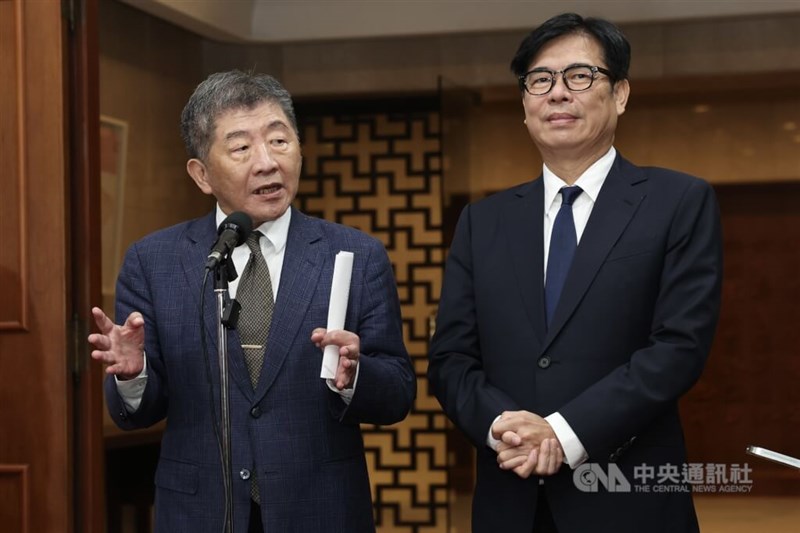
Taipei, July 21 (CNA) Taiwan's six special municipalities support the Cabinet's proposed amendments to the Act Governing Food Safety and Sanitation and back refinements including a tiered monitoring system for food businesses based on their size and risk profile, Minister Without Portfolio Chen Shih-chung (陳時中) said Tuesday.
Chen made the remarks after chairing a two-hour Cabinet meeting on the proposed amendments, prompted by the ongoing Central Union Oil Corp. food safety scandal.
The meeting was attended by representatives from all six special municipalities, including Taipei Mayor Chiang Wan-an (蔣萬安), Taichung Mayor Lu Shiow-yen (盧秀燕) and Kaohsiung Mayor Chen Chi-mai (陳其邁). New Taipei, Taoyuan and Tainan were represented by their deputy mayors.
Chen said participants agreed with the overall direction of the amendments and discussed ways to strengthen source management, production oversight and digital governance, including establishing a shared information platform for central and local authorities.
Local officials also proposed tailoring monitoring requirements to the size and characteristics of food businesses and incorporating risk communication, assessment and control into a tiered system, Chen said, adding that the proposal would be incorporated into the draft.
He said Chen Chi-mai suggested classifying businesses according to their potential social impact, with larger or higher-risk operators subject to stricter self-management requirements.
Premier Cho Jung-tai (卓榮泰) also urged the Cabinet to address systemic shortcomings through swift legislative amendments to meet public expectations, Chen said.
Speaking separately, Chiang said he had presented Taipei's recommendations and called for further refinement of the Cabinet's draft to streamline the legislative process.
Lu welcomed the consultation with local governments but said the amendments should undergo more thorough review to ensure they are comprehensive rather than "roughly drafted."
According to the Ministry of Health and Welfare, the proposed amendments cover 10 areas, including stricter self-inspection requirements for high-risk food businesses, certification of in-house laboratories, and stronger laboratory management and reporting rules.
Other proposed changes include third-party sampling and notification mechanisms, risk-based local inspections, tougher penalties for delayed or false reporting, expanded traceability requirements, safeguards to ensure payment of fines, a central command mechanism for major food safety incidents, and clearer rules governing product recalls and relisting.
The Central Union Oil contamination scandal broke in late June 2026 after authorities discovered that batches of soybean-based cooking oil contained excessive levels of benzo[a]pyrene (BaP), a dangerous Group 1 carcinogen.
- Politics
Chinese exchange student deported over video showing him 'pinching Lai'
10/16/2026 08:45 PM - Politics
Chiang proposes easing urban renewal threshold; Shen questions bottlenecks
10/16/2026 08:22 PM - Society
Champi expected to become typhoon within 24 hours; path remains uncertain
10/16/2026 07:40 PM - Politics
10 local election candidates fail eligibility review: CEC
10/16/2026 07:27 PM - Politics
Taiwan lawmakers pass health insurance premium subsidies for seniors
10/16/2026 07:24 PM