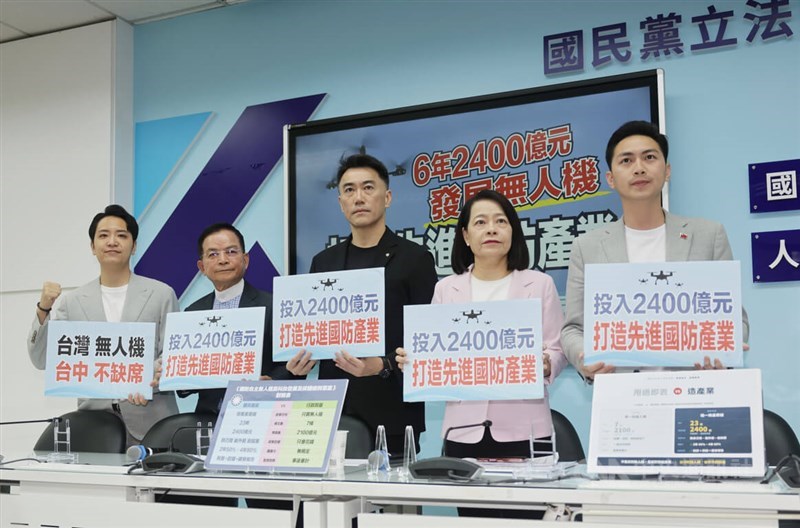
Taipei, June 30 (CNA) The legislative caucuses of Taiwan's opposition parties on Tuesday unveiled drone procurement bills that would use the general budget to fund the purchase of locally made drones rather than a special budget, as proposed by the Cabinet.
Under the draft bill proposed by the caucus of the main opposition Kuomintang (KMT), the spending cap is set at NT$240 billion (US$7.53 billion) over six years, with annual spending capped at NT$40 billion.
Government agencies would be required to brief the Legislative Yuan on procurement plans worth NT$100 million or more and report on the progress of each procurement plan to lawmakers annually.
The draft bill would also require suppliers of critical drone components, including flight control and navigation chips and communications modules, to pass information security and supply chain security reviews.
The KMT caucus backed funding the bill using the central government's general budget because it believes doing so would "normalize" the procurement process and reduce the risk of corruption, KMT caucus secretary-general Lin Pei-hsiang (林沛祥) told a news conference Tuesday.
Also on Tuesday, the caucus of the smaller opposition Taiwan People's Party (TPP) proposed its own domestic drone procurement bill, which does not set a spending cap.
TPP caucus convener Chen Ching-lung (陳清龍) said his caucus' proposal would also fund drone procurement through the general budget because it values "fiscal discipline" and does not want special budgets to become the norm.
The bill would require the government to formulate unmanned aerial vehicle development guidelines every four years and review them every two years, TPP deputy caucus convener Wang An-hsiang (王安祥) said.
The general budget of Taiwan's central government can run deficits of up to 15 percent of total spending. Special, or supplementary, budgets, allow spending beyond that threshold and are financed by separately issuing debt.
The ruling Democratic Progressive Party has also favored using special budgets because they bypass normal budget planning procedures and facilitate timely and sustained implementation of public programs.
In response to the opposition party bills, ruling Democratic Progressive Party spokesperson Lin Chu-yin (林楚茵) said reliance on the general budget would significantly increase fiscal pressure and could crowd out spending on social welfare and education.
In addition, she said, because the general budget is planned and reviewed annually, it would not guarantee continuity in funding, which would introduce anxiety and uncertainty in the drone industry, hampering its long-term growth.
Earlier this month, the Cabinet submitted a special budget bill with a spending cap of NT$210 billion for drone procurement to the Legislature for review.
Under the Cabinet's proposal, there are no annual caps and the funding would go to the end of 2031, with funds coming from government borrowing or budget surpluses carried over from the previous fiscal year.
The Ministry of National Defense has said funding drone procurement through a special budget would enable it to place large, long-term orders with domestic defense companies while supporting innovation to keep pace with the rapid evolution of drone technology.
(By Wang Cheng-chung, Chen Chun-hua and Sean Lin)
Enditem/ls
- Politics
Taipei Mayor Chiang agrees to at least one televised debate with Shen
10/13/2026 08:45 PM - Society
Animal groups renew push for referendum on full ban of wild boar snares
10/13/2026 08:36 PM - Science & Tech
NTHU study finds plant compound may help treat brain injuries
10/13/2026 07:50 PM - Business
Economists see AI boom sustaining Taiwan growth, urge diversification
10/13/2026 07:25 PM - Society
Northern Taiwan to see heavier rain Thursday before weather stabilizes
10/13/2026 07:04 PM