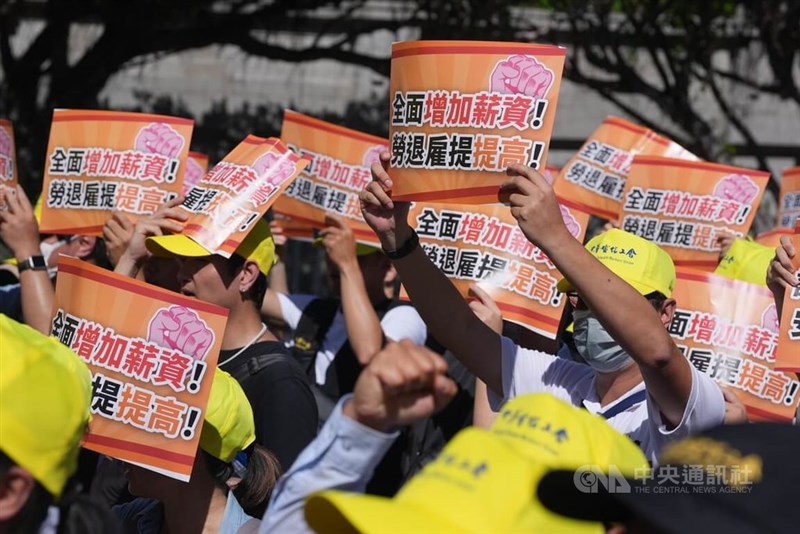
Taipei, Oct. 19 (CNA) Hundreds of workers rallied outside the Presidential Office on Monday, demanding higher wages, increased employer pension contributions and clearer profit-sharing rules, amid a recent wave of strikes and strike authorization votes across Taiwan.
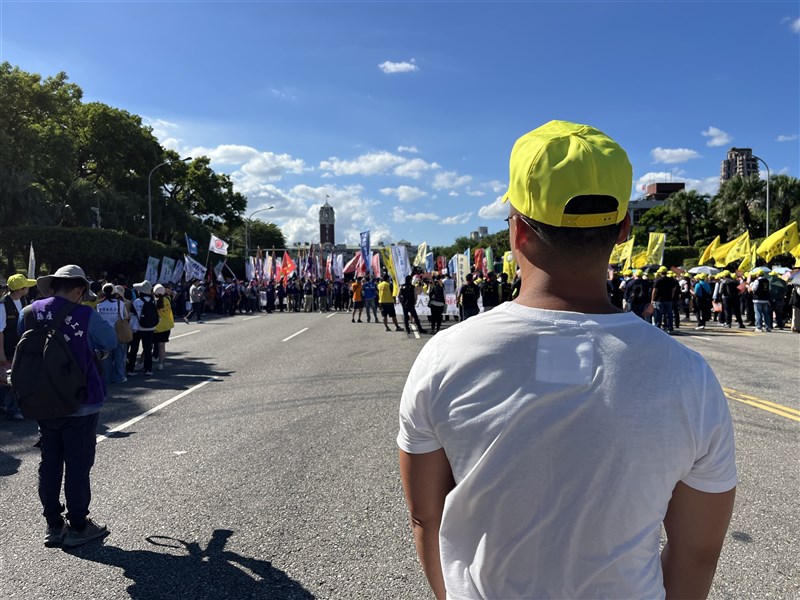
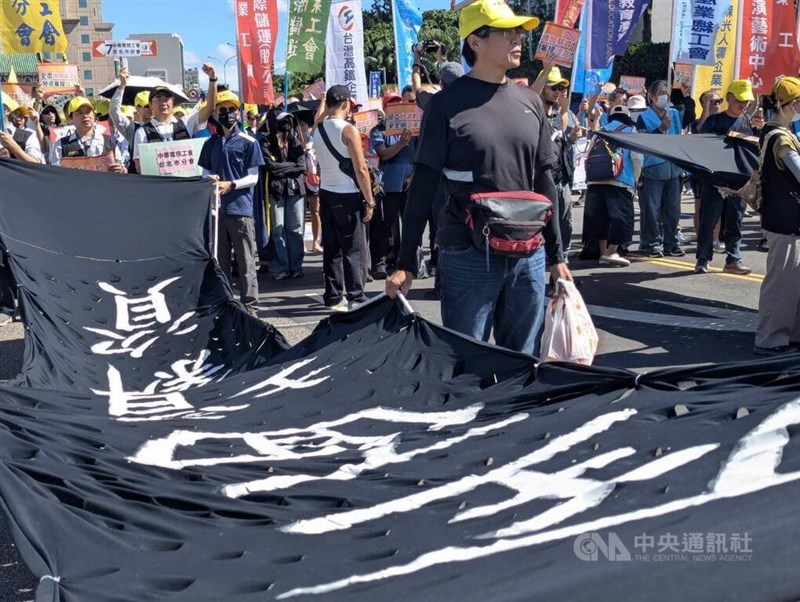
Participants representing dozens of labor unions from across Taiwan gathered on Ketagalan Boulevard before marching through nearby streets past the Legislative Yuan and returning to the boulevard under the afternoon sun.
Pension reform
Speaking to reporters before the rally, Ho Cheng-chia (何政家), chairman of the Taiwan Solidarity Front Confederation of Trade Unions, focused specifically on what he felt was an outdated labor pension system.
Introduced in July 2005, the new labor pension system consists of retirement accounts for individual workers and requires employers to contribute at least 6 percent of an employee's salary to the account every month.
The employee can voluntarily contribute an additional 6 percent to increase the amount saved. The total built up in the fund can be collected in a lump sum or as a monthly annuity upon retirement as long as contributions have been made for at least 15 years.
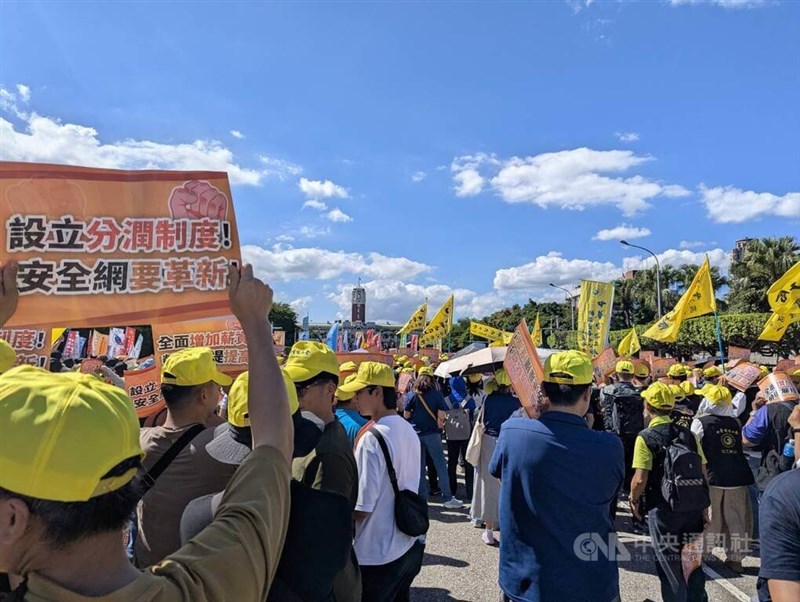
Ho argued that it was time to increase the employer's minimum 6 percent obligation, saying it was too low to ensure adequate retirement savings and that an increase would help make up for 21 years of insufficient contributions.
"We hope to raise it to 9 percent first and then gradually to 15 percent," he said, noting that employers' annual retirement costs per worker under the old pension system were estimated at around 12 percent of wages.
Government figures show that about 7.87 million workers had contributions made under the new system as of July 2026, while an estimated 115,000 were exclusively under the old system as of December 2025.
The new labor pension system is one of two retirement plans that most workers in Taiwan qualify for.
The other is the "old-age benefits" under the labor insurance system. The current labor insurance premium is 11.5 percent of salaries, capped at NT$45,800 per month, with employers paying 70 percent.
Because of the relatively low salary cap, retirement benefits under the insurance system are generally limited to under US$900 a month.
Both systems are run by the Bureau of Labor Insurance under the Ministry of Labor.
Ho also urged amendments to Article 29 of the Labor Standards Act to establish clearer requirements for distributing company profits to employees, saying that economic gains should benefit workers beyond the technology sector.
Strike votes amid labor unrest
The rally followed recently concluded strikes at glassmaker AGC Display Glass Taiwan Inc. and snack producer Kuai Kuai Co., as well as strike authorization votes by unions at Chunghwa Telecom and the Taoyuan operations of U.S. memory chipmaker Micron Technology Inc.
Chunghwa Telecom Workers' Union Chairman Teng Ke-lien (鄧克亷) said its Taoyuan and Kaohsiung branches had passed strike authorization votes, with other branches set to hold votes in succession.
The union, which launched the vote to demand higher pay amid what Teng described as record company profits, has approximately 20,000 members across 26 branches, representing nearly all company employees.
"Striking is just a means, not our goal," Teng said, urging management to "respond positively" to workers' demands, while noting that a walkout was unlikely before year-end.
Paul Chen, a Chunghwa Telecom engineer with more than five years' service, said he took leave to join the protest despite concerns about possible retaliation.
"I'm still a little worried, but I think we need to fight for our demands and let the company hear our real voices," Chen, who spoke under a pseudonym, told CNA.
Under Article 35 of Taiwan's Labor Union Act, employers are barred from retaliating against workers for participating in union activities or labor disputes.
General strike call
Speaking at the rally, Taoyuan Confederation of Trade Unions Chairwoman Shih Shu-hua (施淑華) called for a nationwide general strike ahead of the 2028 elections if pension reform remained stalled.
"We must show these political parties that workers cannot be pushed around," she said.
Responding to the protest, the Ministry of Labor said it remained "open" to raising employer pension contributions but stressed that changes required "careful evaluation."
It also highlighted environmental, social and governance (ESG) assessment incentives for listed companies that voluntarily increase their contribution rates.
The ministry also pointed to minimum wage reviews and collective bargaining incentives to promote pay raises and profit-sharing, urging employers to consider raising existing employees' salaries as the monthly minimum wage increases from NT$29,500 (US$908.05) this year to NT$30,900 in 2027.
- Society
Taiwan, Philippines sign animal husbandry research pact
10/19/2026 07:26 PM - Society
Workers rally in Taipei for pension reform, profit-sharing rules
10/19/2026 07:00 PM - Politics
Ho proposes bus reforms; Chiang outlines smart safety network in Taichung
10/19/2026 06:21 PM - Sports
Xiao Xiang-wen wins Taiwan's 1st gold at Nagoya Asian Para Games
10/19/2026 06:04 PM - Science & Tech
NTHU to explore research reactor development with NuCube
10/19/2026 05:43 PM