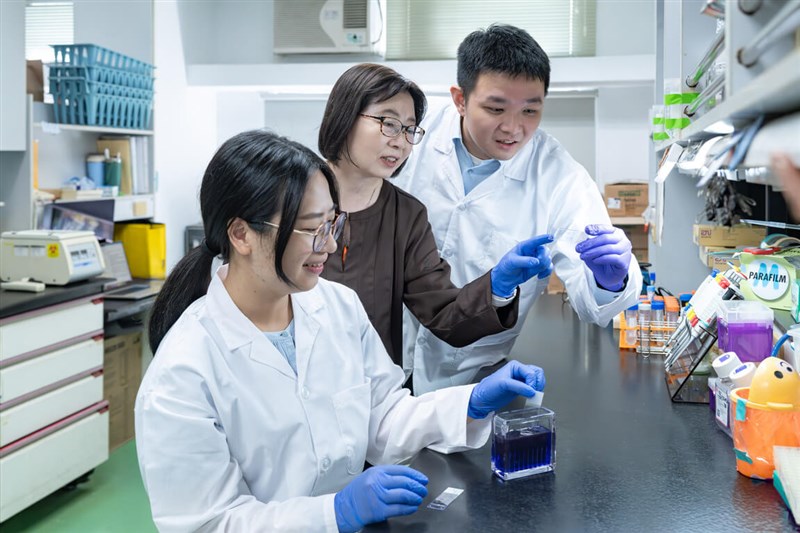
Taipei, Oct. 13 (CNA) A plant compound may help repair damaged nerve cells and improve movement after traumatic brain injury, offering a potential new approach to treatment, a National Tsing Hua University (NTHU) research team said Tuesday.
The study, published in the international journal Phytomedicine in October, showed that isorhoifolin, extracted from the tropical plant Monstera epipremnoides, improved recovery from traumatic brain injuries in mice, NTHU said in a news release.
Linyi Chen (陳令儀), who leads the team, said the study showed how isorhoifolin works on two types of brain cells: It helps damaged nerve projections grow back and reduces harmful substances in astrocytes, creating a better environment for nerve repair.
Chen, dean of NTHU's College of Life Sciences and Medicine, said the findings could provide a basis for future research into other neurological injuries and inflammatory conditions, including stroke and "brain fog" associated with COVID-19.
Brain damage can be likened to a "broken neural road," according to Wang Yi (王翊), the study's first author and a doctoral student at NTHU's Institute of Molecular Medicine.
He said repairing brain damage requires both helping nerves regrow and clearing harmful substances, such as free radicals, that can slow recovery.
According to NTHU, the research took more than eight years, with researchers testing over 2,000 extracts from nearly 900 plants at the Dr. Cecilia Koo Botanic Conservation Center (KBCC), a nonprofit tropical plant conservation organization in Pingtung County.
The team extracted about 1 kilogram of leaves, then sent the active fractions to Germany to separate and identify individual compounds, eventually isolating isorhoifolin, NTHU said.
The discovery could have implications for future treatment.
About 70 million people worldwide suffer traumatic brain injuries each year and no approved drug directly currently promotes nerve repair and functional recovery, NTHU said.
After determining its structure, the team began chemically synthesizing isorhoifolin and can now produce it on a gram scale and develop related compounds with NTHU's chemistry department, according to Wang.
However, before clinical trials can begin, the team must complete larger-scale drug production and toxicology testing, Wang said, adding that the team plans to seek guidance from the U.S. Food and Drug Administration.
The study found that isorhoifolin is detected in the brain tissue of mice 15 minutes after intranasal administration, indicating that it can reach the brain, according to Chen.
Chen said intranasal administration is noninvasive and convenient, and if development and clinical trials are successful, nasal sprays could be explored for mild cases and intravenous treatment for severe cases.
- Science & Tech
NTHU study finds plant compound may help treat brain injuries
10/13/2026 07:50 PM - Business
Economists see AI boom sustaining Taiwan growth, urge diversification
10/13/2026 07:25 PM - Society
Northern Taiwan to see heavier rain Thursday before weather stabilizes
10/13/2026 07:04 PM - Society
Taiwan CDC to procure nearly 500,000 more flu, COVID-19 vaccine doses
10/13/2026 06:48 PM - Science & Tech
ITRI showcases cultural technology at Kaohsiung expo
10/13/2026 06:00 PM