By Sunny Lai, CNA staff reporter
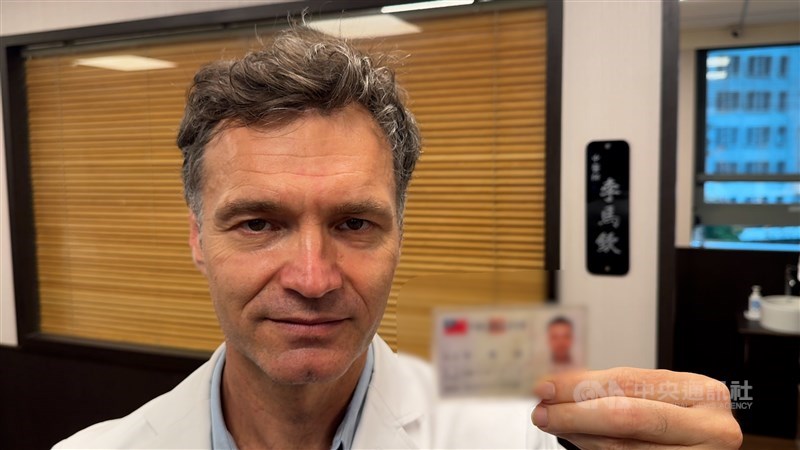
After Marcin Zbylut became a Taiwanese citizen in early 2020, life for the Polish-born traditional Chinese medicine doctor remained much the same, including his work at two clinics in Greater Taipei and the family responsibilities he carried.
But something did shift.
"The biggest thing for me was that I felt like now I fully belong to Taiwan, that I'm part of the society," Zbylut, 49, told CNA in a recent interview.
For him, obtaining Taiwanese citizenship through a special route for high-level foreign professionals was a way of deepening his ties to Taiwan, which he now calls home.
Nearly a decade after Taiwan amended the Nationality Act to let a narrow group of eligible foreign professionals naturalize without having to renounce their original nationality, Zbylut's journey offers a glimpse into how the system has worked in practice -- and where it still falls short.
From Europe to Taiwan
Born in Poland and educated in Germany and the United Kingdom in molecular biology, Zbylut first came to Taiwan over 20 years ago after living and working in Europe alongside people from East Asia, including his roommate from Taiwan.
He came to believe that "the 21st century is going to be an Asian century," recalling being impressed by Asian people's professionalism and ethics at the time.
After doing his own research and drawing on travel experience, he concluded that Taiwan was the best fit for him.
"I came to Taiwan and I thought, yeah, this is the place," he said. "I immediately fell in love with Taiwan."
Chinese medicine
After moving to Taiwan in late 2005, Zbylut briefly worked at a trading company before studying Mandarin on a Taiwanese government scholarship from 2007 to 2009 and later enrolling at China Medical University in Taichung in 2010 to study traditional Chinese medicine.
He was first exposed to traditional Chinese medicine during a visit to China in the early 2000s, and the idea of pursuing the field had stayed with him ever since.
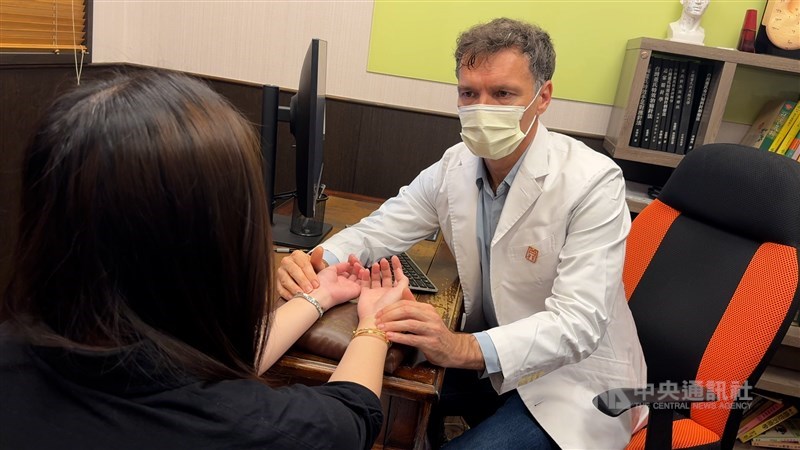
Zbylut recalled being "shocked and impressed" when a Chinese physician, after taking the pulse of both him and his brother and asking only a few questions, was able to identify specific health issues affecting them both.
After graduating in mid-2015, he began working at Hualien Tzu Chi Hospital, where he remained until 2019 and eventually served as chief resident.
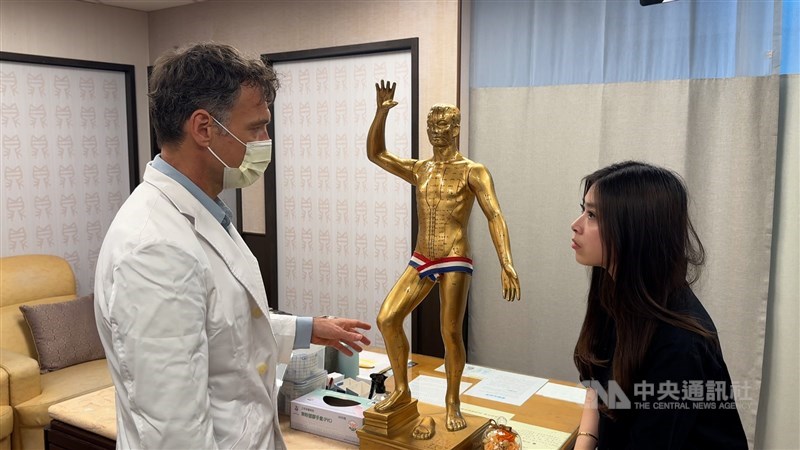
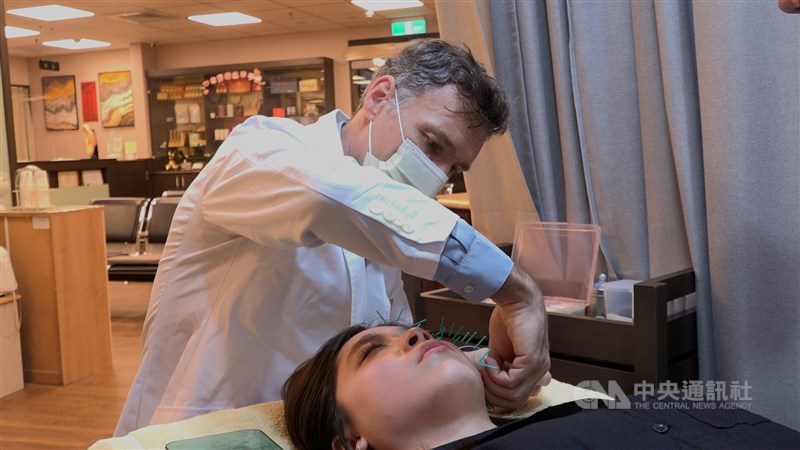
He now practices at two clinics in Taipei and New Taipei, where he treats patients with a focus on cosmetic acupuncture.
Why citizenship matters
Though he already held permanent residency, Zbylut said he saw his future in Taiwan and felt it would be "more practical to be naturalized."
Part of the reason, he said, was that his non-citizen status placed restrictions on his medical practice, including preventing him from opening his own clinic as a sole practitioner.
Beyond the practical considerations, Zbylut said he also wanted to be "even more grounded in this country."
Under Taiwan's general naturalization rules, most foreign nationals are required to renounce their original nationality before becoming Taiwanese citizens.
An alternative pathway
While Zbylut had considered giving up his Polish citizenship at one point, he later opted for the high-level professional route -- created after Taiwan amended the law in 2016 -- which lets recognized foreign professionals obtain citizenship without renouncing their original nationality.
According to the Ministry of the Interior (MOI), eligible foreign nationals must be recommended by the relevant government agency and approved through a joint review on the grounds that their expertise serves Taiwan's interests.
As of the end of 2025, 379 foreign high-level professionals -- including Zbylut, whose field was listed as traditional Chinese medicine -- had successfully naturalized without renouncing their original nationality, MOI data showed.
But the path was not easy.
Zbylut said when he began working on the application in early 2019, the process was difficult to navigate because so little information was available.
Describing the process as a "closed loop," Zbylut said there was no contact person or designated channel for inquiries, and most of the information provided by the authorities was in Chinese.
Eventually, Hualien Tzu Chi Hospital helped with the application, and about nine months after he submitted the application, Zbylut obtained Taiwanese citizenship.
Help is better now, but criticism remains
Compared with when Zbylut applied in 2019, the process now appears somewhat easier to navigate.
The MOI's Department of Household Registration has a dedicated "High-Level Professional" section on its website, in both Chinese and English, with information on the legal framework, application guidance, contact windows for recommendation-related inquiries, and recommendation letter templates.
Still, criticism of Taiwan's broader citizenship regime continues.
In August 2024, an NGO called Crossroads launched a successful petition on the government's platform calling for a standardized path to citizenship for long-term permanent residents without requiring them to renounce their original nationality.
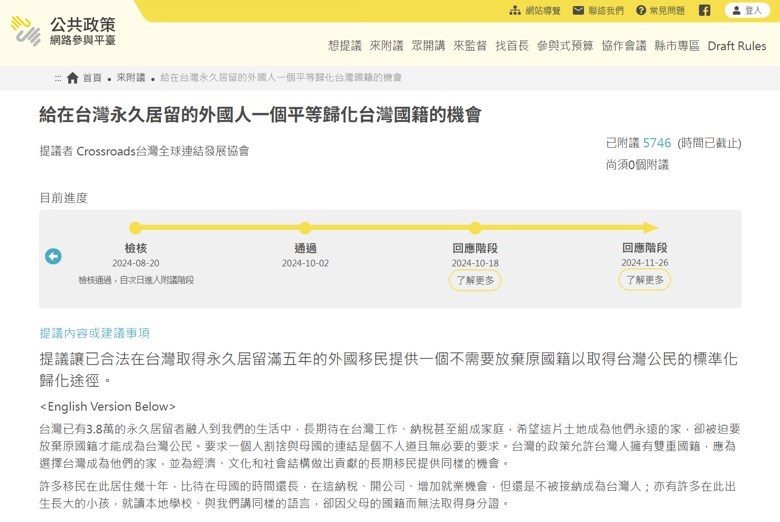
The MOI, however, rejected the proposal later that year, saying such a change could have "major impacts" on Taiwan's fiscal burden, social welfare obligations and national security.
The ministry also said the existing high-level professional route could only serve as "an exception."
In Zbylut's view, Taiwan's naturalization policy for foreign professionals remains "very limited in scope" and "very difficult to go through."
"If it was up to me, I would make it like in most liberal democracies, where you are allowed to have dual citizenship," he said.
Enditem/AW
![DPP at 40: Founders reflect on risk, rise, reckoning]() DPP at 40: Founders reflect on risk, rise, reckoningFour decades after the Democratic Progressive Party (DPP) was founded under martial law, its pioneers recall the risks they took, the democratic changes they helped bring about and the challenges facing the party today.09/28/2026 11:10 AM
DPP at 40: Founders reflect on risk, rise, reckoningFour decades after the Democratic Progressive Party (DPP) was founded under martial law, its pioneers recall the risks they took, the democratic changes they helped bring about and the challenges facing the party today.09/28/2026 11:10 AM!['Umpire strikes back': Taiwanese ump sets U.S. pro baseball milestone]() 'Umpire strikes back': Taiwanese ump sets U.S. pro baseball milestoneIn her younger days, Sophiyah Liu (劉柏君) was a spiritual medium, serving as a bridge between the mortal plane and that of the unknown.09/18/2026 04:44 PM
'Umpire strikes back': Taiwanese ump sets U.S. pro baseball milestoneIn her younger days, Sophiyah Liu (劉柏君) was a spiritual medium, serving as a bridge between the mortal plane and that of the unknown.09/18/2026 04:44 PM![Made in Taiwan, sovereign in Europe: France's different chip strategy]() Made in Taiwan, sovereign in Europe: France's different chip strategyDuring a May visit to a high-performance computing center operated by the French Alternative Energies and Atomic Energy Commission (CEA) in Bruyères-le-Châtel, south of Paris, French President Emmanuel Macron was photographed holding a sample of Rhea1.09/05/2026 05:27 PM
Made in Taiwan, sovereign in Europe: France's different chip strategyDuring a May visit to a high-performance computing center operated by the French Alternative Energies and Atomic Energy Commission (CEA) in Bruyères-le-Châtel, south of Paris, French President Emmanuel Macron was photographed holding a sample of Rhea1.09/05/2026 05:27 PM
- Business
Amazon taking part in Taiwan PCB maker's private placement
09/29/2026 09:06 PM - Sports
Taiwan snatches 2 more silvers in shooting, Kurash at Asian Games
09/29/2026 08:42 PM - Business
Taiwan economic indicators stay strong for 9th straight month: NDC
09/29/2026 07:44 PM - Politics
AIDC, Corrections Agency hold counter-drone drill
09/29/2026 07:15 PM - Politics
KMT, TPP legislators reject all 27 of Lai's Control Yuan nominees
09/29/2026 06:55 PM