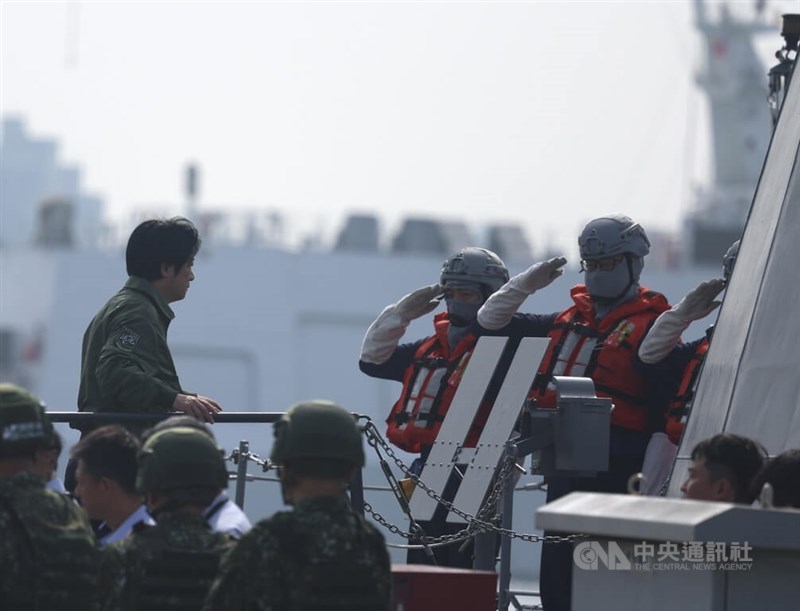
Kaohsiung, Aug. 8 (CNA) President Lai Ching-te (賴清德) on Saturday boarded a domestically developed missile boat as he inspected a coastal defense exercise simulating efforts to repel an incursion by Chinese warships.
Lai boarded a Kuang Hua VI-class missile boat armed with Hsiung Feng II anti-ship missiles at Tsoying Naval Base in Kaohsiung and delivered remarks over the vessel's public address system.
He called on Navy and Coast Guard personnel participating in the drill to respond proactively to a range of scenarios and strengthen their combat readiness and coordination to safeguard the country's sovereignty and the safety of its people.
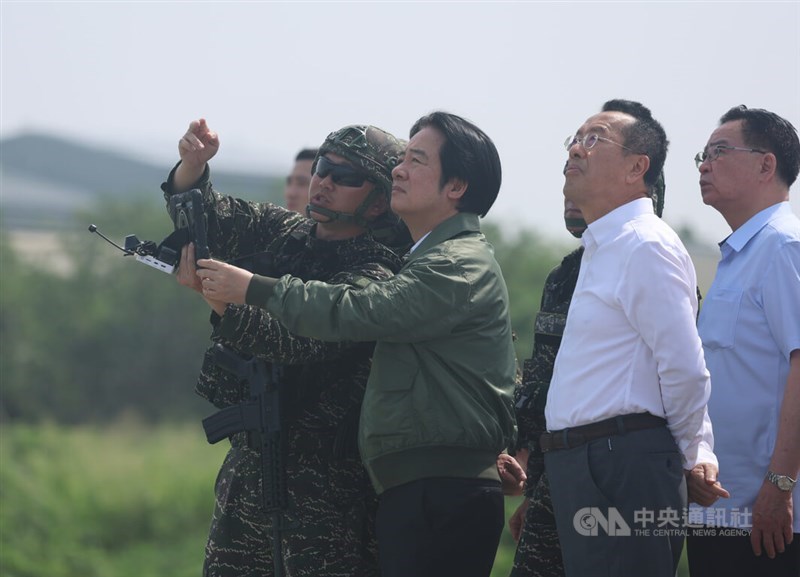
"In the face of external threats and challenges, the government continues to work to strengthen national defense and provide the military and Coast Guard personnel with its fullest support," Lai said.
The drill was held as part of Taiwan's annual Han Kuang exercises, which began Wednesday and will conclude on Aug. 14.
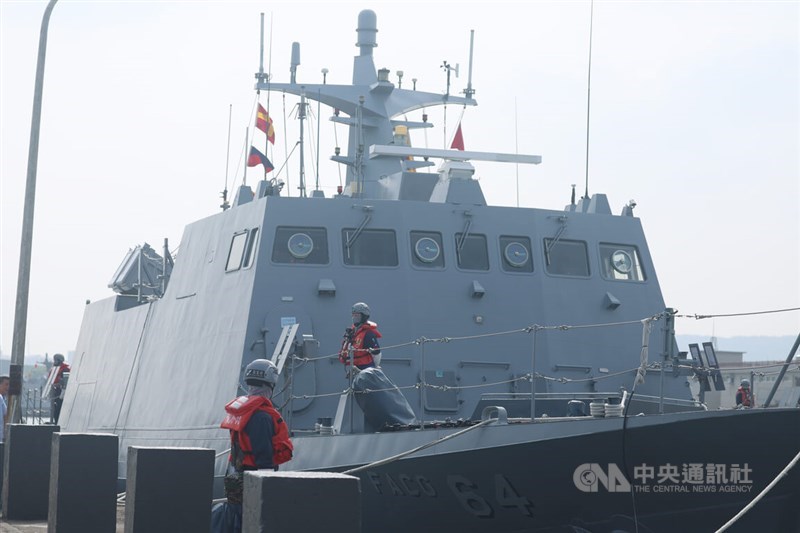
The Kuang Hua VI-class missile boat, with a full-load displacement of just 186.5 metric tons, is designed for surprise attacks and is typically deployed in groups against larger adversaries. It is capable of long-range strikes and has a top speed of 33 knots (61 kilometers per hour).
The exercise also tested the Coast Guard Administration's ability to transition its patrol vessels to wartime roles. After receiving an order from the Navy's Littoral Operations Command, an Anping-class patrol vessel, based on the Navy's Tuo Chiang-class corvette, led four Kuang Hua VI-class missile boats to sea to simulate an engagement with invading Chinese amphibious assault ships.
According to the Ministry of National Defense, Anping-class patrol vessels are normally tasked with maritime patrols, emergency response and expelling trespassing fishing boats, but can be equipped with Hsiung Feng II and III anti-ship missiles for anti-surface warfare.
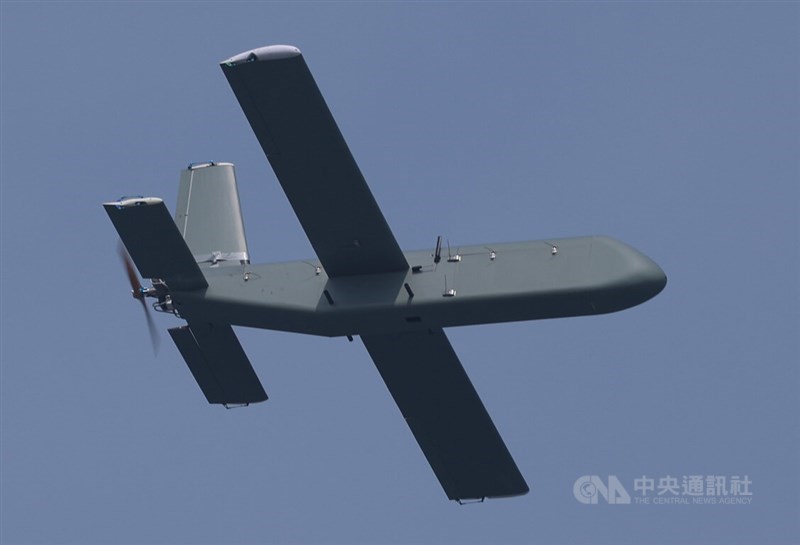
Another highlight of the exercise was the deployment of two types of drones that are still undergoing testing for coastal defense operations.
One was a medium-sized kamikaze drone -- a drone designed to track and strike targets by crashing into them -- while the other was an attack drone, according to a military source. Both were supplied by the Armaments Bureau for the exercise.
Two kamikaze drones hovered near a beach at the naval base before simulating strikes on designated targets.
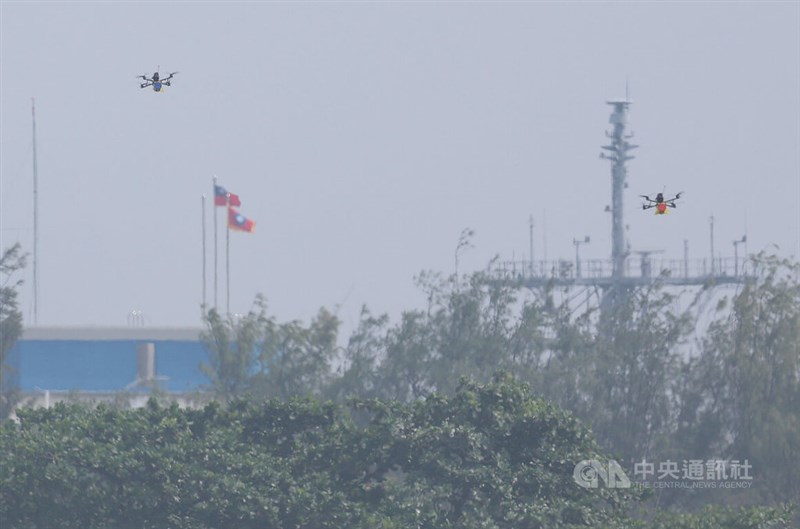
Meanwhile, four attack drones launched from a nearby site and simulated an attack on maritime targets.
The drones were tested according to predetermined parameters and are expected to be refined based on the results, a source familiar with the matter said.
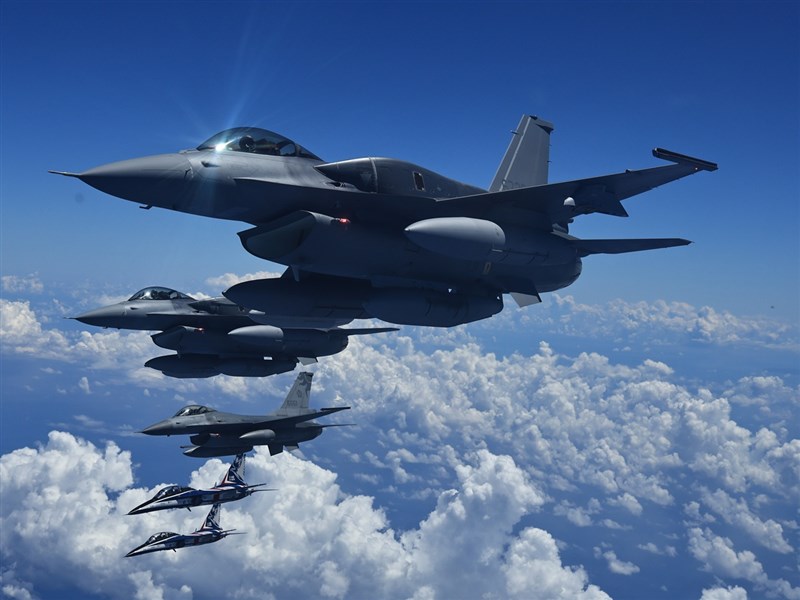
![Defense ministry releases images of jets escorting new F-16Vs]() Defense ministry releases images of jets escorting new F-16VsThe Ministry of National Defense on Saturday released footage and photos of an F-16V Block 20 and Brave Eagle advanced jet trainers escorting two F-16V Block 70s that Taiwan received a day earlier.10/03/2026 03:05 PM
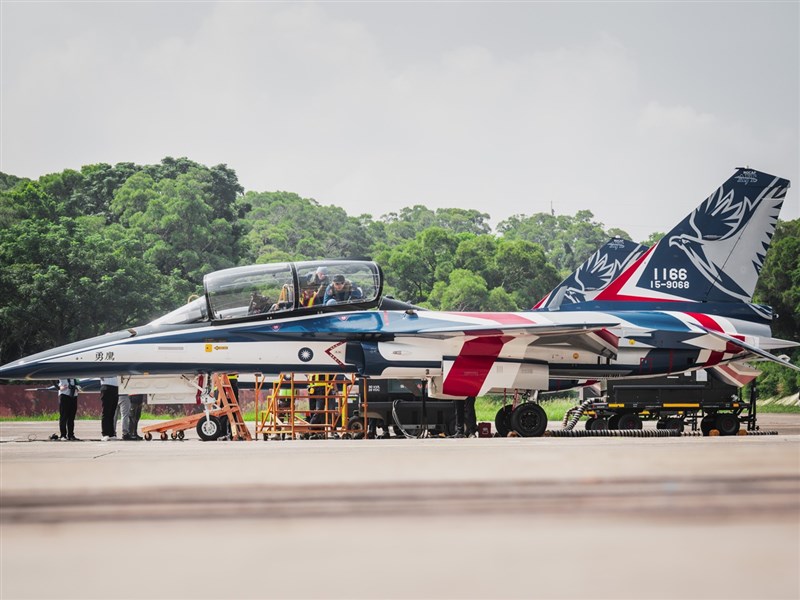
Defense ministry releases images of jets escorting new F-16VsThe Ministry of National Defense on Saturday released footage and photos of an F-16V Block 20 and Brave Eagle advanced jet trainers escorting two F-16V Block 70s that Taiwan received a day earlier.10/03/2026 03:05 PM![Taiwan completes production of 66 Brave Eagle advanced jet trainers]() Taiwan completes production of 66 Brave Eagle advanced jet trainersTaiwan completed production of all 66 domestically developed Brave Eagle advanced jet trainers Thursday, with Aerospace Industrial Development Corp. (AIDC) Chairman Tsao Chin-pin (曹進平) personally piloting one of the final two aircraft to the Air Force Academy in Kaohsiung's Gangshan District.09/24/2026 03:18 PM
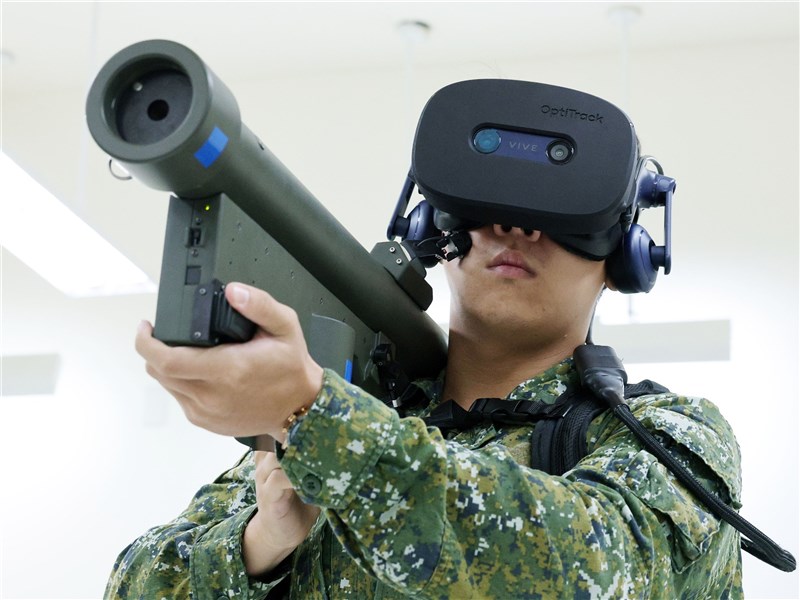
Taiwan completes production of 66 Brave Eagle advanced jet trainersTaiwan completed production of all 66 domestically developed Brave Eagle advanced jet trainers Thursday, with Aerospace Industrial Development Corp. (AIDC) Chairman Tsao Chin-pin (曹進平) personally piloting one of the final two aircraft to the Air Force Academy in Kaohsiung's Gangshan District.09/24/2026 03:18 PM![Army unveils Stinger simulators, highlights counter-drone role]() Army unveils Stinger simulators, highlights counter-drone roleTaiwan's Army unveiled simulators for United States-made Stinger missile systems Tuesday, highlighting their use in training personnel to engage airborne targets, including drones.09/22/2026 07:39 PM
Army unveils Stinger simulators, highlights counter-drone roleTaiwan's Army unveiled simulators for United States-made Stinger missile systems Tuesday, highlighting their use in training personnel to engage airborne targets, including drones.09/22/2026 07:39 PM
- Politics
Shen holds 1st Taipei campaign motorcade; Chiang urges debate coordination
10/11/2026 08:39 PM - Society
Firefighters work to extinguish Miaoli trash dump fire
10/11/2026 07:58 PM - Politics
Lai's National Day speech steady, avoided provoking Beijing: Scholar
10/11/2026 06:53 PM - Society
Songshan: The ups and downs of Taipei's 'other airport'
10/11/2026 06:36 PM - Society
Philippines opens largest OFW service center in Taipei, eyes expansion
10/11/2026 06:11 PM