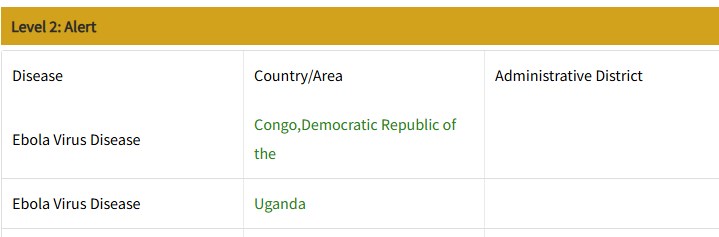
Taipei, May 20 (CNA) The Taiwan Centers for Disease Control (CDC) has raised the level of its Ebola travel advisory for the Democratic Republic of the Congo (DRC) and Uganda, and it urged medical providers to ask patients about their travel and exposure history.
In raising its travel advisory for the DRC and Uganda from "watch" to the second-level "alert," the CDC urged travelers to "take enhanced precautionary measures" in regions experiencing Ebola outbreaks.
More than 500 suspected cases, including 130 suspected deaths, have been reported in the DRC, with 30 confirmed cases, while Uganda has also confirmed two imported cases, according to Tuesday's Ebola update from the World Health Organization (WHO).
The WHO has determined that the Ebola outbreak in the DRC and Uganda constitutes a public health emergency of international concern, but does not qualify as a pandemic emergency.
Unlike other Ebola strains with vaccines developed from past outbreaks, the Bundibugyo strain driving the current outbreak has no vaccines or specific treatments for prevention or cure, CDC spokesperson Tseng Shu-hui (曾淑慧) told CNA on Wednesday.
Travelers to Ebola-affected regions should not touch the blood, body fluids, or secretions of suspected or confirmed cases, attend funerals or handle corpses, or come in contact with bats, primates, or other wild animals, Tseng said.
They should also maintain proper hand hygiene and respiratory practices, she said.
Noting that the decision to raise the travel advisory was based on information from U.S. and European counterparts, Tseng said the CDC considered the Ebola outbreak's threat to Taiwan relatively low.
Nevertheless, the CDC has issued a notice to medical providers, reminding them to check patients' travel, occupation, contact, and cluster histories, Tseng said.
Travelers returning from the DRC, Uganda, or neighboring outbreak countries should monitor their health for 21 days, as the Ebola virus has an incubation period of up to 21 days, she said.
If symptoms appear, individuals should promptly contact local health authorities or call the 1922 epidemic prevention hotline to reduce domestic risk, she said.
According to the WHO, the incubation period for Bundibugyo virus disease ranges from 2 to 21 days, with individuals usually not infectious until the onset of symptoms.
Early non‑specific symptoms include fevers, fatigue, muscle pain, headaches, and sore throats, complicating clinical diagnosis and delaying detection.
- Society
Northern town hits 14.9°C early Wednesday amid radiation cooling
10/14/2026 10:37 AM - Business
U.S. dollar up sharply in Taipei trading
10/14/2026 10:16 AM - Society
Taiwan headline news
10/14/2026 10:09 AM - Business
Taiwan shares open higher
10/14/2026 09:09 AM - Politics
Taipei Mayor Chiang agrees to at least one televised debate with Shen
10/13/2026 08:45 PM