ANALYSIS/Taiwan gains role in Ukraine drone supply chain, but still depends on China
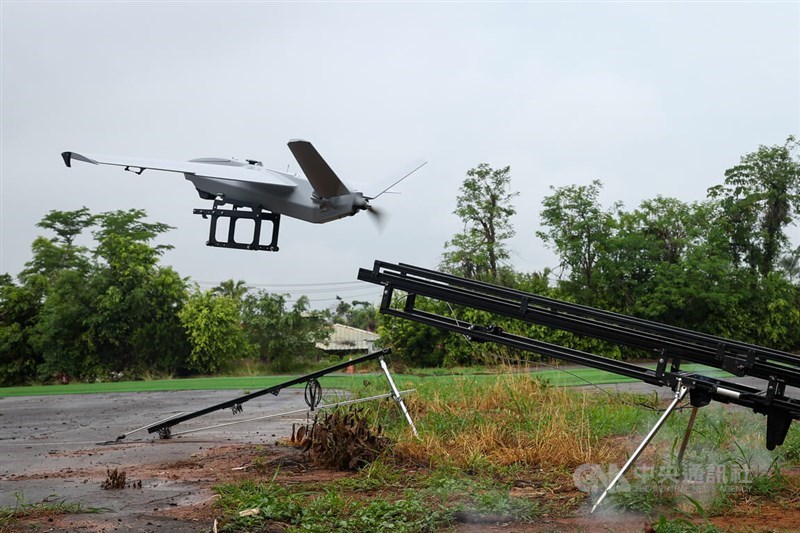
Taipei, July 21 (CNA) Taiwanese suppliers are gaining a foothold in Ukraine's drone supply chain, but costs, the scale of production and continued reliance on Chinese inputs remain major obstacles to further expansion, researchers at a Taiwan-based think tank told CNA.
At its annual forum in June, the DSET said Taiwan exported about 139,000 drones in the first quarter of 2026, surpassing the 123,000 drones it exported in all of 2025, with most of them destined for Ukraine via Poland and the Czech Republic.
According to Ukrainian and Taiwanese entities interviewed for an April DSET report, seven Ukrainian firms among 61 drone-related companies were sourcing flight controllers, batteries, motors and other microelectronics from four Taiwanese companies.
But other opportunities exist for Taiwan, said Samara Duerr, a national security analyst at the Research Institute for Democracy, Society and Emerging Technology (DSET).
Taiwan's microelectronic, semiconductor and manufacturing capabilities could be applied directly to advanced drone components, for which Ukrainian demand still exceeds supply, and Ukraine is also interested in Taiwanese fiber-optic cables, imaging payloads and sensors, Duerr said.
Political sensitivities, however, remain an obstacle to government-to-government cooperation, as overt Ukraine defense ties with Taiwan could be seen as provoking China, the analyst said.
Also problematic is that drone manufacturing is still dependent on Chinese components.
That dependence was highlighted when Ukraine recently secured permission to use part of an initial 5.9 billion euro (US$6.73 billion) tranche of European Union-backed defense financing to purchase certain Chinese drone components.
EU-funded defense purchases are generally required to come from the bloc, Ukraine or approved partners, but Kyiv may request a carve-out when eligible suppliers cannot provide comparable products quickly enough or in sufficient quantities.
The carve-out option came despite EU efforts to reduce reliance on China, which it has called a key enabler of Russia's war because of its support for Russia's military-industrial complex.
One area that illustrates the tug-of-war between Taiwan's efforts to establish a presence in Ukraine's drone supply chain and its ongoing dependence on China is the drone battery market, according to a DSET report released on July 14.
Titled "Powering Resistance: Opportunities and Challenges in Localizing Taiwan's Drone Battery Supply Chain," the report said at least one Taiwanese manufacturer was shipping between 5 million and 7 million battery cells a month for Ukraine's market.
Ukrainian customs data also showed that imports of Taiwan-origin storage batteries reached US$54.6 million in 2025, although the category includes products used for purposes other than drones.
Angela Glowacki, a DSET energy resilience analyst and one of the report's authors, said Taiwan-made nickel-manganese-cobalt lithium-ion cells had proven suitable for cold-weather battlefield operations and were used in first-person-view drones.
The report also pointed out, however, that Taiwan's battery supply chain remained heavily dependent on Chinese inputs.
Although the share of Taiwan-made drones using Chinese battery cells has fallen from around 70 percent to 50 percent, China continues to dominate the production of cathode active materials, cathode material precursors and anode active materials.
Those upstream inputs collectively account for around 70 percent of a battery's cost, Glowacki said.
Avoiding Chinese materials would therefore require sufficient and sustained demand to persuade alternative suppliers to produce key inputs that cost 40 percent to 50 percent more than their Chinese equivalents, the report said.
A poll of 30 Ukrainian manufacturers by the Snake Island Institute and the Ukrainian Council of Defence Industry found that all but one continued to import at least some Chinese components, but 76.7 percent said they would abandon Chinese sourcing altogether if competitive alternatives became available.
For Taiwan to expand production and qualify for overseas markets, the DSET recommended that it standardize drone batteries, obtain international certifications such as the AS9100D aerospace quality standard, and explore joint ventures or factories abroad.
Duerr said access to future orders would ultimately depend on whether Taiwanese suppliers could compete with Chinese products on cost, production scale and delivery time.
"If Taiwanese manufacturers can prove their competitiveness on these factors against Chinese defense products, they have just as much of an opportunity to secure orders," she said.
![Lai's WWII remarks warn of China's bid to reshape world order: Analysts]() Lai's WWII remarks warn of China's bid to reshape world order: AnalystsA senior official said Saturday that President Lai Ching-te's (賴清德) emphasis on preserving the historical facts of World War II in his National Day address highlighted concerns over Beijing's efforts to undermine the postwar international order.10/10/2026 07:27 PM
Lai's WWII remarks warn of China's bid to reshape world order: AnalystsA senior official said Saturday that President Lai Ching-te's (賴清德) emphasis on preserving the historical facts of World War II in his National Day address highlighted concerns over Beijing's efforts to undermine the postwar international order.10/10/2026 07:27 PM![Laos air base part of China's Indian Ocean ambitions: Expert]() Laos air base part of China's Indian Ocean ambitions: ExpertThe recent opening of a joint air support center in Laos is part of China's decades-long power-projection efforts to extend its influence into the Indian Ocean, a Taiwanese defense expert said Sunday.10/04/2026 04:44 PM
Laos air base part of China's Indian Ocean ambitions: ExpertThe recent opening of a joint air support center in Laos is part of China's decades-long power-projection efforts to extend its influence into the Indian Ocean, a Taiwanese defense expert said Sunday.10/04/2026 04:44 PM!['Hao-yu like that?' A deep dive into Lee's rookie MLB season]() 'Hao-yu like that?' A deep dive into Lee's rookie MLB seasonOne of the biggest stars on the Detroit Tigers' Threads account is infielder Lee Hao-yu (李灝宇), with posts featuring the Taiwanese rookie rarely drawing fewer than 5,000 likes, far more than the 1,000 likes posts featuring other players only occasionally draw.10/03/2026 10:00 AM
'Hao-yu like that?' A deep dive into Lee's rookie MLB seasonOne of the biggest stars on the Detroit Tigers' Threads account is infielder Lee Hao-yu (李灝宇), with posts featuring the Taiwanese rookie rarely drawing fewer than 5,000 likes, far more than the 1,000 likes posts featuring other players only occasionally draw.10/03/2026 10:00 AM
- Politics
Taipei Mayor Chiang agrees to at least one televised debate with Shen
10/13/2026 08:45 PM - Society
Animal groups renew push for referendum on full ban of wild boar snares
10/13/2026 08:36 PM - Science & Tech
NTHU study finds plant compound may help treat brain injuries
10/13/2026 07:50 PM - Business
Economists see AI boom sustaining Taiwan growth, urge diversification
10/13/2026 07:25 PM - Society
Northern Taiwan to see heavier rain Thursday before weather stabilizes
10/13/2026 07:04 PM