AI helps colonoscopies detect more lesions in high-risk patients: NTUH
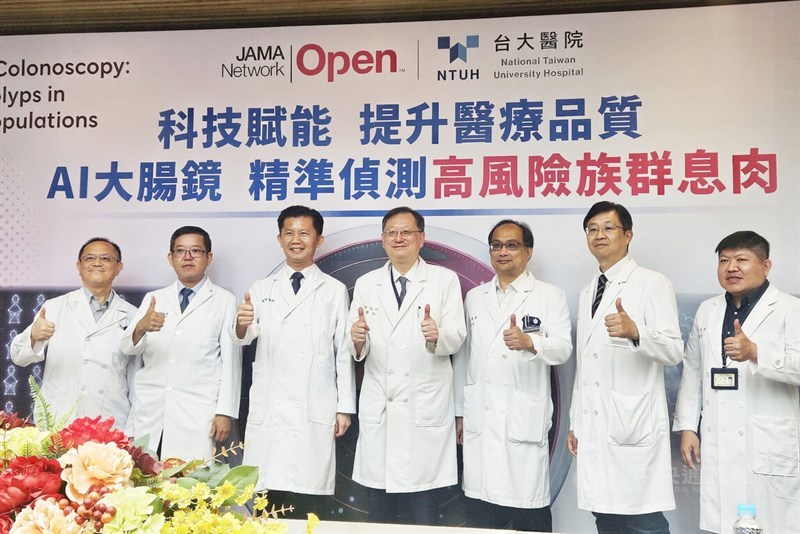
Taipei, July 6 (CNA) A clinical trial in Taiwan has found that AI-assisted colonoscopies can help doctors detect more adenomas among people at high risk of colorectal cancer, potentially offering greater prevention of the disease.
When doctors perform a colonoscopy, "the adenomas detected are what we call precancerous lesions," Chiu Han-mo (邱瀚模), director of National Taiwan University Hospital's (NTUH) Health Management Center, said at a news conference in Taipei on Monday.
"Although not every one of them will necessarily develop into cancer, finding and removing more of these tumors, or polyps, can in fact lower the future risk of colorectal cancer," he said.
Chiu said doctors perform colonoscopies by visually inspecting the colon, but after conducting 10 or 20 procedures, they can become fatigued later in the day, making it "easier" to miss adenomas.
Accurate detection is important given that colorectal cancer was Taiwan's third-leading cause of death from cancer in 2025, after lung and liver cancer, taking the lives of 7,146 people, according to Ministry of Health and Welfare data.
Clinical trial
To evaluate whether AI could improve adenoma detection, NTUH and three other hospitals in Taiwan partnered to conduct the clinical trial from 2022 to 2024, comparing the outcomes of AI-assisted colonoscopies with standard colonoscopies.
The trial enrolled 1,356 people at high risk of colorectal cancer who were undergoing colonoscopies at the four hospitals and randomly assigned them to receive either an AI-assisted colonoscopy or standard colonoscopy.
According to Chiu, the AI system worked like a "second pair of eyes" by marking suspected adenomas on screens in real time and sounding an alert to remind doctors to examine them more closely.
The doctor, however, still decided whether an adenoma should be removed, he said, noting that AI is meant to assist physicians rather than replace them.
Detection results
In the overall study population, the adenoma detection rate was 58.5 percent in the AI-assisted group, compared with 53.3 percent in the standard colonoscopy group.
Chiu said the benefit was more apparent among 864 patients who tested positive in fecal immunochemical tests (FITs), which are widely used in Taiwan as an initial screening tool for colorectal cancer by detecting hidden blood in stool samples.
In that subgroup, 65.3 percent of patients who received an AI-assisted colonoscopy were found to have adenomas, compared with 57.4 percent among those who underwent a standard colonoscopy, an increase of 7.9 percentage points that Chiu said was statistically significant.
In other words, AI-assisted colonoscopy helped detect adenomas in about eight additional patients for every 100 FIT-positive examinees, he said.
AI as a 'teacher'
Chiu also noted that the AI system helped narrow the performance gap between senior physicians and younger doctors, with the adenoma detection rate among less experienced physicians rising to 58.0 percent from 47.9 percent when they used the system.
"When younger doctors perform examinations, they told me it feels as if the AI is like a teacher standing behind them, reminding them that they may have missed something here or there," Chiu said.
He said the improvement in detection was expected because the AI model was trained on more than 100,000 colonoscopy images collected over the years by senior physicians, as the development of the system dates back to the COVID-19 pandemic.
With the system already approved by the Taiwan Food and Drug Administration, NTUH Superintendent Yu Chong-jen (余忠仁) said it is currently available for use by patients.
The study was published in the international journal JAMA Network Open on April 15, 2026, under the title "Computer-Assisted Colonoscopy in High-Adenoma Detection Rate Settings in a High-Risk Population: A Randomized Clinical Trial."
- Business
Taiwan shares open higher
10/06/2026 09:09 AM - Business
NT$10 receipts win NT$10 million prizes
10/05/2026 09:02 PM - Politics
OCAC minister, family accused of misusing public resources overseas
10/05/2026 08:58 PM - Politics
New Eswatini envoy pledges support for Taiwan's int'l participation
10/05/2026 08:17 PM - Politics
Taichung mayoral rivals Ho, Chiang visit transport project sites
10/05/2026 07:41 PM