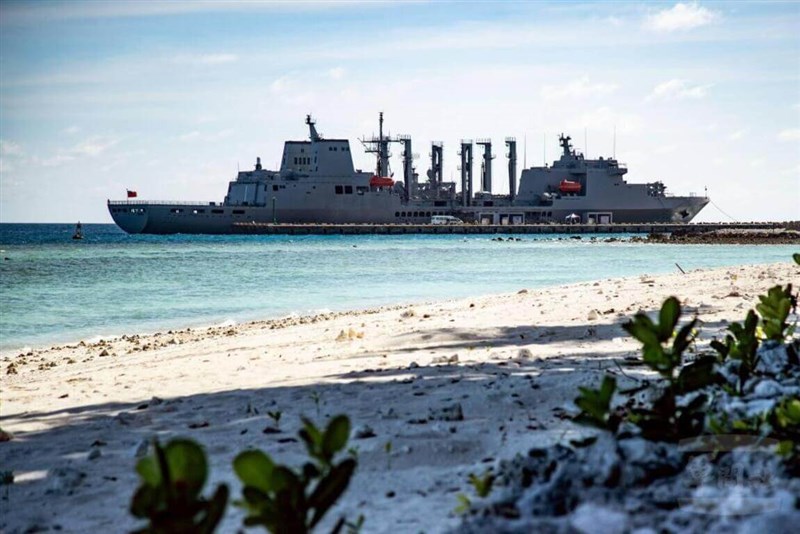
Taipei, July 22 (CNA) Foreign Minister Lin Chia-lung (林佳龍) has reaffirmed Taiwan's sovereignty claims in the South China Sea amid tensions between China and the Philippines in the disputed waters, but he acknowledged that Taipei was not actively asserting those claims.
Appearing at a legislative hearing on Taiwan's South China Sea policy on Wednesday, held in conjunction with the 10th anniversary of an arbitral tribunal ruling on claims in the sea, Lin reiterated that the Republic of China's (Taiwan) sovereignty claims over islands in the South China Sea remained unchanged.
It also holds four principles tied to those claims: resolving disputes peacefully in line with international law, including Taiwan in multilateral dispute-resolution mechanisms, upholding freedom of navigation and overflight, and promoting regional resource sharing.
Asked by opposition Kuomintang (KMT) lawmakers why the current Democratic Progressive Party (DPP) administration has taken a relatively low-profile approach to asserting the claims, Lin said the issue was highly sensitive given the current geopolitical situation.
Lin was also asked why former President Tsai Ing-wen (蔡英文) and incumbent President Lai Ching-te (賴清德), both DPP members, did not or have not visited the Spratly Island claimed by Taiwan -- Taiping Island (Itu Aba) -- to assert Taiwan's claims.
Former President Chen Shui-bian (陳水扁) of the DPP, who served in office from 2000 to 2008, and former President Ma Ying-jeou (馬英九) of the KMT, who was in office from 2008 to 2016, both visited Taiping Island while in office.
"Taiping Island is, of course, an island rather than a rock," Lin said. "Taiwan has a legitimate claim to the South China Sea islands."
Because the People's Republic of China (PRC) and the ROC maintain similar claims in the South China Sea, Taiwan could be disadvantaged if it actively publicized its sovereignty claims, Lin said.
That is especially true at a time when Taiwan needs as many international friends as possible amid Chinese expansion in the South China Sea and East China Sea, Lin said.
Lin's reference to Taiping Island being an island rather than a rock goes back to the arbitral tribunal's ruling on July 12, 2016, when it ruled that China's "nine-dash line" claim had no legal basis under the U.N. Convention on the Law of the Sea (UNCLOS).
It also found that China's actions within the Philippines' exclusive economic zone had violated Manila's sovereign rights.
The PRC responded by saying that it neither accepted nor recognized the ruling issued by the Permanent Court of Arbitration in The Hague.
The tribunal also found that Taiwan-administered Taiping Island, the largest naturally formed feature in the Spratly Islands, was legally a rock rather than an island under UNCLOS, meaning it was not entitled to a 200-nautical-mile exclusive economic zone.
Taiwan, whose South China Sea claims largely overlap those made by Beijing, also rejected the ruling.
Lin said Taiwan was a stakeholder in the 2016 arbitration but was neither consulted nor included in the proceedings, and therefore did not accept the ruling.
Lin said Taiwan's bottom line was that all disputes and competing claims in the region should be resolved peacefully rather than through the use of force.
That includes the latest incident that occurred Monday, when Manila accused a Chinese coast guard officer of repeatedly striking a Filipino sailor on the head with a wooden baton, injuring him and damaging a Philippine Navy rubber boat.
- Business
Amazon taking part in Taiwan PCB maker's private placement
09/29/2026 09:06 PM - Sports
Taiwan snatches 2 more silvers in shooting, Kurash at Asian Games
09/29/2026 08:42 PM - Business
Taiwan economic indicators stay strong for 9th straight month: NDC
09/29/2026 07:44 PM - Politics
AIDC, Corrections Agency hold counter-drone drill
09/29/2026 07:15 PM - Politics
KMT, TPP legislators reject all 27 of Lai's Control Yuan nominees
09/29/2026 06:55 PM