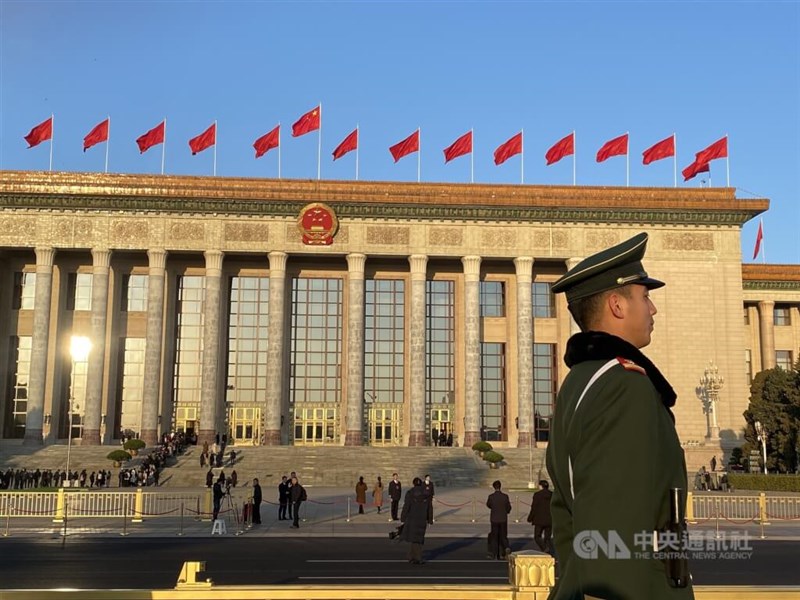
Washington, July 14 (CNA) A Taiwanese judge specializing in national security cases on Tuesday urged law enforcement authorities in Taiwan and the United States to jointly take on threats from China's transnational repression under the recently implemented Ethnic Unity and Progress Promotion Law.
Speaking with CNA, Taipei District Court judge Hsu Kai-chieh (許凱傑) suggested Taipei and Washington set up a joint task force to promptly share law enforcement experiences in dealing with cross-border repression cases.
Hsu, who has long focused on adjudicating national security, espionage and infiltration cases, is currently visiting think tanks in Washington, D.C., to discuss the threats posed by China's transnational repression.
He said Taiwan's government should also reinforce its transnational repression reporting platform to allow members of the public to immediately report cases to law enforcement authorities.
The platform should be equipped with a certification mechanism to avoid any tampering of the platform, he added.
Hsu said that coordination of interagency efforts in the government will be equally critical to identify the nature of transnational repression and preserve evidence. These efforts will require a robust interagency notification mechanism, such as a real-time collaboration system between the police and border control agencies.
In the face of challenges from China's new ethnic unity law, Hsu said, Taiwan should have efficient legal countermeasures and tools, adding that the current Anti-Infiltration Act would not be enough, and that law enforcement authorities should apply the Criminal Code to impose heavier punishment.
Concerns over China's threats in transnational repression have been running deeper after a Hong Kong passport holder, surnamed Liu (廖), last week allegedly attacked Taipei-based Japanese political commentator Akio Yaita, who had often criticized China.
Taiwan's Mainland Affairs Council (MAC), the government agency responsible for cross-strait affairs, described the attack as the "first case of transnational repression" in Taiwan since the ethic unity law was passed.
Chinese authorities have claimed the law serves as a legal basis to target individuals outside of its borders who violate the new law on ethnic unity.
So far, however, no evidence has been presented on Liu's motives or how his actions were tied to China's unity law, according to prosecutors.
Separately, U.S. Democratic Senator Adam Schiff and Republican Senator John Curtis on Tuesday jointly introduced the Stop Transnational Repression Act of 2026, a bill aimed at curbing transnational repression, including threats and acts of violence carried out by governments against individuals beyond their borders, following the passage of China's ethnic unity law.
The legislation marks the first effort to establish a federal definition of transnational repression-related crimes and impose enhanced criminal penalties. Under the bill, violators could face up to 10 years in prison and fines of up to US$100,000.
The bill would also centralize federal oversight of transnational repression prosecutions within the National Security Division of the Department of Justice and criminal investigations into such activities within the Federal Bureau of Investigation, according to the two senators.
- Politics
New THSRC trains may pave way for family cars, senior citizen cards
10/06/2026 09:00 PM - Politics
Shen, Chiang open to debate over drug policy in Taipei mayoral race
10/06/2026 08:41 PM - Society
10 indicted for reselling restricted chips to Hong Kong for China
10/06/2026 08:26 PM - Society
Kuai Kuai workers end 5-day strike with relocation compensation deal
10/06/2026 07:46 PM - Politics
Foreign minister opens Phoenix office, 14th U.S. diplomatic post
10/06/2026 06:55 PM