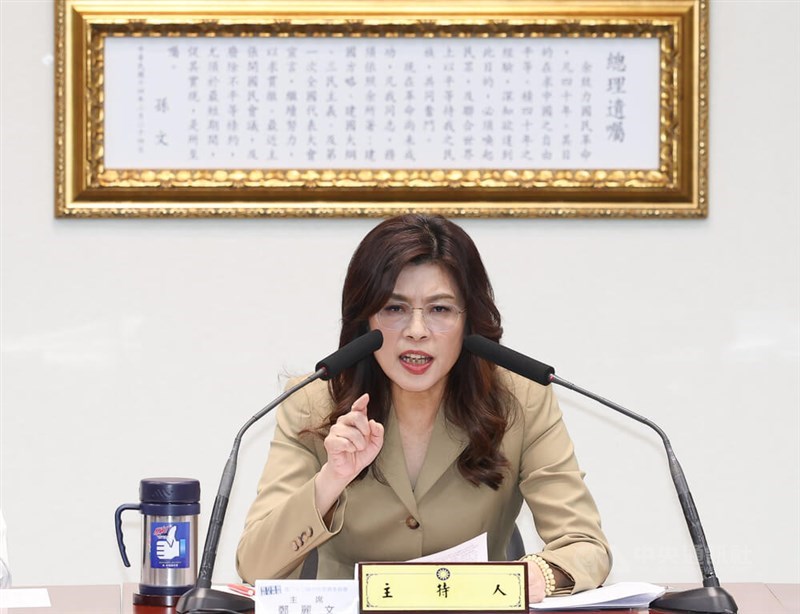
Taipei, June 23 (CNA) Kuomintang (KMT) Chairwoman Cheng Li-wun (鄭麗文) on Tuesday described the status quo in the Taiwan Strait as both sides belonging to "one China," framing that political formula as the basis for restarting cross-strait dialogue.
Restarting dialogue and exchanges based on the "1992 consensus" and an "anti-Taiwan independence" stance is the only way to ensure a peaceful and stable cross-strait relationship, Cheng said during an online interview.
Cheng was responding to host Tang Hsiang-lung (唐湘龍), who suggested her stance on the status quo differed from that of American Institute in Taiwan (AIT) Director Raymond Greene, also asked if her proposal was workable.
AIT views on status quo
Greene told the United Daily News (UDN) in an interview published Tuesday that over 70 percent of Taiwan's public backs the status quo, a consensus he described as the best basis for Taipei's elected leaders to conduct talks with Beijing.
Given this consensus, Greene said Beijing's attempts to divide Taiwanese society are unlikely to succeed, adding that dialogue without preconditions remains the best way to prevent miscalculations and resolve differences, the UDN reported.
According to the report, Greene argued that those who advocate accommodating Beijing's preferences, such as keeping Taiwan's defenses weak, assume that China wants to preserve the status quo, even though its words and actions show no such intention.
KMT framework on 1992 consensus
In her reply to Tang, Cheng said her proposal is necessary because the status quo under the ruling Democratic Progressive Party (DPP) is "increasingly difficult to maintain."
Cheng argued that a decade of deteriorating cross-strait ties has brought the region to the brink of war, where any action -- miscalculated or not -- could spark a conflict, noting that widespread concern internationally explains why her policies are gaining traction.
The "1992 consensus" is a framework for cross-strait relations, which the KMT says was an understanding reached in 1992 between the then KMT government and Beijing that there is "one China," with each side free to interpret what that means.
The DPP's rejection of the "1992 consensus," along with its stance that Taiwan is a sovereign nation independent of the People's Republic of China (PRC), prompted Beijing to cut off official talks in 2016, when the DPP returned to power following eight years of KMT rule.
Cheng insisted there is "no alternative way" to ensure cross-strait peace and stability other than what she has proposed to resume cross-strait dialogue, though she noted that enhancing Taiwan's defense capabilities and resilience remains vital and has her support.
Status quo definition debate
The KMT chair then went on to slam the DPP government for trying to alter the status quo, which she argued dictates that both sides belong to "one China," in line with the constitution of the Republic of China (ROC), Taiwan's formal name.
"By constantly pushing 'new two-states theory,' the DPP is changing the status quo, destroying the status quo, and playing with fire," she said.
The "new two-states theory" was coined by former President Ma Ying-jeou (馬英九) to characterize the DPP's stance that the "ROC and PRC are not subordinate to each other," drawing a parallel to late President Lee Teng-hui's (李登輝) "special state-to-state" doctrine.
Speaking in a separate setting, Su Chi (蘇起), a former National Security Council secretary-general under the Ma administration, said he concurred with Greene that the vast majority of Taiwanese support maintaining the status quo, but noted that the definition of the "status quo" has never been clarified.
The status quo in 2016, when the DPP succeeded the Ma administration, was built on a framework of active cross-strait interaction and differed significantly from the current status quo, which the DPP defines through its "mutually non-subordinate" formulation, Su said.
Su made the remarks at an event hosted by the KMT to mark the release of a documentary titled "The Peace Maker," featuring Cheng's trip to China in April.
Responding to Cheng, Chuang Jui-hsiung (莊瑞雄), secretary-general of the DPP's legislative caucus, rejected her assertion that both sides of the strait belong to "one China."
Many of Beijing's actions, such as its military harassment, threats, and gray-zone activities around the island, are what actually undermine and disrupt the status quo, he argued.
- Culture
Podcaster Brian Tseng wins Golden Bell lifestyle program award
10/18/2026 03:22 PM - Sports
Taiwanese duo wins men's doubles gold at World Junior Championships
10/18/2026 02:43 PM - Society
Taiwan headline news
10/18/2026 12:07 PM - Politics
Taiwan security chief urges closer Europe ties against authoritarianism
10/17/2026 09:19 PM - Sports
Gant's eight scoreless innings lift Dragons to win in Taiwan Series opener
10/17/2026 08:26 PM